 Back
BackUnderstanding Electric Field Direction from Equipotential Curves
Study Guide - Smart Notes
 Tailored notes based on your materials, expanded with key definitions, examples, and context.
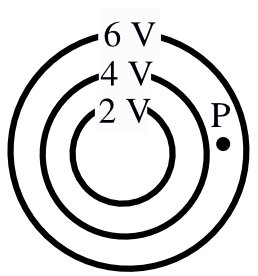
Q8. For the equipotential curves with the labeled potentials shown to the right, what is the direction of the electric field at point “P”?
Background
Topic: Electric Fields and Equipotential Surfaces
This question tests your understanding of how electric fields relate to equipotential lines. Specifically, it asks you to determine the direction of the electric field at a given point based on the arrangement of equipotential curves.
Key Terms and Formulas:
Equipotential lines: Curves where the electric potential is constant.
Electric field direction: Always points from higher potential to lower potential, perpendicular to equipotential lines.
Relationship between field and potential:
Step-by-Step Guidance
Identify the values of the equipotential lines near point P. In the image, the lines are labeled 6 V, 4 V, and 2 V, with P located outside the 6 V line.
Recall that the electric field points from regions of higher potential to regions of lower potential, and is perpendicular to the equipotential lines.
Determine the direction from the higher potential (closer to the center) to the lower potential (farther out). At point P, the field will point away from the center, perpendicular to the equipotential curves.
Compare the possible answer choices (Right, Left, Down, Up, E = 0) and consider the orientation of point P relative to the equipotential lines.
Try solving on your own before revealing the answer!
Final Answer: Right
The electric field at point P points to the right, from higher to lower potential, perpendicular to the equipotential lines.
This follows from the fact that electric fields always point away from higher potential toward lower potential, and the equipotential lines are concentric circles with increasing voltage toward the center.
