 Back
BackUniform Circular Motion, Frames of Reference, and Apparent Weight
Study Guide - Smart Notes
 Tailored notes based on your materials, expanded with key definitions, examples, and context.
Uniform Circular Motion
Introduction to Circular Motion
Uniform circular motion occurs when an object moves at a constant speed along a circular path. Although the speed remains constant, the direction of the velocity changes continuously, resulting in a nonzero acceleration. - Uniform Circular Motion: Motion with constant speed in a circle. - Acceleration: Present due to the continuous change in direction of velocity. - Velocity Vector: Always tangent to the circle at any point. 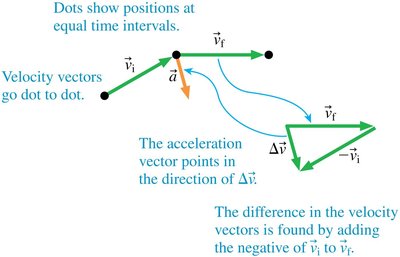
Velocity and Acceleration in Circular Motion
The velocity of an object in uniform circular motion is always tangent to the circle, and the acceleration vector points toward the center of the circle. This inward acceleration is called centripetal acceleration. - Velocity Components: Speed (constant) and direction (changing). - Tangential Velocity (vT): The linear velocity along the circle. - Centripetal Acceleration (ac): Always directed toward the center. 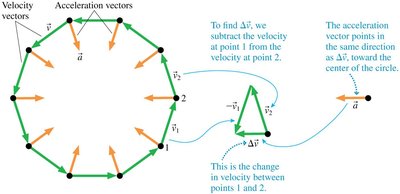
Calculating Acceleration by Vector Subtraction
Acceleration is defined as the change in velocity over time. The difference in velocity vectors is found by adding the negative of the initial velocity to the final velocity: 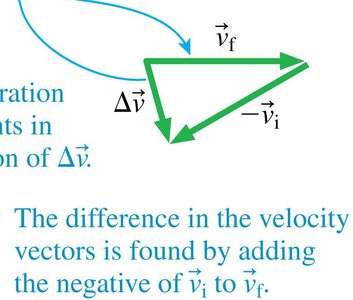
Equation for Centripetal Acceleration
The magnitude of centripetal acceleration is given by: where is the tangential velocity and is the radius of the circle. - Interpretation: Faster speeds or smaller radii require greater centripetal acceleration.
Centripetal Force
The force responsible for keeping an object in circular motion is called centripetal force. It always points toward the center of the circle and is given by: where is the mass of the object. - Examples: Tension in a string, friction between tires and road, or normal force in a banked turn.
Frames of Reference
Inertial and Non-Inertial Frames
A frame of reference is a point of view from which motion is observed. - Inertial Frame: Not accelerating; Newton's Laws apply. - Non-Inertial Frame: Accelerating; Newton's Laws may not apply directly. - Example: Observers inside a car (non-inertial) vs. observers on the roadside (inertial).
Artificial Gravity and Centrifugal Force
In a non-inertial frame (such as inside a rotating space station), an observer feels a centrifugal force that is equal and opposite to the centripetal force. This is a fictitious force arising from the acceleration of the frame. - Apparent Weight: The weight felt by an observer in a non-inertial frame, which can differ from true weight.
Weight, Apparent Weight, and Weightlessness
Weight vs. Apparent Weight
- Weight: The force of gravity acting on an object (). - Apparent Weight: The normal force experienced, which can change in an accelerating frame (e.g., elevator, rotating ride).
Weightlessness
Weightlessness is not the absence of gravity, but the absence of a normal force. It occurs when an object and its frame of reference are accelerating together, such as in free fall or in a plane following a parabolic trajectory. - Conditions for Weightlessness: 1. Lack of a normal force 2. Falling with your frame of reference 3. Perception of everything else not falling
Apparent Weight in Elevators
When an elevator accelerates upward, you feel heavier; when it accelerates downward, you feel lighter. The normal force changes depending on the direction and magnitude of acceleration. - Upward Acceleration: Increased normal force (feel heavier) - Downward Acceleration: Decreased normal force (feel lighter)
Applications and Examples
Pendulums and Centripetal Force
Pendulums are not examples of uniform circular motion because their tangential speed is not constant. At the equilibrium point, the net force is the centripetal force, but the restoring force and centripetal force are perpendicular and serve different purposes. - Restoring Force: Changes speed. - Centripetal Force: Changes direction.
Digital Scales and Apparent Weight
Digital scales measure the normal force, which is the apparent weight. In situations involving circular motion (horizontal or vertical circles, banked turns), the normal force can vary, affecting the reading on the scale.
Horizontal Circles
Any force directed toward the center of the circle (tension, friction, normal force) provides the centripetal force necessary for circular motion. Gravity is often balanced and not directly involved in horizontal circular motion.
Summary Table: Frames of Reference and Forces
Frame of Reference | Observed Forces | Apparent Weight |
|---|---|---|
Inertial | Gravity, Centripetal Force | True Weight |
Non-Inertial | Gravity, Centripetal Force, Centrifugal Force (fictitious) | Apparent Weight |
Key Equations
Additional info:
Some explanations and context were expanded for clarity, including the distinction between inertial and non-inertial frames, the role of normal force in apparent weight, and the application of centripetal force in various scenarios.
