 Back
BackUniversity Physics II: Electric Charge, Forces, and Vectors – Step-by-Step Study Guidance
Study Guide - Smart Notes
 Tailored notes based on your materials, expanded with key definitions, examples, and context.
Q1. Describe the behavior of the tape as you bring objects toward it (e.g., a hand, a pen, etc).
Background
Topic: Electrostatics and Electric Charge
This question explores the concept of electric charge and how objects can become charged through contact and separation, leading to observable forces (attraction or repulsion) between objects.
Key Terms and Concepts:
Electrostatic charge: The property of matter that causes it to experience a force when near other electrically charged matter.
Attraction/Repulsion: Charged objects can attract or repel other objects depending on their charges.
Step-by-Step Guidance
Press a piece of sticky tape onto a surface and peel it off, then hang it from the edge of a table as described.
Slowly bring different objects (like your hand or a pen) near the tape and observe any movement or reaction of the tape.
Think about what might cause the tape to move toward or away from the object. Consider the possibility of the tape having gained or lost electrons during the peeling process, making it electrically charged.
Reflect on whether the tape is attracted to or repelled by neutral objects, and what that suggests about the nature of the charge on the tape and the objects you bring near it.
Try solving on your own before revealing the answer!

Q2. Make another piece of tape as described above. Bring the second tape toward the first. (a) Describe your observations. (b) Why is it important to keep your hands and other objects away from the tapes? (c) Explain why this precaution is necessary.
Background
Topic: Charging by Contact and Induction
This question investigates how two objects, when prepared in the same way, interact electrically, and why experimental controls are important in electrostatics experiments.
Key Terms and Concepts:
Like charges repel, unlike charges attract: This is a fundamental rule of electrostatics.
Discharge: When a charged object touches another object, it can lose its charge.
Step-by-Step Guidance
Prepare a second piece of tape in the same way as the first and bring it close to the first tape. Observe whether the tapes attract or repel each other.
Consider what would happen if you touched the tapes with your hands or another object. Would the behavior change?
Think about why it is important to avoid touching the tapes during the experiment. What effect does touching have on the charge of the tapes?
Explain, in terms of charge transfer or discharge, why keeping other objects away is necessary for accurate observations.
Try solving on your own before revealing the answer!
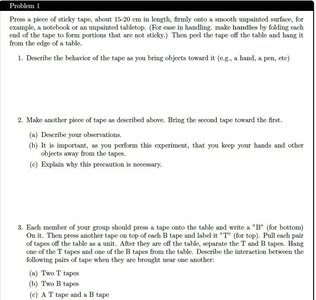
Q3. Each member of your group should press a tape onto the table and write a “B” (for bottom) on it. Then press another tape on top of each B tape and label it “T” (for top). Pull each pair of tapes off the table as a unit. After they are off the table, separate the T and B tapes. Hang one of the T tapes and one of the B tapes from the table. Describe the interaction between the following pairs of tape when they are brought near one another: (a) Two T tapes (b) Two B tapes (c) A T tape and a B tape
Background
Topic: Charge Separation and Electrostatic Forces
This question explores how separating two objects that were in contact can result in opposite charges, and how these charges interact.
Key Terms and Concepts:
Charge separation: When two materials are pulled apart, electrons may transfer from one to the other, leaving one positively charged and the other negatively charged.
Electrostatic force: The force between two charged objects, which can be attractive or repulsive.
Step-by-Step Guidance
After labeling and separating the T and B tapes, hang them as described.
Bring two T tapes near each other and observe their interaction. Do the same for two B tapes, and then for a T tape and a B tape.
Recall the rule: like charges repel, opposite charges attract. Use this to interpret your observations.
Think about what this tells you about the type of charge on the T and B tapes after separation.
Try solving on your own before revealing the answer!
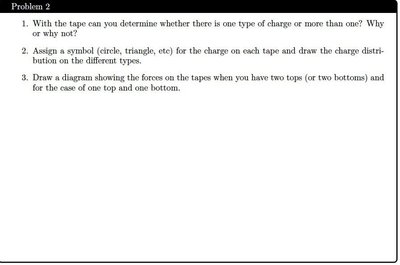
Q4. With the tape can you determine whether there is one type of charge or more than one? Why or why not?
Background
Topic: Nature of Electric Charge
This question asks you to consider whether the experiment provides evidence for the existence of more than one type of electric charge.
Key Terms and Concepts:
Electric charge types: There are two types of electric charge: positive and negative.
Step-by-Step Guidance
Review your observations from the tape experiments. Did you see both attraction and repulsion?
Consider whether these observations could be explained if there were only one type of charge, or if two types are necessary.
Think about the limitations of the experiment and whether it can distinguish between one or two types of charge.
Try solving on your own before revealing the answer!
Q5. Assign a symbol (circle, triangle, etc) for the charge on each tape and draw the charge distribution on the different types.
Background
Topic: Charge Distribution and Representation
This question is about representing the charge on each tape visually, which helps in understanding and communicating the results of the experiment.
Key Terms and Concepts:
Charge symbol: A way to visually indicate the type of charge (e.g., +, −, or a chosen symbol).
Step-by-Step Guidance
Choose a symbol for each type of charge you believe is present on the T and B tapes.
Draw a simple diagram showing the tapes and their assigned charges.
Indicate the direction of forces (attraction or repulsion) between the tapes based on their charges.
Try solving on your own before revealing the answer!
Q6. Draw a diagram showing the forces on the tapes when you have two tops (or two bottoms) and for the case of one top and one bottom.
Background
Topic: Vector Representation of Forces
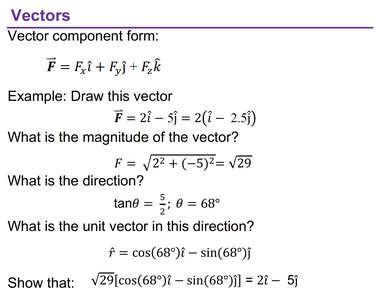
This question asks you to represent the forces between charged objects using vectors, a key skill in physics.
Key Terms and Concepts:
Vector: A quantity with both magnitude and direction, used to represent forces.
Step-by-Step Guidance
Draw two tapes (either both T or both B) and use arrows to show the direction of the forces between them (repulsion).
Draw one T tape and one B tape and use arrows to show the direction of the forces (attraction).
Label your diagrams clearly with the symbols you assigned in the previous question.
Try solving on your own before revealing the answer!
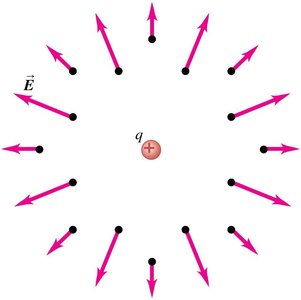
Q7. The electric force is a vector quantity. In this problem you will determine the force on a third charge due to 2 other charges in vector component form and then by determining the magnitude and direction of the force. All answers will be in terms of some or all of the variables k, Q ≡q1 = q2 = q3, and r.
Background
Topic: Coulomb's Law and Vector Addition
This question tests your ability to use Coulomb's Law to calculate the net force on a charge due to multiple other charges, using vector components.
Key Terms and Formulas:
Coulomb's Law:
Vector addition: Forces are added component-wise.
Step-by-Step Guidance
Write the expressions for the force on q3 due to q1 and q2, as given in the problem statement.
Substitute the values for q1, q2, and q3 (all equal to Q) into the force expressions.
Add the force vectors component-wise to find the total force on q3 in vector component form.
Simplify the expressions as much as possible, but do not calculate the final numeric values yet.
Try solving on your own before revealing the answer!
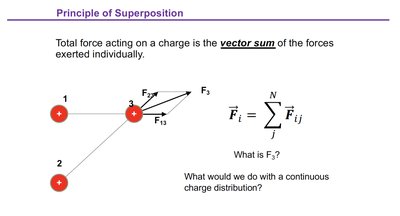
Q8. Work with your group to find the magnitude and direction (angle from the positive x-axis) of the total force of the two charges on q3.
Background
Topic: Magnitude and Direction of Vectors
This question asks you to use the Pythagorean theorem and trigonometry to find the magnitude and direction of a force vector given its components.
Key Terms and Formulas:
Magnitude of a vector:
Direction (angle θ):
Step-by-Step Guidance
Identify the x and y components of the total force vector from your previous calculation.
Use the Pythagorean theorem to set up the expression for the magnitude of the total force.
Set up the expression for the direction (angle from the positive x-axis) using the arctangent function.
Try solving on your own before revealing the answer!

Q9. Two metal spheres are hanging from nylon threads. When you bring the spheres close to each other, they tend to attract. Based on this information alone, discuss all the possible ways that the spheres could be charged. Is it possible that after the spheres touch, they will cling together? Explain.
Background
Topic: Charging and Charge Redistribution
This question explores the possible charge states of objects that attract and what happens when they touch and exchange charge.
Key Terms and Concepts:
Attraction: Can occur between opposite charges or between a charged and a neutral object.
Charge redistribution: When two conductors touch, charge can flow between them until they reach the same potential.
Step-by-Step Guidance
List all possible combinations of charge states for the two spheres that could result in attraction (e.g., one neutral and one charged, or one positive and one negative).
Consider what happens when the spheres touch—how does charge move between them?
Think about whether the spheres will continue to attract, repel, or neither after touching, based on their new charge states.
Try solving on your own before revealing the answer!
Q10. Two point charges, +Q and +2Q, are separated by distance d. Where on the line between them should you place a third charge so that the net force on it is zero? Explain your answer.
Background
Topic: Equilibrium of Forces in Electrostatics
This question tests your understanding of how the electric force depends on both charge and distance, and how to set up an equilibrium condition.
Key Terms and Formulas:
Coulomb's Law:
Equilibrium: Net force is zero when the magnitudes of the forces from each charge are equal and opposite.
Step-by-Step Guidance
Let the third charge be placed at a distance r from the +Q charge and (d − r) from the +2Q charge.
Write the expressions for the magnitude of the force on the third charge due to each of the other two charges.
Set the magnitudes of these forces equal to each other and solve for r in terms of d.
Try solving on your own before revealing the answer!
Q11. Good conductors of electricity, such as metals, are typically good conductors of heat; insulators, such as wood, are typically poor conductors of heat. Explain why there is a relationship between conduction of electricity and conduction of heat in these materials.
Background
Topic: Properties of Conductors and Insulators
This question connects the microscopic properties of materials to their macroscopic behavior in conducting electricity and heat.
Key Terms and Concepts:
Free electrons: In conductors, electrons can move freely, allowing both electric current and thermal energy to be transferred efficiently.
Insulators: Lack free electrons, so they do not conduct electricity or heat well.
Step-by-Step Guidance
Recall that both electrical and thermal conduction rely on the movement of electrons (or other charge carriers) in a material.
Explain how the presence of free electrons in metals allows for efficient transfer of both electric charge and thermal energy.
Contrast this with insulators, where electrons are tightly bound and cannot move freely.
Try solving on your own before revealing the answer!
