 Back
BackVectors and Motion in Two Dimensions: Study Guide
Study Guide - Smart Notes
 Tailored notes based on your materials, expanded with key definitions, examples, and context.
Vectors and Motion in Two Dimensions
Using Vectors
Vectors are fundamental in physics for representing quantities that have both magnitude and direction, such as displacement, velocity, and acceleration. Understanding how to manipulate vectors is essential for analyzing motion in two dimensions.
Vector Definition: A vector is a quantity with both size (magnitude) and direction.
Displacement Vector: Represents the straight-line connection from the initial to the final position, regardless of the actual path taken.
Equality of Vectors: Two vectors are equal if they have the same magnitude and direction, regardless of their starting points.
Velocity Vector: Indicates both the speed and direction of a moving particle.
Vector Addition and Subtraction
Vector addition is used to find the net result of multiple displacements or velocities. The process is commutative and can be visualized using geometric rules.
Resultant Vector: The sum of two or more vectors.
Tip-to-Tail Rule: Place the tail of the second vector at the tip of the first; the resultant is drawn from the tail of the first to the tip of the second.
Parallelogram Rule: Both vectors are drawn from a common origin; the resultant is the diagonal of the parallelogram formed.
Vector Subtraction: To subtract vector B from A, reverse B and add it to A.
Multiplication by a Scalar
Multiplying a vector by a scalar changes its magnitude but may also reverse its direction if the scalar is negative.
Positive Scalar: Changes magnitude, direction remains the same.
Zero Scalar: Results in the zero vector (no magnitude).
Negative Scalar: Reverses direction without changing magnitude.
Coordinate Systems and Vector Components
Coordinate systems, typically Cartesian, are used to break vectors into components parallel to the axes, simplifying calculations.
Component Vectors: Any vector A can be decomposed into A_x and A_y components.
Determining Components: The sign of each component depends on the direction relative to the axes.
Vector Addition via Components: Add corresponding components to find the resultant vector.
Tilted Axes
For motion on slopes or ramps, axes can be tilted to align with the direction of motion, making component analysis easier.
Decomposition: Vectors can be decomposed along tilted axes using trigonometric relationships.
Motion in Two Dimensions
Objects moving in two dimensions have displacement, velocity, and acceleration vectors that change in both magnitude and direction. Motion diagrams help visualize these changes.
Velocity Vector: Points in the direction of displacement.
Acceleration Vector: Indicates changes in velocity, either in magnitude or direction.
Projectile Motion
Projectile motion describes the two-dimensional movement of objects under gravity, such as balls, jumpers, or cars. The horizontal and vertical motions are independent but must be analyzed together.
Projectile: An object moving under the influence of gravity alone.
Independence of Components: Horizontal motion is at constant velocity; vertical motion is at constant acceleration (free fall).
Acceleration: Vertical acceleration is downward; horizontal acceleration is zero.
Kinematic Equations: Vertical: Horizontal:
Range: The horizontal distance traveled by a projectile.
Example: Dock jumping dogs, grasshoppers, and cars on ramps are analyzed using projectile motion principles.
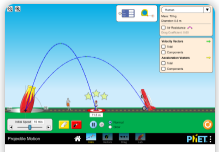
Problem-Solving Approach: Projectile Motion
Solving projectile motion problems involves separating the motion into horizontal and vertical components, applying kinematic equations, and checking results for physical reasonableness.
Strategize: Treat horizontal and vertical motions separately.
Prepare: Draw diagrams, establish coordinate systems, and define knowns and unknowns.
Solve: Use kinematic equations for each component.
Assess: Check units and reasonableness of answers.
Circular Motion
Circular motion occurs when an object moves in a circle at constant speed. The velocity vector changes direction continuously, resulting in centripetal acceleration toward the center.
Uniform Circular Motion: Constant speed, changing direction.
Centripetal Acceleration: Always points toward the center of the circle. Formula:
Period: Time for one revolution. Formula:
Relative Motion
Relative motion describes how the velocity of an object depends on the observer's frame of reference. Vector addition is used to relate velocities between different observers.
Relative Velocity: The velocity of an object relative to a particular observer.
Vector Addition:
Example: The speed of a seabird relative to the air and ground.
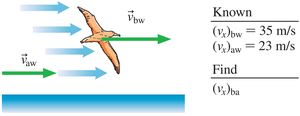
Example: Finding the ground speed of an airplane with wind.
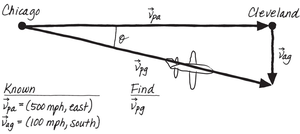
Summary Table: Key Concepts in Two-Dimensional Motion
Concept | Definition | Equation |
|---|---|---|
Vector Addition | Sum of two vectors | |
Projectile Motion | Motion under gravity |
|
Circular Motion | Motion in a circle |
|
Relative Velocity | Velocity relative to observer |
Additional info: Academic context and example problems were expanded for clarity and completeness.
