 Back
Backlecture 18
Study Guide - Smart Notes
 Tailored notes based on your materials, expanded with key definitions, examples, and context.
Compound Microscope and Telescope
Compound Microscope
The compound microscope uses two lenses: the objective and the eyepiece. The objective forms a real, magnified image of the object, which then acts as the object for the eyepiece. The eyepiece further magnifies this image, allowing for high overall magnification.
Objective lens (fo): Forms a real, inverted image close to its focal point.
Eyepiece lens (fe): Acts as a magnifying glass for the image formed by the objective.
Tube length (L): Distance between the objective and eyepiece focal points.
Near point (N): Closest distance at which the eye can focus comfortably (typically 25 cm).
Angular magnification (M) of a compound microscope is given by:
where is the tube length, is the focal length of the objective, is the near point, and is the focal length of the eyepiece.
Example: For cm, cm, cm, cm:
The maximum magnification using the eyepiece alone as a magnifying glass is:
For cm, cm:
Telescope
The astronomical telescope is designed to view distant objects. The objective lens forms a real image near its focal plane, which is then magnified by the eyepiece for comfortable viewing with a relaxed eye.
Objective lens (fo): Large focal length, gathers light from distant objects.
Eyepiece lens (fe): Short focal length, magnifies the image formed by the objective.
Length of telescope (L):
Angular magnification (M) of a telescope:
Example: mm, mm:
mm = 99.0 cm
Wave Nature of Light: Interference and Diffraction
Snell's Law and Refraction
Snell's Law describes how light bends when passing from one medium to another:
is the index of refraction, is the angle with respect to the normal.
When , light slows down and bends toward the normal.
Dispersion of Light: Prisms and Rainbows
Dispersion occurs because the index of refraction depends on wavelength. Shorter wavelengths (violet) are refracted more than longer wavelengths (red), causing white light to spread into a spectrum.
Prisms separate light into its constituent colors due to wavelength-dependent refraction.
Rainbows are formed by dispersion and internal reflection in water droplets.
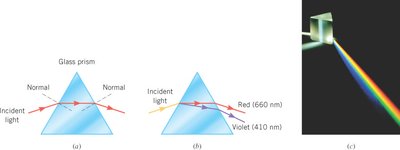
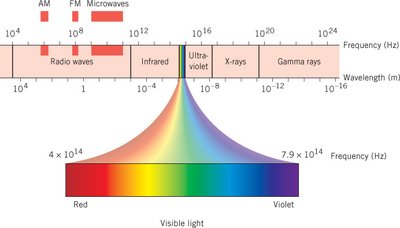
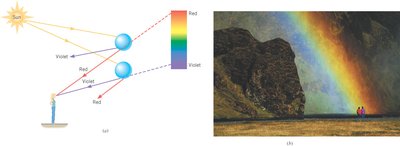
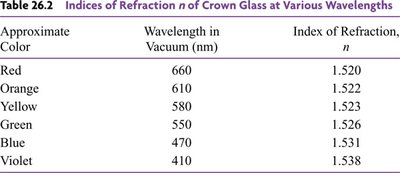
Table: Indices of Refraction for Crown Glass
Approximate Color | Wavelength in Vacuum (nm) | Index of Refraction, n |
|---|---|---|
Red | 660 | 1.520 |
Orange | 610 | 1.522 |
Yellow | 580 | 1.523 |
Green | 550 | 1.526 |
Blue | 470 | 1.531 |
Violet | 410 | 1.538 |
Diffraction
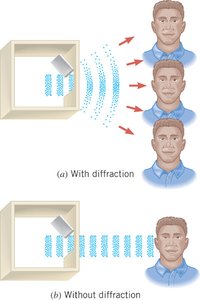
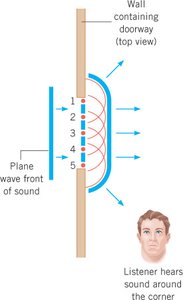
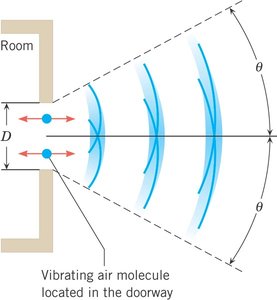
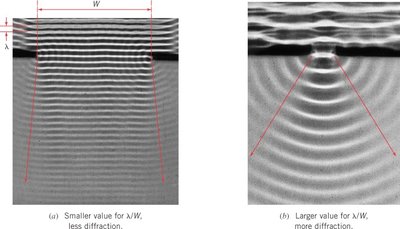
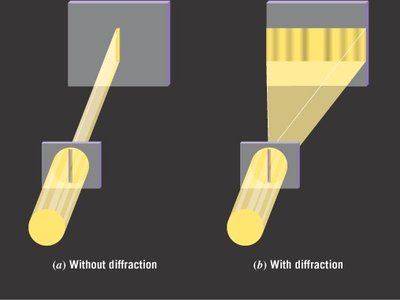
Diffraction is the bending of waves around obstacles or through openings. The extent of diffraction increases as the wavelength becomes comparable to the size of the opening or obstacle.
For an opening of width and wavelength :
When , radian ().
Huygens' Principle
According to Huygens' principle, every point on a wavefront acts as a source of secondary spherical wavelets. The new wavefront is the tangent to all these wavelets.
Principle of Linear Superposition
When two or more light waves overlap, their electric fields add together. This can result in constructive (amplified) or destructive (diminished) interference, depending on their phase relationship.
Constructive interference: Waves arrive in phase, amplitudes add.
Destructive interference: Waves arrive out of phase, amplitudes subtract.
Coherent sources: Maintain a constant phase relationship, necessary for stable interference patterns.
Young's Double-Slit Experiment
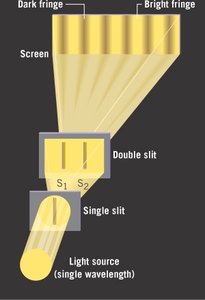
Young's experiment demonstrates the wave nature of light by producing an interference pattern of bright and dark fringes on a screen. Two slits act as coherent sources, and the pattern depends on the wavelength and slit separation.
Bright fringes (constructive interference):
Dark fringes (destructive interference):
= slit separation, = wavelength, = order of fringe (0, 1, 2, ...)
The distance from the central maximum to the -th bright fringe on a screen at distance is:
(for small angles)
Example: For nm, m, m, third-order bright fringe:
m = 4.56 cm
White Light in Young's Experiment
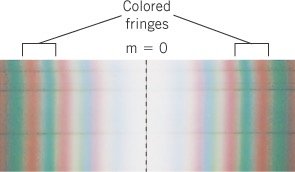
When white light is used, each wavelength produces its own set of fringes. The central fringe is white (all colors overlap), while colored fringes appear on either side, with red farther from the center than green due to its longer wavelength.
Single-Slit Diffraction and Double-Slit Interference
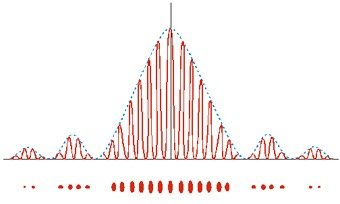
Single-slit diffraction produces a central bright maximum with decreasing intensity maxima on either side. Double-slit interference patterns are superimposed on the single-slit envelope.
Summary Table: Comparison of Interference and Diffraction
Phenomenon | Cause | Pattern |
|---|---|---|
Double-slit interference | Superposition of waves from two slits | Equally spaced bright and dark fringes |
Single-slit diffraction | Bending of light through a single slit | Central maximum with decreasing side maxima |
Additional info: The notes above integrate and expand upon the provided material, ensuring all key concepts from the original file are covered and explained in a self-contained, academically rigorous manner.
