 Back
BackDiscussion 13
Study Guide - Smart Notes
 Tailored notes based on your materials, expanded with key definitions, examples, and context.
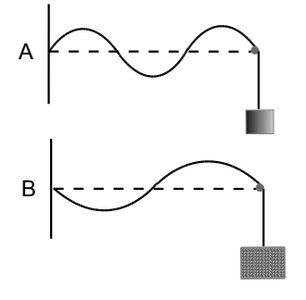
Q1. What is the ratio of the masses of the two blocks mA : mB, given that standing waves of identical frequencies are formed on identical ropes, each with tension provided by a hanging block?
Background
Topic: Waves on a String
This question tests your understanding of how the speed of a wave on a string depends on the tension and mass per unit length, and how tension is related to the mass of the hanging block.
Key formula:
Where:
= speed of the wave
= tension in the rope (provided by the weight of the block, )
= mass per unit length of the rope
Step-by-Step Guidance
Recall that the speed of the wave depends on the tension and mass per unit length: .
Since the ropes are identical and the frequencies are identical, the wave speeds must be equal for both ropes.
Set the wave speeds equal: .
Since is the same for both ropes, this simplifies to .
Recall that tension is provided by the hanging block: , so and .
Try solving on your own before revealing the answer!
Final Answer: mA : mB = 1 : 1
Since the tensions must be equal for identical wave speeds and ropes, the masses must be equal: .
This follows directly from the relationship between tension and mass.
Q2. A uniform block floats with 1/3 of its volume above the surface of water. Find the mass density of the block in terms of the mass density of water .
Background
Topic: Buoyancy and Archimedes' Principle
This question tests your understanding of how the fraction of a floating object's volume above water relates to its density compared to the fluid.
Key formula:
Where:
= density of the block
= density of water
Step-by-Step Guidance
Let be the total volume of the block. is the submerged volume.
Since 1/3 of the block is above water, 2/3 is submerged: .
Apply Archimedes' Principle: the weight of the block equals the weight of displaced water.
Set up the equation: .
Substitute and solve for in terms of .
Try solving on your own before revealing the answer!
Final Answer:
The block's density is two-thirds that of water, since only two-thirds of its volume is submerged.
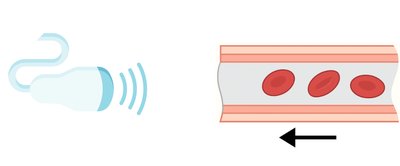
Q3. A Doppler ultrasound device emits waves at MHz. Red blood cells move toward the transducer at m/s. The speed of sound in tissue is m/s. What is the frequency of the reflected wave detected by the transducer?
Background
Topic: Doppler Effect for Sound Waves
This question tests your ability to apply the Doppler effect for waves reflected from moving objects, specifically in a medical context.
Key formula:
(for moving observer)
For reflection, apply the Doppler effect twice: once for the moving blood cells as observer, then as source.
Where:
= source frequency
= speed of sound in tissue
= speed of blood cells toward the source
Step-by-Step Guidance
First, calculate the frequency as received by the moving blood cells (observer): .
Next, the blood cells act as a moving source reflecting the wave back: .
Combine the two steps: .
Plug in the values: MHz, m/s, m/s.
Set up the calculation, but do not compute the final value yet.
Try solving on your own before revealing the answer!
Final Answer: 5.00195 MHz
Using the combined Doppler formula and plugging in the values, the detected frequency is slightly higher than the emitted frequency due to the blood cells moving toward the transducer.
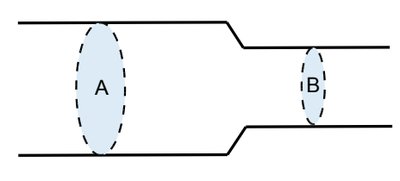
Q4. Water passes steadily through a pipe where the cross-sectional area at A is twice as big as at B. At which point is the volume flow rate greater, and by how much?
Background
Topic: Fluid Dynamics & Continuity Equation
This question tests your understanding of the continuity equation for incompressible fluids, which relates flow rate to cross-sectional area and velocity.
Key formula:
Where:
= volume flow rate
= cross-sectional area
= fluid velocity
Step-by-Step Guidance
Recall the continuity equation: for incompressible fluids, .
Set up the equation: .
Given , relate the velocities: .
Calculate the flow rates at each point: , .
Compare and using the relationships above, but do not compute the final comparison yet.
Try solving on your own before revealing the answer!
Final Answer: Tie
The volume flow rate is the same at both points, as required by the continuity equation for incompressible fluids.
