Back
BackWaves and Sound: Oscillations, Wave Types, and Sound Phenomena
Study Guide - Smart Notes
 Tailored notes based on your materials, expanded with key definitions, examples, and context.
Oscillations and Simple Harmonic Motion
Spring Forces and Vibrations
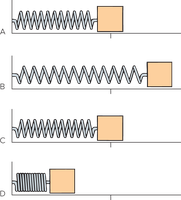
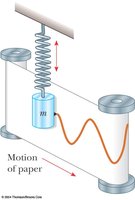
Oscillations are repetitive back-and-forth motions about an equilibrium position. A classic example is a mass attached to a spring, which exhibits simple harmonic motion (SHM) when displaced from equilibrium. The restoring force in a spring is proportional to the displacement, as described by Hooke's Law.
Restoring Force: The force that acts to return the system to equilibrium, given by , where is the spring constant and is the displacement.
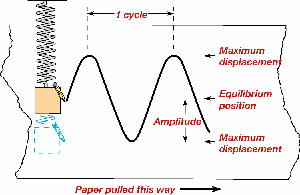
Equilibrium Position: The point where the net force on the mass is zero and the spring is neither stretched nor compressed.
Simple Harmonic Motion (SHM): Motion where the restoring force is directly proportional to displacement and acts in the opposite direction.
Cycle: One complete to-and-fro motion.
Describing Vibrations
Key quantities used to describe vibrations include amplitude, period, and frequency.
Amplitude (A): The maximum displacement from equilibrium.
Period (T): The time required for one complete cycle of motion.
Frequency (f): The number of cycles per second, measured in hertz (Hz).
Types of Waves
Mechanical and Non-Mechanical Waves
Waves are disturbances that transfer energy from one place to another without transferring matter. They can be classified based on their need for a medium and the direction of particle oscillation.
Mechanical Waves: Require a material medium (e.g., air, water, string) to propagate.
Electromagnetic Waves: Do not require a medium; can travel through a vacuum (e.g., light, radio waves).
Matter Waves: Associated with particles such as electrons (quantum mechanics).
Transverse and Longitudinal Waves
Mechanical waves are further classified by the direction of oscillation relative to wave propagation.
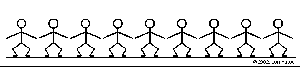
Transverse Waves: The medium oscillates perpendicular to the direction of wave travel (e.g., waves on a string).
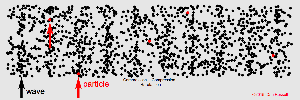
Longitudinal Waves: The medium oscillates parallel to the direction of wave travel (e.g., sound waves in air).
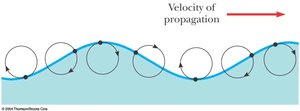
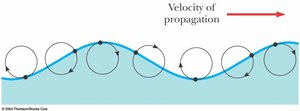
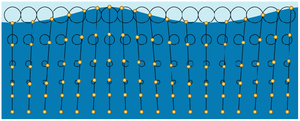
Surface Waves: Exhibit both transverse and longitudinal characteristics (e.g., water waves).


Surface Waves
Surface waves occur at the interface between two media, such as air and water. The particles move in circular or elliptical paths, combining both transverse and longitudinal motion.

Wave Properties
Amplitude, Wavelength, and Period
Waves are characterized by several measurable properties:
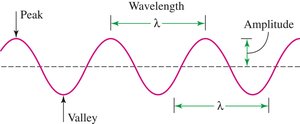
Amplitude (A): Maximum displacement from the equilibrium position.
Wavelength (\(\lambda\)): The distance between two consecutive points in phase (e.g., crest to crest).
Period (T): Time for one complete cycle to pass a point.
Frequency (f): Number of cycles per second, .
Wave Motion and Energy Transfer
Waves transfer energy without transferring matter. The medium returns to its original position after the wave passes, demonstrating that only energy is transported.
Sound Waves
Nature of Sound
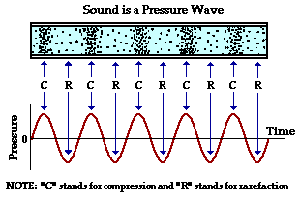
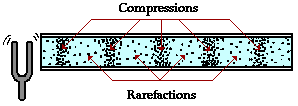
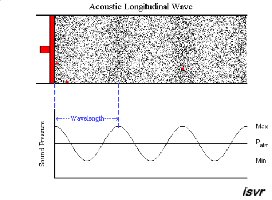
Sound is a mechanical longitudinal wave produced by vibrating objects in a medium (solid, liquid, or gas). The vibration causes compressions and rarefactions in the medium, which propagate as sound waves.
Compression: Region where particles are close together.
Rarefaction: Region where particles are spread apart.
Sound Wave Representation
Sound waves can be visualized as pressure variations over time, with compressions corresponding to high pressure and rarefactions to low pressure.
Hearing and the Human Ear
The human ear detects sound waves within a specific frequency range (approximately 20 Hz to 20,000 Hz). The ear converts pressure variations into electrical signals interpreted by the brain as sound.

Musical Instruments and Harmonics
String Instruments
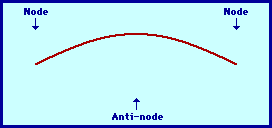
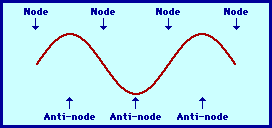
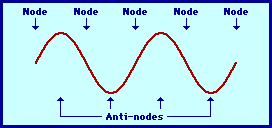
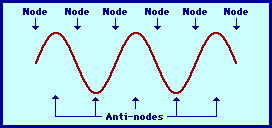
String instruments produce sound through transverse waves on stretched strings. The tone consists of a fundamental frequency and overtones (harmonics), which determine the instrument's timbre.
Wind Instruments
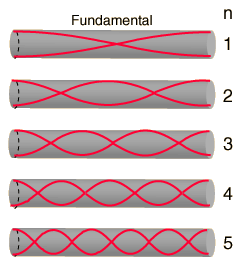
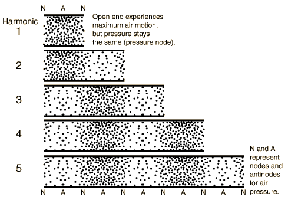
Wind instruments produce sound by vibrating columns of air (longitudinal waves). The pitch depends on the length of the air column, and the tone contains both the fundamental and overtones.


Speed of Sound
Speed in Different Media
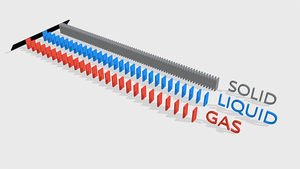
The speed of sound depends on the properties of the medium (density and elasticity). It is generally fastest in solids, slower in liquids, and slowest in gases.
Liquid (25°C) | Speed (m/s) |
|---|---|
Glycerol | 1904 |
Seawater | 1533 |
Water | 1493 |
Mercury | 1450 |
Kerosene | 1324 |
Methyl alcohol | 1143 |
Carbon tetrachloride | 926 |
Categories and Frequency Ranges of Sound Waves
Types of Sound Waves
Audible Waves: 20 Hz to 20 kHz (human hearing range).
Infrasonic Waves: Below 20 Hz.
Ultrasonic Waves: Above 20 kHz.
Frequency Ranges of Human Voice
Type of Voice | Frequency Range (Hz) |
|---|---|
Bass | 87.31 - 349.23 |
Baritone | 98.00 - 392.00 |
Tenor | 130 - 493.88 |
Contralto | 130.81 - 698.46 |
Soprano | 246.94 - 1,174.70 |
An octave represents a doubling or halving of frequency.
Resonance and Damped Oscillations
Natural Frequency and Resonance
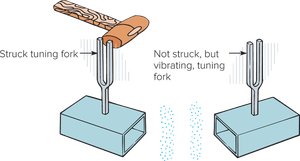
All objects have a natural frequency of vibration. Resonance occurs when an external force drives a system at its natural frequency, resulting in large amplitude oscillations. This phenomenon is responsible for effects such as shattering glass with sound or the collapse of bridges due to wind-induced vibrations.

Doppler Effect
Frequency Shift Due to Relative Motion
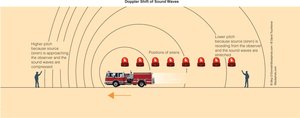
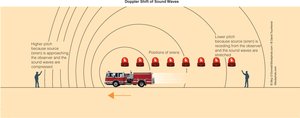
The Doppler Effect is the change in frequency (and wavelength) of a wave as observed when the source and observer are in relative motion. When the source approaches, the observed frequency increases; when it recedes, the frequency decreases.
Approaching Source: Higher pitch (shorter wavelength).
Receding Source: Lower pitch (longer wavelength).
Shock Waves and Sonic Booms
When a source moves faster than the speed of sound in a medium, it creates a shock wave, resulting in a sonic boom. This is observed with supersonic aircraft, bullets, and thunder.