 Back
BackWaves: Properties, Superposition, and Standing Waves
Study Guide - Smart Notes
 Tailored notes based on your materials, expanded with key definitions, examples, and context.
General Properties of Waves
Wave Motion and Transverse Waves
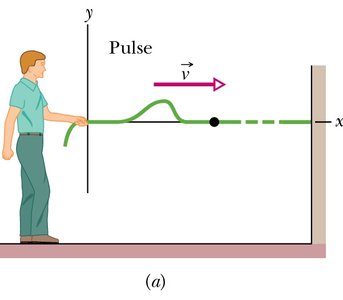
Wave motion is a fundamental mechanism by which disturbances from equilibrium propagate through a medium, transporting energy from one location to another. In the case of a taut string, a pulse or wave form travels along the string, while individual particles of the string move primarily perpendicular to the direction of wave travel. Such waves are known as transverse waves.
Transverse wave: The displacement of particles is perpendicular to the direction of wave propagation.
Energy transport: Waves carry energy from the source to other parts of the medium.
Wave speed: On a string of uniform density and tension, waves travel at a constant speed.
Sinusoidal Waves and Simple Harmonic Motion
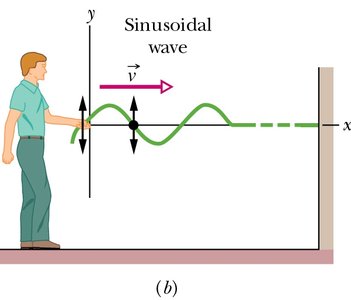
Sinusoidal waves are characterized by each particle undergoing simple harmonic motion about its equilibrium position. The displacement of a particle at position x and time t is given by:
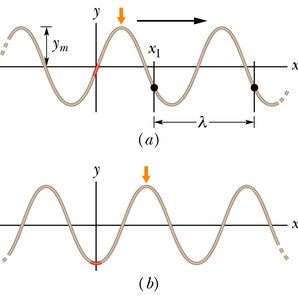
Amplitude (ym): Maximum displacement from equilibrium.
Wavelength (\(\lambda\)): Distance between repetitions of the wave shape.
Period (T): Time for one complete cycle.
Frequency (f): Number of oscillations per unit time.
Angular frequency (\(\omega\)): \(\omega = 2\pi f\)
Wave number (k): \(k = \frac{2\pi}{\lambda}\), units: rad/m
The displacement equation for a wave traveling in the +x direction:
The wave speed is related to wavelength and frequency:
Wave Equations and Velocity
Wave Equation for Traveling Waves
The general equation for a sinusoidal wave traveling in the +x direction is:
For a wave traveling in the -x direction:
Transverse Velocity of String Elements
The transverse velocity u of a string element is the rate of change of displacement at a fixed position x:
It is important to distinguish between the speed of propagation v of the wave and the speed u of a particle in the medium.
Wave Speed on a String
The speed of a wave on a taut string depends on the tension (\(\tau\)) and the linear mass density (\(\mu\)):
Doubling the frequency for the same string and tension halves the wavelength, since wave speed remains constant.
Energy and Power in Waves
Kinetic and Potential Energy
The energy in a wave consists of both kinetic and potential energy. Energy moves with the disturbance.
Kinetic energy rate:
Average kinetic energy rate:
Average power:
Doubling amplitude increases average power by a factor of 4.
Superposition and Interference
Principle of Superposition
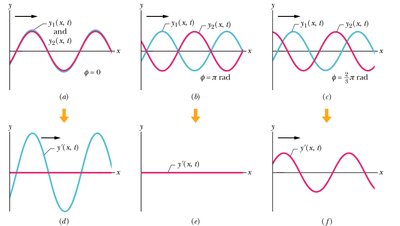
When two waves travel simultaneously along the same string, their displacements add algebraically:
Constructive interference: Waves in phase (\(\phi = 0\)) produce maximum amplitude.
Destructive interference: Waves out of phase by \(\pi\) radians produce zero amplitude.
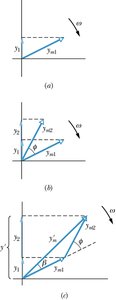
Phase difference: The amplitude of the resultant wave depends on the phase difference \(\phi\).
Resultant wave equation for two waves with phase difference \(\phi\):
Phasor Representation
Phasors are rotating vectors used to represent sinusoidal waves. The length of the phasor is the amplitude, and its angular velocity is the angular frequency. The projection on the y-axis gives the displacement at any point.
Phasor diagrams can be used to visualize the addition of waves and their phase relationships.
Standing Waves
Formation and Properties of Standing Waves
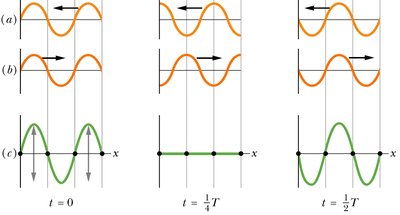
Standing waves are formed by the superposition of two waves with the same frequency and amplitude traveling in opposite directions. The resultant wave has fixed points called nodes (no motion) and antinodes (maximum amplitude).
Nodes: Points where the string never moves.
Antinodes: Points of maximum vibration.
Standing wave equation:
Nodes occur at or for
Resonant Frequencies and Harmonics
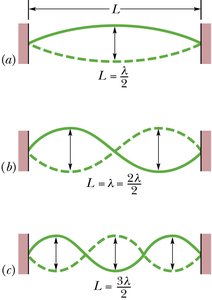
For a string of length L fixed at both ends, only certain frequencies (resonant frequencies) produce standing waves. The ends must be nodes, so an integer number of half-wavelengths must fit into the length:
for
for
Increasing tension or decreasing length increases the resonant frequency.
Fundamental mode (first harmonic):
Second harmonic:
Additional info: The notes cover the fundamental concepts of wave motion, including mathematical descriptions, energy transport, superposition, interference, phasor representation, and standing waves, all of which are central to college-level physics (Ch.16 - Traveling Waves and Sound, Ch.17 - Superposition and Standing Waves).
