Back
BackWork, Energy, and Power: Physics Study Guide
Study Guide - Smart Notes
 Tailored notes based on your materials, expanded with key definitions, examples, and context.
Work and Energy
An Overview of Energy
Energy is a fundamental scalar quantity in physics, meaning it has magnitude but no direction. It is conserved in isolated systems, and can take various forms such as kinetic, potential, thermal, and chemical energy. On Earth, most energy originates from the sun and is stored thermally and chemically, for example, in metabolic processes or as potential energy due to object height, mass, or elastic deformation.
Kinetic energy describes the energy of motion and depends on the mass and speed of an object.
Potential energy is stored due to an object's position or configuration.
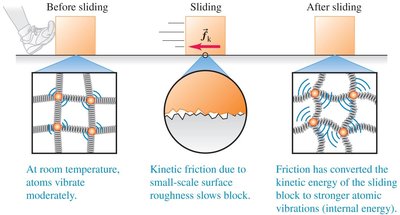
Internal energy can be "lost" as heat due to dissipation at the molecular level.
Work in Physics
Definition of Work
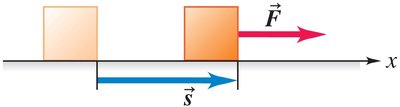
In physics, work is defined as the product of a constant force F applied through a parallel displacement s. Only the component of force in the direction of displacement contributes to work. Work is a scalar quantity and can be positive, negative, or zero, depending on the direction of force relative to displacement.
Formula: (for force parallel to displacement)
Work is positive if energy is added to the system, negative if energy is taken away, and zero if there is no change.
Work with Forces at Angles
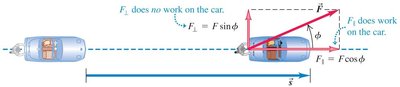
When forces are applied at angles, they must be resolved into components. Only the component parallel to displacement does work. The work done can be calculated using the cosine of the angle between force and displacement.
Formula:
If the force is perpendicular to displacement, no work is done.
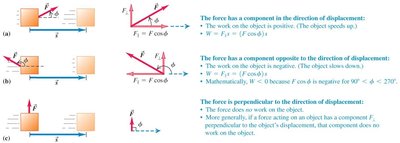
Work Done by Multiple Forces
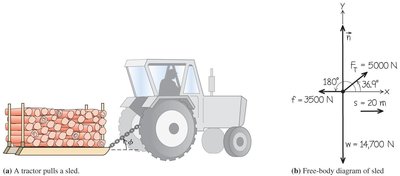
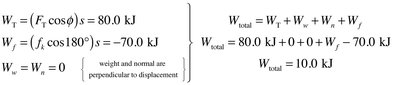
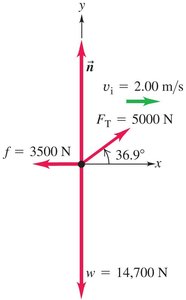
When several forces act on an object, the total work is the sum of the work done by each force. For example, in a tractor pulling a sled, the total work includes contributions from the tractor force, friction, weight, and normal force.
Work by each force is calculated using its component along the displacement.
Weight and normal force often do no work if perpendicular to displacement.
Kinetic Energy and the Work-Energy Theorem
Kinetic Energy
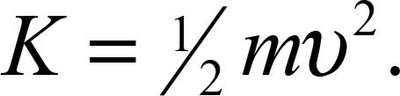
Kinetic energy (K) is the energy of motion for a particle of mass m moving at speed v. It is always positive and measured in joules.
Formula:
Units: joules [kg·m2/s2]

Work-Energy Theorem
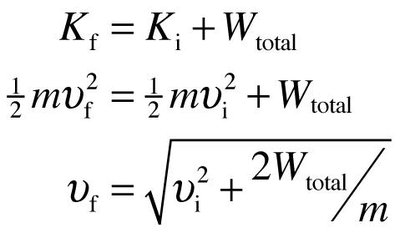
The work-energy theorem states that the work done by the net external force on a particle equals its change in kinetic energy. If the total work is zero, the kinetic energy and speed remain constant.
Formula:
Work can be positive, negative, or zero.
Example: Tractor Pulling a Sled
By knowing the initial speed and total work done, the final speed after displacement can be calculated using the work-energy theorem.
Formula:
Potential Energy
Conservative Forces and Potential Energy
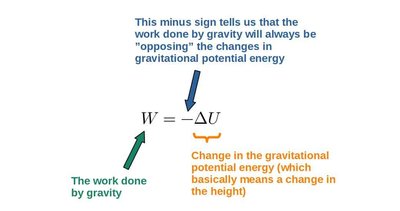
Conservative forces, such as gravity and elastic forces, produce a constant value of work regardless of the path taken. These forces allow energy to be stored as potential energy due to spatial arrangement.
Gravitational potential energy:
Potential energy can be positive or negative depending on the reference point.
Conservation of Mechanical Energy
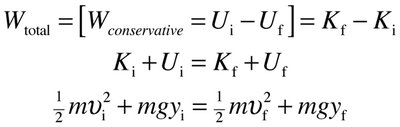
If only conservative forces act, the total mechanical energy (kinetic plus potential) is conserved. The change in potential energy is related to the work done by the net force.
Formula:
Mechanical energy is conserved in the absence of non-conservative forces.
Conservative vs. Non-Conservative Forces
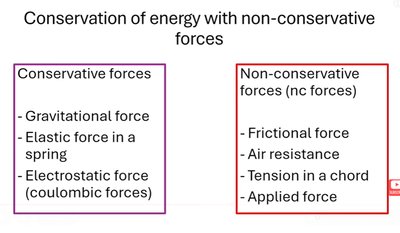
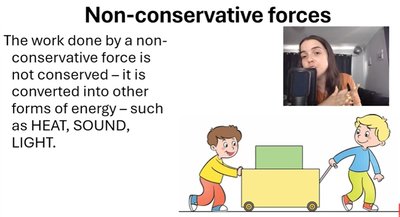
Conservative forces return energy when motion is reversed, while non-conservative forces (like friction) convert mechanical energy into other forms such as heat, sound, or light.
Conservative forces: Gravitational, elastic, electrostatic
Non-conservative forces: Friction, air resistance, tension, applied force
Energy Conservation with Non-Conservative Forces
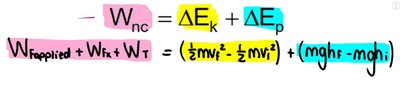
When non-conservative forces are present, the work they do is not conserved and is converted to other forms of energy. The total change in kinetic and potential energy equals the work done by non-conservative forces.
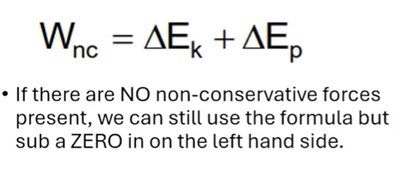
Formula:
If no non-conservative forces are present, is zero.
Power
Definition of Power
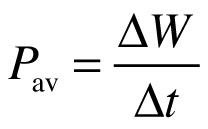
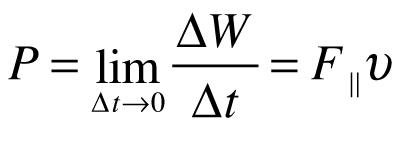
Power is the rate at which work is done. The average power is the work done divided by the time interval, and instantaneous power is the limit as the time interval approaches zero.
Average power:
Instantaneous power:
Units: watt [W], where 1 W = 1 J/s
Example: Power Output in a Marathon Stair Climb
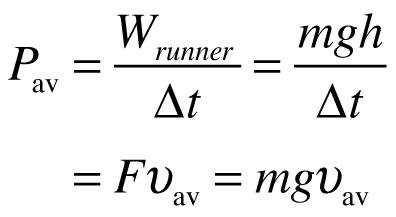
When a runner climbs stairs, the work done is equal to the work done by gravity. The average power output is calculated using the change in height and time interval.
Formula: