 Back
BackWork, Energy, and the Work-Energy Theorem
Study Guide - Smart Notes
 Tailored notes based on your materials, expanded with key definitions, examples, and context.
Work and the Dot Product
Definition of Work
In physics, work is defined as the energy transferred to or from an object via the application of force along a displacement. The mathematical definition for work done by a constant force is:
Work (W):
This is the dot product of the force vector and the displacement vector.
Work can be positive, negative, or zero depending on the angle between the force and displacement.
Dot Product Properties:
If , the work is negative.
The dot product is a scalar (not a vector).
Component form:
Work by a Constant Force
For a constant force along a straight path:
Units: Joule (J), where
Work is positive if force and displacement are in the same direction, zero if perpendicular, and negative if in opposite directions.
Work in Physical Situations
Work Done by Gravity and Other Forces
When lowering an object at constant speed, gravity does positive work (), while the hand does negative work ().
The total work done on the object is zero if it moves at constant speed (forces balance).
Work Done by Tension in Circular Motion
When an object moves in a circle at constant speed, the tension in the string is always perpendicular to the displacement, so the work done by tension is zero.
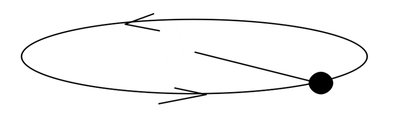
Work Done by Multiple Forces
Forces such as tension, friction, gravity, and normal force can all act on an object. The sign and magnitude of the work done by each depend on their direction relative to displacement.
Conservative and Non-Conservative Forces
Conservative Forces
A conservative force is one for which the work done is independent of the path taken, depending only on the initial and final positions.
Examples: Gravity, spring force, electric force.
Work done by gravity over a closed path is zero.
Non-Conservative Forces
Work done by non-conservative forces (e.g., friction) depends on the path taken.
Example: Work Done by Gravity Along a Path
For a mass moving along a square path and ending 0.5 m below its starting point, the work done by gravity depends only on the vertical displacement, not the path taken.
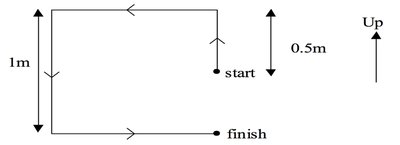
Work Done by a Variable Force
General Definition of Work
If the force is not constant or the path is curved, break the motion into small segments and sum the work:
Total work: (or as an integral)
Work as Area Under Force-Displacement Curve
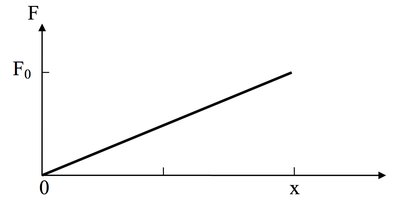
When force varies with position, the work done is the area under the vs. curve.
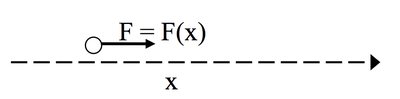
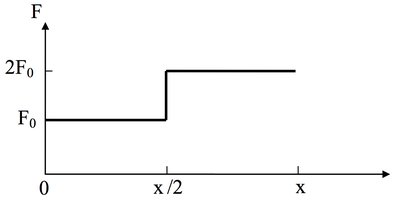
Example: Linearly Increasing Force
If increases linearly from 0 to over , the work done is:
Spring Forces and Hooke's Law
Hooke's Law
For an ideal spring:
is the spring constant (N/m).
Work required to stretch a spring from to :
Kinetic Energy and the Work-Energy Theorem
Kinetic Energy
Definition:
Units: Joules (J)
Kinetic energy is always positive or zero.
Work-Energy Theorem
The work-energy theorem states that the net work done on an object is equal to its change in kinetic energy:
Applications and Examples
Work Done by Friction and Air Resistance
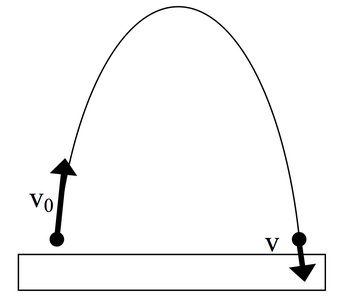
When non-conservative forces like friction or air resistance act, they do negative work (remove energy from the system).
Power
Definition:
Units: Watts (W), where
For constant force in 1-D:
Summary Table: Conservative vs. Non-Conservative Forces
Type of Force | Path Dependence | Examples |
|---|---|---|
Conservative | No | Gravity, Spring, Electric |
Non-Conservative | Yes | Friction, Air Resistance |
