 Back
BackWork, Heat, and the First Law of Thermodynamics: A Comprehensive Study Guide
Study Guide - Smart Notes
 Tailored notes based on your materials, expanded with key definitions, examples, and context.
Work, Heat, and the First Law of Thermodynamics
Introduction to Thermodynamics
Thermodynamics is the study of energy, its transformations, and its relation to matter. The first law of thermodynamics is a statement of energy conservation, particularly as it applies to thermal systems. This chapter explores the concepts of work, heat, and internal energy, and how they are interrelated through the first law.
The First Law of Thermodynamics
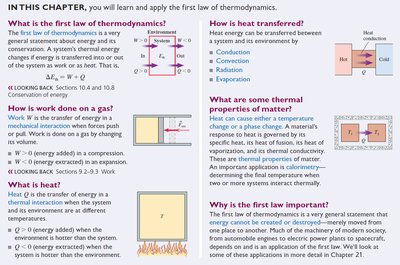
The first law of thermodynamics states that the change in the internal energy of a system equals the sum of the heat added to the system and the work done on the system:
Internal energy (Eint): The total energy contained within a system, including kinetic and potential energies at the microscopic level.
Heat (Q): Energy transferred due to a temperature difference between the system and its surroundings.
Work (W): Energy transferred when an external force moves the boundary of the system.
Work and Heat as Energy Transfer Mechanisms
Work and heat are two distinct processes by which energy can be transferred between a system and its environment:
Work (W): Mechanical energy transfer, such as compression or expansion of a gas.
Heat (Q): Non-mechanical energy transfer, always from a hotter to a colder body.
Neither work nor heat is a state variable; their values depend on the process path, not just the initial and final states.
Work Done by a Gas
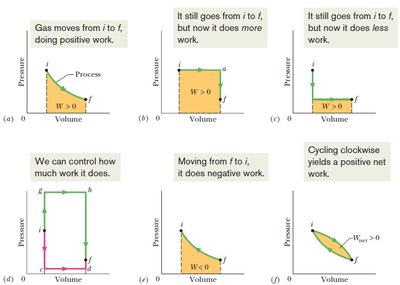
When a gas expands or is compressed, work is done by or on the gas. The work done during a quasi-static (slow and reversible) process is given by:
If the gas expands (), (work done by the gas).
If the gas is compressed (), (work done on the gas).
If the volume is constant, (isochoric process).
Special Ideal Gas Processes
Isochoric (Constant Volume): , so .
Isobaric (Constant Pressure): .
Isothermal (Constant Temperature): for an ideal gas.
Adiabatic (No Heat Exchange): , so .
Heat, Temperature, and Thermal Energy
It is important to distinguish between heat, temperature, and thermal energy:
Heat (Q): Energy in transit due to a temperature difference.
Temperature (T): A measure of the average kinetic energy of the particles in a substance.
Thermal Energy: The total internal energy associated with the random motions of particles.
Calorimetry and Specific Heat
When heat is added to or removed from a substance, the temperature change depends on the mass and the specific heat:
Specific heat (c): The amount of heat required to raise the temperature of 1 kg of a substance by 1 K.
Molar specific heat (C): The amount of heat required to raise the temperature of 1 mole of a substance by 1 K.
Phase Changes and Latent Heat
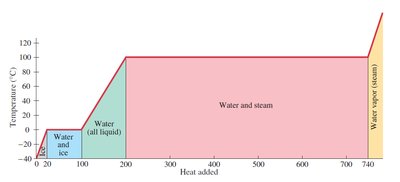
During a phase change (e.g., melting, boiling), the temperature remains constant while the substance absorbs or releases heat:
Latent heat of fusion (Lf): For melting/freezing.
Latent heat of vaporization (Lv): For boiling/condensation.
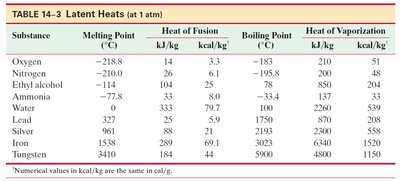
Substance | Melting Point (°C) | Heat of Fusion (kJ/kg) | Boiling Point (°C) | Heat of Vaporization (kJ/kg) |
|---|---|---|---|---|
Water | 0 | 334 | 100 | 2260 |
Oxygen | -218.8 | 14 | -183 | 210 |
Nitrogen | -210.0 | 26 | -195.8 | 200 |
Lead | 327 | 23 | 1750 | 870 |
Iron | 1538 | 289 | 3032 | 6340 |
Tungsten | 3410 | 184 | 5900 | 4800 |
Heat Transfer Mechanisms
There are three primary mechanisms for heat transfer:
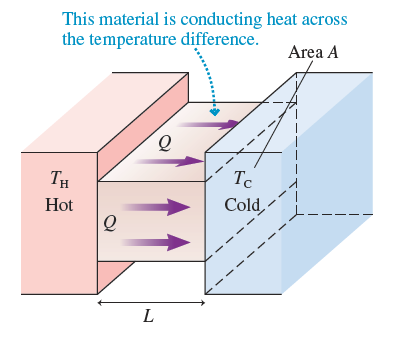
Conduction: Transfer of energy through collisions between particles in a solid or stationary fluid.
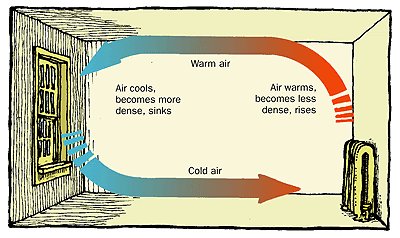
Convection: Transfer of energy by the bulk movement of fluid.
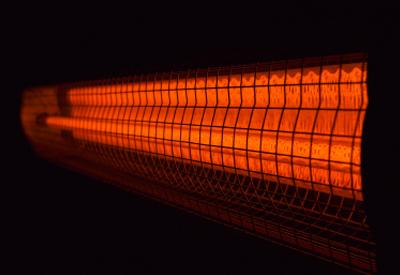
Radiation: Transfer of energy by electromagnetic waves, such as infrared radiation.
Conduction
The rate of heat transfer by conduction is given by:
k: Thermal conductivity of the material.
A: Cross-sectional area.
L: Length (thickness) of the material.
Convection
Convection involves the movement of fluid, carrying energy from one place to another. It can be natural (due to density differences) or forced (using fans or pumps).
Radiation
All objects emit thermal radiation. The power radiated by an object is given by the Stefan-Boltzmann law:
e: Emissivity (0 to 1).
σ: Stefan-Boltzmann constant ( W/m2K4).
A: Surface area.
T: Absolute temperature (K).
Newton's Law of Cooling
Newton's law of cooling describes the rate at which an object exchanges heat with its environment:
T: Temperature of the object.
TS: Surrounding (ambient) temperature.
k: Cooling coefficient.
The solution to this differential equation is:
Applications and Problem Solving
Apply the first law of thermodynamics to analyze energy changes in physical systems.
Use calorimetry to solve problems involving heat exchange and phase changes.
Calculate heat transfer rates for conduction, convection, and radiation in practical scenarios.
