 Back
BackLecture 20
Study Guide - Smart Notes
 Tailored notes based on your materials, expanded with key definitions, examples, and context.
X-Ray Diffraction
Principles of X-Ray Diffraction
X-ray diffraction is a powerful experimental technique used to determine the crystal structure of materials. When a beam of X-rays is directed at a crystallized molecule, the X-rays are scattered by the atoms in the crystal, producing an interference pattern that can be analyzed to reveal the arrangement of atoms. - X-rays are electromagnetic waves with wavelengths on the order of atomic spacings (about 0.1 nm). - The interference pattern is a result of constructive and destructive interference of the scattered X-rays. - This method is essential for studying the structure of complex molecules, such as DNA and salts like NaCl. 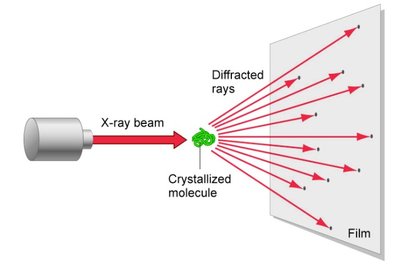
Production of X-Rays
X-rays are produced in an X-ray tube, where electrons are emitted from a heated cathode and accelerated towards an anode by a high voltage. When these high-speed electrons strike the metal target (anode), X-rays are generated. - Cathode: Emits electrons via thermionic emission. - Anode: Target for accelerated electrons; X-rays are produced upon impact. 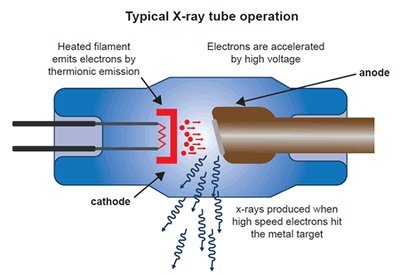
Bragg's Law and Crystal Structure Analysis
The condition for constructive interference (maxima) in a crystal is given by Bragg's Law: where is the order of the maximum, is the wavelength of X-rays, is the interatomic spacing, and is the angle of incidence. - For NaCl, m. - X-rays are ideal for probing atomic-scale structures due to their short wavelength.
Diffraction Patterns and Applications
The diffraction pattern produced by X-ray scattering can be recorded on a film and analyzed to determine the crystal structure. - Patterns from NaCl show regular spots, while DNA produces patterns indicative of its double helix structure. 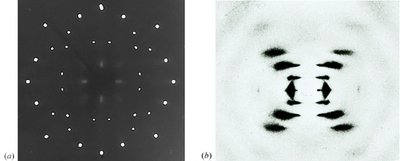
Example Calculation
To find the atomic spacing for an unknown crystal: Given nm, , and : m nm
Polarization of Light
Nature of Polarized Waves
Polarization refers to the orientation of the vibrations of a transverse wave. A wave is linearly polarized if its vibrations occur along a single direction. - Only waves vibrating parallel to a slit can pass through it; perpendicular vibrations are blocked. 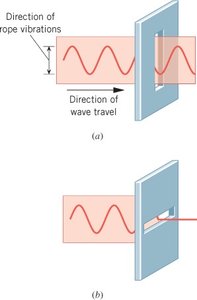
Polarized vs. Unpolarized Light
- Polarized light: Electric field fluctuates along a single direction. - Unpolarized light: Electric field directions are randomly distributed, perpendicular to the direction of wave travel. 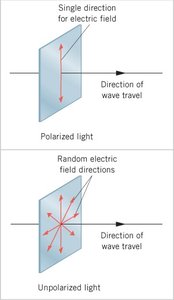
Production of Polarized Light
Polarizing materials can convert unpolarized light into polarized light. The transmitted intensity is half that of the incident unpolarized light, as the perpendicular component is blocked. - Transmission axis: Direction of polarization of light passing through the material. - Intensity: (units: W/m2) 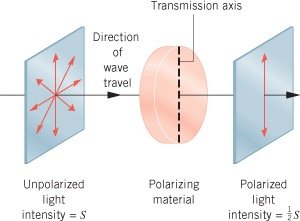
Malus' Law
Malus' Law describes the intensity of polarized light after passing through an analyzer at angle : where is the intensity before the analyzer.
Polarization by Scattering
Polarized light is produced when unpolarized sunlight is scattered by molecules in the atmosphere. The degree of polarization increases with the angle relative to the incident sunlight. 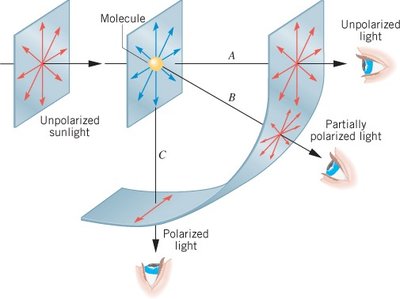
Applications: Polaroid Sunglasses and 3-D Movies
- Polaroid sunglasses: Block horizontally polarized light reflected from surfaces, reducing glare. - 3-D movies: Use crossed polarizers for each eye to create a stereoscopic effect. 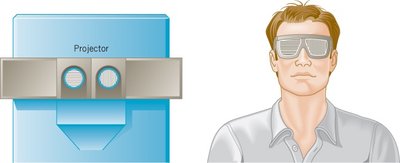
Partially Polarized Light
When light passes through a polarizer at an angle, it can be partially polarized and partially unpolarized. The total intensity is the sum of both components. 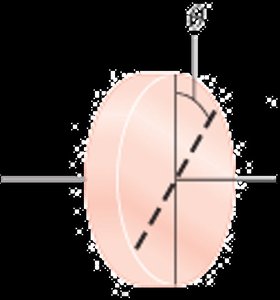
Polarization and Reflection/Refraction
Brewster's Law
Brewster's Law gives the angle at which reflected light is completely polarized: where and are the refractive indices of the two media. - At the polarizing angle , reflected light is 100% polarized. 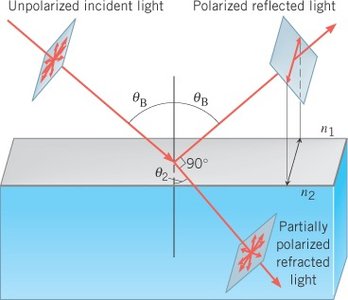
Resolving Power of Optical Instruments
Diffraction and Resolution
The ability of an optical instrument to distinguish between two closely spaced objects is limited by diffraction. - The first minimum of a circular diffraction pattern is given by: where is the wavelength and is the diameter of the aperture. 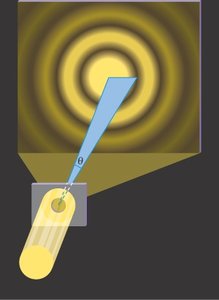
Rayleigh Criterion
The Rayleigh criterion states that two point objects are just resolved when the first dark fringe of one object's diffraction pattern falls on the central bright fringe of the other. - : Wavelength of light - : Diameter of optical device opening - : Minimum resolvable angle (radians) 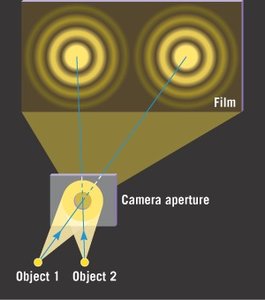
Example: Resolving Power from an Airplane
A pilot flying at height m, with pupil diameter mm, and green light nm: m Minimum distance between objects that can be resolved: 0.27 m
Summary Table: Key Equations
Phenomenon | Equation | Variables |
|---|---|---|
X-ray Diffraction (Bragg's Law) | : order, : wavelength, : spacing, : angle | |
Malus' Law | : initial intensity, : angle | |
Brewster's Law | , : refractive indices | |
Rayleigh Criterion | : wavelength, : diameter |
Additional info: The notes cover topics from Ch 24 (The Wave Nature of Light), Ch 25 (Optical Instruments), and Ch 27 (Early Quantum Theory and Models of the Atom), all relevant to a college physics course.
