 Back
BackAlgebraic, Polynomial, Exponential, and Logarithmic Functions: Precalculus Review Notes
Study Guide - Smart Notes
 Tailored notes based on your materials, expanded with key definitions, examples, and context.
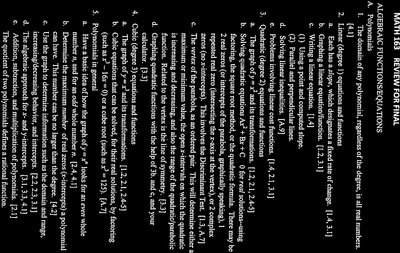
Algebraic Functions and Equations
Polynomial Functions
Polynomial functions are a fundamental class of functions in precalculus, characterized by their algebraic expressions and predictable behavior. Understanding their properties is essential for analyzing graphs and solving equations.
Definition: A polynomial function is an expression of the form , where and is a non-negative integer.
Degree: The degree of a polynomial is the highest power of present.
Roots/Zeros: The solutions to are called roots or zeros. The number of real roots depends on the degree and the nature of the coefficients.
End Behavior: The end behavior of a polynomial function is determined by its leading term .
Graphing: The graph of a polynomial is continuous and smooth, with turning points determined by the degree.
Example: is a cubic polynomial.
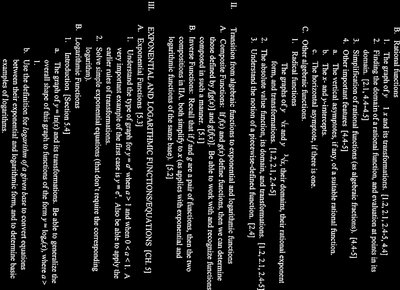
Rational Functions
Rational functions are quotients of polynomials and exhibit unique properties such as asymptotes and discontinuities.
Definition: A rational function is of the form , where and are polynomials and .
Domain: The domain excludes values where .
Asymptotes: Vertical asymptotes occur at zeros of ; horizontal or oblique asymptotes depend on the degrees of and $Q(x)$.
Example: has a vertical asymptote at .
Exponential and Logarithmic Functions
Exponential Functions
Exponential functions model rapid growth or decay and are defined by a constant base raised to a variable exponent.
Definition: An exponential function is , where and .
Properties:
Domain: All real numbers
Range: Positive real numbers
Growth/Decay: If , the function grows; if , it decays.
Example: is an exponential growth function.
Logarithmic Functions
Logarithmic functions are the inverses of exponential functions and are used to solve equations involving exponents.
Definition: is the logarithm base of , where , , and .
Properties:
Domain:
Range: All real numbers
Inverse:
Example: is the common logarithm.
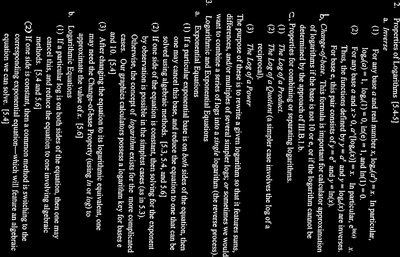
Properties of Logarithms
Logarithms follow specific algebraic properties that simplify expressions and solve equations.
Product Rule:
Quotient Rule:
Power Rule:
Change of Base:
Solving Exponential and Logarithmic Equations
Solving these equations often requires applying properties of exponents and logarithms, and sometimes involves restrictions on the domain.
Exponential Equations:
Set equal bases and equate exponents:
Take logarithms of both sides if bases differ.
Logarithmic Equations:
Apply logarithm properties to combine or separate terms.
Check for extraneous solutions due to domain restrictions.
Example: Solve . Since , .
Graphical Representations
Graphs of Polynomial, Rational, Exponential, and Logarithmic Functions
Graphing these functions helps visualize their behavior, including intercepts, asymptotes, and end behavior.
Polynomial Graphs: Continuous, with turning points and end behavior determined by degree and leading coefficient.
Rational Graphs: May have discontinuities and asymptotes.
Exponential Graphs: Rapid increase or decrease, always positive.
Logarithmic Graphs: Pass through , vertical asymptote at .
Summary Table: Properties of Functions
The following table summarizes key properties of polynomial, rational, exponential, and logarithmic functions.
Function Type | General Form | Domain | Range | Key Features |
|---|---|---|---|---|
Polynomial | All real numbers | All real numbers | Continuous, smooth, turning points | |
Rational | All real numbers except | Depends on and | Asymptotes, discontinuities | |
Exponential | All real numbers | Positive real numbers | Rapid growth/decay | |
Logarithmic | All real numbers | Inverse of exponential, vertical asymptote |
Additional info:
Some content was inferred and expanded for completeness, including definitions, examples, and a summary table. The images included are directly relevant as they visually reinforce the review notes for algebraic, exponential, and logarithmic functions.
