 Back
BackAnalytic Trigonometry: Inverse Secant, Cosecant, and Cotangent Functions
Study Guide - Smart Notes
 Tailored notes based on your materials, expanded with key definitions, examples, and context.
Analytic Trigonometry
Inverse Secant, Cosecant, and Cotangent Functions
In this section, we explore the definitions, properties, and applications of the inverse secant, cosecant, and cotangent functions. These functions are essential for solving equations and evaluating expressions involving trigonometric relationships, especially when working with right triangles and their applications in precalculus.
Definition of Inverse Secant, Cosecant, and Cotangent Functions
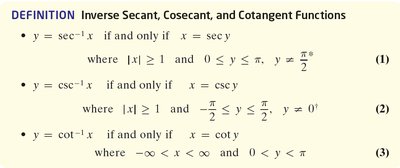
Inverse Secant Function: The inverse secant function, denoted as , is defined such that where and , .
Inverse Cosecant Function: The inverse cosecant function, denoted as , is defined such that where and , .
Inverse Cotangent Function: The inverse cotangent function, denoted as , is defined such that where and .
Finding the Value of Inverse Secant, Cosecant, and Cotangent Functions
To evaluate inverse trigonometric functions, identify the angle whose trigonometric value matches the given number, considering the restricted range for each function.
Example 1: The angle such that is (since and ), within the range , .
Example 2: The angle such that is , since and .
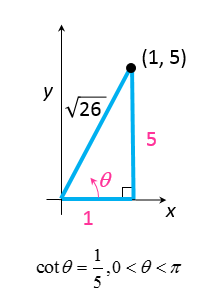
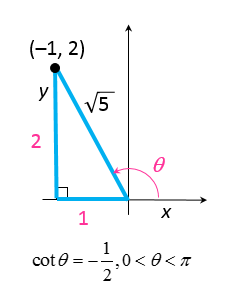
Example 3: The angle such that , with .
Approximating Values of Inverse Trigonometric Functions
When exact values are not possible, use a calculator in radian mode to approximate the values of inverse trigonometric functions. For example:
radians
radians
radians
radians
Exact Values of Composite Functions Involving Inverse Trigonometric Functions
Composite functions such as or can be evaluated exactly using right triangles and the Pythagorean theorem.
Example: Let , so . Construct a right triangle with opposite side 1 and adjacent side 3. The hypotenuse is . Thus, .
Example: Let , so . In quadrant IV, .
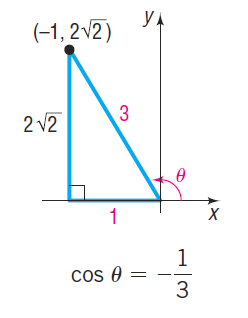
Example: Let , so . Construct a triangle with adjacent side , hypotenuse $3. Thus, .
Writing Trigonometric Expressions as Algebraic Expressions
Trigonometric expressions involving inverse functions can often be rewritten as algebraic expressions in terms of a variable. This is done by letting be the angle defined by the inverse function, constructing a right triangle, and expressing the desired trigonometric function in terms of the given variable.
Example: Write as an algebraic expression in . Let . Construct a right triangle with adjacent side $u$ and opposite side $1\sqrt{u^2 + 1}\cos \theta = \frac{u}{\sqrt{u^2 + 1}}$, so $\cos(\cot^{-1} u) = \frac{u}{\sqrt{u^2 + 1}}$.
Summary Table: Inverse Trigonometric Functions
Function | Definition | Domain | Range |
|---|---|---|---|
, | |||
, | |||
