Back
BackAngles and Radian Measure: Foundations for Trigonometry
Study Guide - Smart Notes
 Tailored notes based on your materials, expanded with key definitions, examples, and context.
Angles and Their Measurement
Definition and Components of an Angle
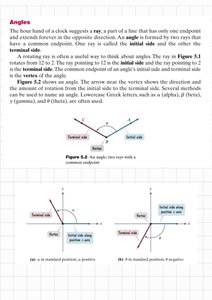
An angle is formed by two rays that share a common endpoint, called the vertex. The initial position of the ray is called the initial side, and the position after rotation is the terminal side. Angles are fundamental in trigonometry and analytic geometry, serving as the basis for measuring rotation and direction.
Ray: A part of a line with one endpoint extending infinitely in one direction.
Initial Side: The starting position of the ray.
Terminal Side: The position of the ray after rotation.
Vertex: The common endpoint of the two rays.
Angles are often denoted by Greek letters such as α (alpha), β (beta), γ (gamma), and θ (theta).
Standard Position of an Angle
An angle is in standard position if its vertex is at the origin of a coordinate plane and its initial side lies along the positive x-axis. The direction of rotation determines the sign of the angle:
Counterclockwise rotation: Positive angle
Clockwise rotation: Negative angle
Measuring Angles: Degrees and Radians
Degrees
The degree is a common unit for measuring angles. One complete revolution is 360°.
Radians
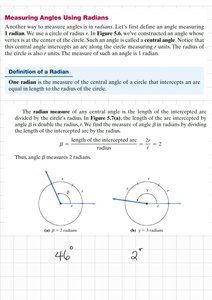
The radian is the measure of a central angle of a circle that intercepts an arc equal in length to the radius of the circle. Radians are the standard unit of angular measure in mathematics.
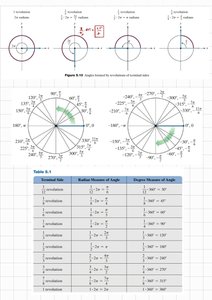
One complete revolution is radians.
Half a revolution is radians.
Quarter revolution is radians.
Relationship Between Degrees and Radians
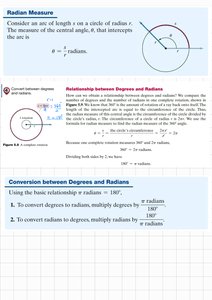
The relationship between degrees and radians is given by:
radians
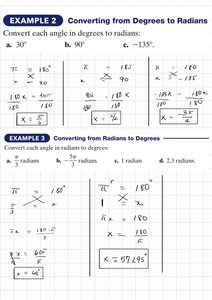
To convert degrees to radians, multiply degrees by .
To convert radians to degrees, multiply radians by .
Examples: Converting Between Degrees and Radians
Degrees to Radians: radians
Radians to Degrees: radians
Coterminal Angles
Definition and Properties
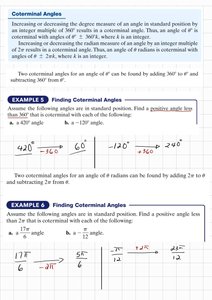
Coterminal angles are angles in standard position that share the same terminal side. They can be found by adding or subtracting integer multiples of (or radians) to a given angle.
For degrees: , where is any integer.
For radians: , where is any integer.
Examples: Finding Coterminal Angles
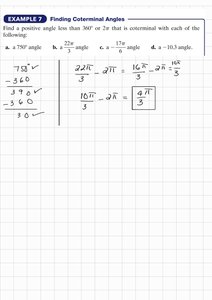
Find a positive angle less than coterminal with :
;
So, is coterminal with .
Arc Length and Circular Motion
Length of a Circular Arc
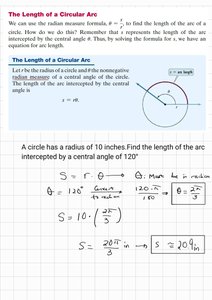
The length of an arc intercepted by a central angle (in radians) in a circle of radius is given by:
Example: For a circle of radius 10 inches and a central angle of ( radians): inches.
Linear and Angular Speed
Definitions
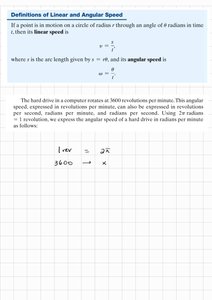
Linear speed (v): The rate at which a point moves along a circular path. , where is arc length and is time.
Angular speed (\omega): The rate at which the central angle changes. , where is in radians.
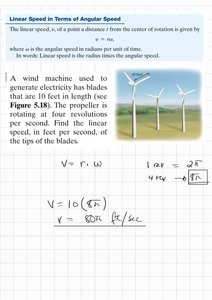
Relationship:
Example: Linear Speed in Terms of Angular Speed
A wind machine has blades 10 feet long, rotating at 4 revolutions per second. Find the linear speed at the tip:
One revolution = radians, so radians/sec.
ft/sec.
Reference Table: Common Angles in Degrees and Radians
The following table summarizes the radian and degree measures of common angles:
Number of Revolutions | Radian Measure of Angle | Degree Measure of Angle |
|---|---|---|
1 revolution | ||
1/2 revolution | ||
1/4 revolution | ||
1/6 revolution | ||
1/8 revolution | ||
1/12 revolution |