 Back
BackAngles and Their Measures: Degrees, Radians, Arc Length, and Motion
Study Guide - Smart Notes
 Tailored notes based on your materials, expanded with key definitions, examples, and context.
Trigonometric Functions
Angles and Their Measures
Understanding angular measure is fundamental in precalculus, as angles serve as the domain elements for trigonometric functions. This section introduces the concepts of degrees and radians, methods for converting between them, and their applications in arc length and motion.
The Problem of Angular Measure
Angle: Formed by two rays with a common endpoint (vertex).
Central Angle: An angle whose vertex is at the center of a circle.
Angular measure can be expressed in degrees or radians.
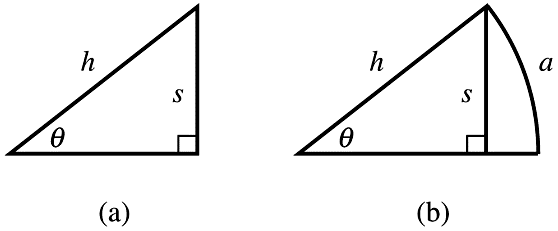
Degrees
Degree (°): A unit of angular measure. One full rotation (circle) is 360°.
DMS System: Each degree is subdivided into 60 minutes (') and each minute into 60 seconds (").
Used in navigation, surveying, and everyday measurements.
Navigation Example
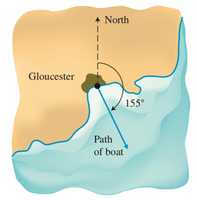
In navigation, bearings are measured clockwise from due north. For example, a boat's course might be described as 155° from north.
Radians
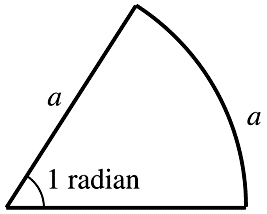
Radian: The angle at the center of a circle that intercepts an arc equal in length to the radius.
One full circle is radians.
Radians are preferred in higher mathematics due to their natural relationship with arc length.
Degree-Radian Conversion
To convert degrees to radians:
To convert radians to degrees:
Examples: Degree and Radian Measure
Example a: How many radians are in 60°?
radians
Example b: How many degrees are in radians?
Example c: Find the length of an arc intercepted by a central angle of radian in a circle of radius 3 in.
Arc length in.
Arc Length Formula
Radian Measure: If is in radians and is the radius, then arc length is:
Degree Measure: If is in degrees:
Example: Perimeter of a Pizza Slice
Given a pizza with radius 8 in. and a slice with central angle , the perimeter is the sum of the two radii and the arc length.
Arc length (if is in radians).
Angular and Linear Motion
Angular Speed: Rate at which an object rotates, measured in units like revolutions per minute (rpm).
Linear Speed: Rate at which a point on the rotating object moves along its path, measured in units like miles per hour (mph) or feet per second (ft/s).
Relationship: , where is linear speed, is radius, and is angular speed in radians per unit time.
Example: Using Angular Speed
A BMX bike with 10-in. radius wheels travels at 24 ft/sec. To find revolutions per minute:
Find circumference: in in ft.
Number of revolutions per second: rev/sec.
Convert to rpm: rpm.
