 Back
BackApplications of Trigonometric Functions: Solving Right Triangles, Bearings, and Simple Harmonic Motion
Study Guide - Smart Notes
 Tailored notes based on your materials, expanded with key definitions, examples, and context.
Applications of Trigonometric Functions
Solving Right Triangles
Solving right triangles is a fundamental application of trigonometry, allowing us to find unknown side lengths or angles using trigonometric ratios. These techniques are widely used in fields such as engineering, architecture, and navigation.
Key Trigonometric Ratios: The three main trigonometric ratios for a right triangle are sine, cosine, and tangent.
Sine:
Cosine:
Tangent:
Solving for Unknowns: Use the known sides and angles to set up equations and solve for the unknown values.
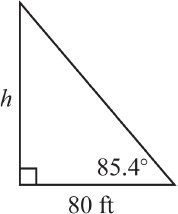
Example: Finding the Height of a Tower
Given a right triangle with an angle of elevation of 85.4° and a horizontal distance of 80 ft, the height of the tower can be found using the tangent function:
ft
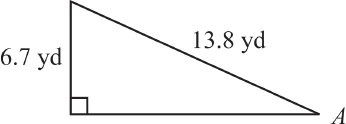
Example: Finding the Angle of a Guy Wire
Given a right triangle with a vertical side of 6.7 yards and a hypotenuse of 13.8 yards, the angle the wire makes with the ground can be found using the sine function:
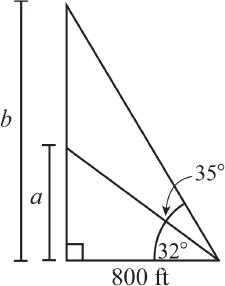
Example: Finding the Height of a Sculpture
Given two angles of elevation (32° and 35°) from a point 800 ft away, the height of the sculpture is the difference between the heights calculated for each angle:
ft
ft
Height of sculpture: ft
Solving Problems Involving Bearings
Bearing problems involve navigation and direction, often using right triangles formed by changes in direction. Bearings are measured clockwise from north or south.
Key Concept: Bearings are used to describe direction in navigation, typically in the format N/S θ° E/W.
Example: If you hike 2.3 miles on a bearing of S 31° W, then turn 90° and hike 3.5 miles on a bearing of N 59° W, you can use the tangent function to find the bearing from the starting point.
Bearing: S 87.7° W
Modeling Simple Harmonic Motion
Simple harmonic motion describes periodic movement, such as a ball on a spring or a pendulum. The displacement is modeled using sine or cosine functions.
General Equation: or
Amplitude (a): Maximum displacement from rest position.
Angular Frequency (ω):
Frequency (f):
Period: Time required for one complete cycle,
Example: Ball on a String
Maximum displacement: 6 inches
Period: 4 seconds
Equation:
Example: Object in Simple Harmonic Motion
Equation:
Maximum displacement: 12 cm
Frequency: oscillation per second
Period: seconds
Summary Table: Trigonometric Applications
Application | Key Formula | Example |
|---|---|---|
Solving Right Triangles | Height of tower: | |
Bearing Problems | Bearing: S 87.7° W | |
Simple Harmonic Motion |
