 Back
BackChapter 7: Additional Topics in Trigonometry – Law of Sines and Law of Cosines
Study Guide - Smart Notes
 Tailored notes based on your materials, expanded with key definitions, examples, and context.
Section 7.1: The Law of Sines
Introduction to the Law of Sines
The Law of Sines is a fundamental relationship in trigonometry that applies to any triangle, not just right triangles. It is especially useful for solving oblique triangles, where no right angle is present. The Law of Sines relates the lengths of the sides of a triangle to the sines of its angles.
Formula:
Applications: Used to solve triangles when given ASA (Angle-Side-Angle), SAA (Side-Angle-Angle), or SSA (Side-Side-Angle) information.
Solving Oblique Triangles Using the Law of Sines
To solve an oblique triangle, use the Law of Sines when you know:
Two angles and one side (ASA or SAA)
Two sides and a non-included angle (SSA, but be cautious of the ambiguous case)
Example: Given , , cm, find , , and .
Find the third angle:
Use the Law of Sines to find the other sides:
cm
cm
The Ambiguous Case (SSA)
When given two sides and an angle not included between them (SSA), there may be zero, one, or two possible triangles. This is known as the ambiguous case.
If , no triangle exists.
If , one or two triangles may exist depending on the sum of angles.
If , exactly one right triangle exists.
Example: Given , , :
Find :
Possible values: ,
Check if the sum with is less than to determine the number of triangles.
Area of an Oblique Triangle Using Sine
The area of a triangle can be found using two sides and the included angle:
Formula:
Example: For sides 8 m and 12 m with included angle :
m2
Applied Problem: Locating a Fire
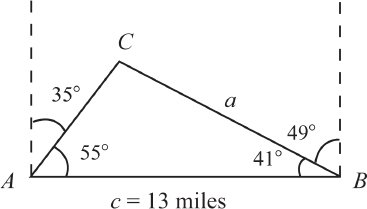
Two fire-lookout stations are 13 miles apart. Bearings from each station to a fire are given. The Law of Sines is used to find the distance from one station to the fire.
Given: miles, , ,
Find (distance from station B to the fire):
miles
Section 7.2: The Law of Cosines
Introduction to the Law of Cosines
The Law of Cosines generalizes the Pythagorean Theorem to all triangles. It is used when you know:
Two sides and the included angle (SAS)
All three sides (SSS)
Formula:
Other forms: ,
Solving Triangles Using the Law of Cosines
Use the Law of Cosines to find an unknown side or angle, then use the Law of Sines or angle sum to find the remaining parts.
Example (SAS): , ,
Use Law of Sines to find other angles.
Example (SSS): , ,
Find angle (opposite the longest side):
Applied Problem: Distance Between Airplanes
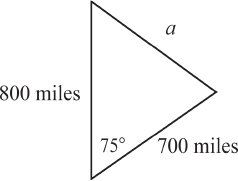
Two airplanes leave an airport at the same time, one flying north at 400 mph and the other on a bearing of at 350 mph. After two hours, their paths form a triangle with sides 800 miles and 700 miles, and included angle $75^\circ$. The Law of Cosines finds the distance between them.
miles
Heron's Formula for Area
When all three sides of a triangle are known, the area can be found using Heron's Formula:
Let (semi-perimeter)
Formula:
Example: m, m, m
m2
