 Back
BackCollege Trigonometry (MAC 1114C) Syllabus & Study Guide
Study Guide - Smart Notes
 Tailored notes based on your materials, expanded with key definitions, examples, and context.
Course Overview: College Trigonometry (MAC 1114C)
Introduction
This course, offered by the University of Central Florida, covers essential topics in trigonometry as part of the precalculus curriculum. It prepares students for advanced mathematics by developing a strong foundation in trigonometric functions, identities, equations, and their applications in geometry and vector analysis.
Course Structure & Learning Objectives
Main Topics Covered
Angles, Arc Length, and Circular Motion: Understanding angle measurement, converting between degrees and radians, and calculating arc length and sector area.
Right Triangle Trigonometry: Evaluating trigonometric functions for acute angles, using identities, and solving right triangles.
Trigonometric Functions of Any Angle: Extending trigonometric functions to all angles, using reference angles, and determining function signs by quadrant.
Unit Circle Approach: Using the unit circle to define and evaluate trigonometric functions, understanding domain, range, and periodicity.
Graphs of Trigonometric Functions: Graphing sine, cosine, tangent, cotangent, secant, and cosecant functions, including transformations and phase shifts.
Inverse Trigonometric Functions: Defining and evaluating inverse trigonometric functions, solving equations involving them.
Trigonometric Equations & Identities: Solving equations, simplifying expressions, and establishing fundamental identities.
Sum, Difference, Double-Angle, and Half-Angle Formulas: Applying advanced trigonometric formulas to solve problems and prove identities.
Applications: Solving triangles using the Law of Sines and Cosines, modeling simple harmonic motion, and working with vectors and polar coordinates.
Detailed Topic Breakdown
Angles, Arc Length, and Circular Motion
Angles are measured in degrees or radians. The length of an arc and the area of a sector are key concepts in circular motion.
Degree and Radian Measure: degrees
Arc Length Formula: (where is arc length, is radius, in radians)
Area of a Sector:
Linear Speed: (where is angular speed)
Right Triangle Trigonometry
Trigonometric functions relate the angles of a right triangle to the ratios of its sides.
Sine:
Cosine:
Tangent:
Fundamental Identities:
Complementary Angle Theorem:
Trigonometric Functions of Any Angle
Trigonometric functions can be evaluated for any angle using the unit circle and reference angles.
Coterminal Angles: Angles differing by multiples of or radians.
Reference Angle: The acute angle formed with the x-axis.
Signs by Quadrant: Sine is positive in Quadrants I and II, cosine in I and IV, tangent in I and III.
Unit Circle Approach; Properties of Trigonometric Functions
The unit circle provides a geometric definition for trigonometric functions and helps visualize their periodicity and symmetry.
Unit Circle: Circle of radius 1 centered at the origin.
Domain and Range: Sine and cosine have domain and range .
Periodicity:
Even-Odd Properties: ,
Graphs of Trigonometric Functions
Graphing trigonometric functions reveals their amplitude, period, phase shift, and vertical shift.
Sine and Cosine:
Tangent and Cotangent:
Secant and Cosecant: Reciprocal functions of cosine and sine, respectively.
Amplitude:
Period:
Inverse Trigonometric Functions
Inverse trigonometric functions allow you to find angles given the value of a trigonometric function.
Inverse Sine:
Inverse Cosine:
Inverse Tangent:
Domains and Ranges: is defined for
Trigonometric Equations & Identities
Solving trigonometric equations and simplifying expressions is essential for advanced problem solving.
Solving Equations: Use algebraic manipulation and identities.
Establishing Identities: Prove equalities using known formulas.
Sum, Difference, Double-Angle, and Half-Angle Formulas
These formulas expand the toolkit for evaluating and simplifying trigonometric expressions.
Sum Formula for Sine:
Difference Formula for Cosine:
Double-Angle Formula:
Half-Angle Formula:
Applications: Solving Triangles, Harmonic Motion, Vectors, and Polar Coordinates
Trigonometry is widely used in geometry, physics, and engineering to solve triangles, model periodic phenomena, and analyze vectors.
Law of Sines:
Law of Cosines:
Simple Harmonic Motion:
Vectors: Addition, subtraction, magnitude, and direction.
Polar Coordinates: , conversion to rectangular: ,
Course Materials
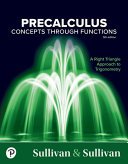
Textbook: Precalculus by Michael Sullivan (Pearson, 2023)
Calculator: TI-30XA (provided for exams)
Online Platform: Pearson Access via Webcourses
Assessment & Grading
Homework: 10% (lowest 3 dropped)
Quizzes: 10% (lowest 3 dropped)
Lecture Attendance: 5% (lowest 3 dropped)
Exams 1-3: 50% (lowest 1 dropped)
Final Exam: 25% (no drop)
Support & Resources
Tutoring: Student Academic Resource Center (SARC), Math Success Center
Supplemental Instruction: Weekly study sessions led by SI Leader
Accessibility: Student Accessibility Services (SAS) for accommodations
Academic Integrity & Policies
Honesty: Adherence to UCF's Code of Conduct
Calculator Policy: Only TI-30XA allowed; no graphing calculators
Attendance: Mandatory for lectures and MALL sessions
Makeup Policy: Only for documented UCF events or legal obligations
Class Schedule Overview
Week | Topics | Assignments |
|---|---|---|
1 | Syllabus, Angles, Arc Length, Circular Motion | Quiz 1, Required Academic Activity |
2 | Right Triangle Trigonometry, Acute Angles | Quiz 2, HW 5.1 & 5.2 |
3 | Any Angle, Unit Circle | Quiz 3, HW 5.3 & 5.4 |
4 | Graphs of Sine & Cosine, Test 1 Review | Test 1, HW 5.5 |
5 | Graphs of Tangent, Cotangent, Cosecant, Secant | Quiz 4, HW 5.6 & 5.7 |
6 | Phase Shift, Inverse Functions | Quiz 5, HW 5.8 |
7 | Inverse Functions Continued, Equations | Quiz 6, HW 6.1 & 6.2 |
8 | Identities, Test 2 Review | Test 2, HW 6.3 & 6.4 |
9 | Sum/Difference, Double/Half-Angle | Quiz 7, HW 6.5 |
11 | Product-to-Sum, Applications | Quiz 8, HW 6.6 & 6.7 |
12 | Law of Sines & Cosines | Quiz 9, HW 7.1 & 7.2 |
13 | Harmonic Motion, Polar Coordinates | Quiz 10, HW 7.3 & 7.5 |
14 | Polar Equations, Test 3 Review | Test 3, HW 8.1 |
15 | Vectors, Final Exam Review | Quiz 11, HW 8.2 & 8.4 |
16 | Final Exam | Final Exam |
Conclusion
This syllabus provides a comprehensive guide to the topics, expectations, and resources for success in College Trigonometry. Mastery of these concepts is essential for further study in mathematics, engineering, and the sciences.
