 Back
BackCombinations and Composition of Functions: Domains and Operations
Study Guide - Smart Notes
 Tailored notes based on your materials, expanded with key definitions, examples, and context.
Functions and Graphs
Combinations of Functions
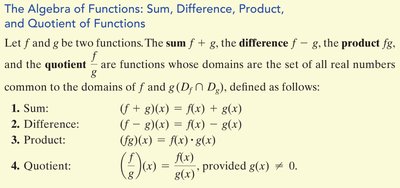
In precalculus, functions can be combined in various ways to create new functions. The most common operations are sum, difference, product, and quotient. Understanding how to find the domain of these combinations is essential for working with functions.
Sum:
Difference:
Product:
Quotient: , provided
The domain of each combination is the set of all real numbers common to the domains of and , except for values that cause division by zero in the quotient.
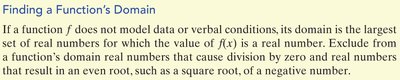
Finding a Function's Domain
The domain of a function is the largest set of real numbers for which the function is defined. Exclude from the domain any values that cause division by zero or result in an even root (such as a square root) of a negative number.
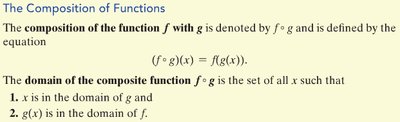
Composite Functions
A composite function is formed by applying one function to the result of another. The composition of with is denoted and defined as . The domain of the composite function consists of all such that $x$ is in the domain of $g$ and is in the domain of $f$.
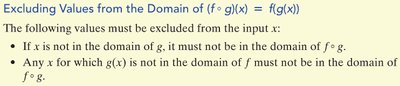
Excluding Values from the Domain of Composite Functions
When finding the domain of , exclude:
Any not in the domain of
Any for which is not in the domain of
Examples and Applications
Example 1: If , the domain is all real numbers since polynomials are defined everywhere.
Example 2: If , exclude values where the denominator is zero: or .
Example 3: If , require .
Example 4: If , require and .
Practice with Composition of Functions
Given and :
Always check the domain for each composition.
Decomposing Functions
Decomposition involves expressing a function as the composition of two simpler functions. For example:
can be written as , , so
can be written as , , so
can be written as , , so
Summary: Understanding combinations and compositions of functions, as well as their domains, is fundamental in precalculus. Always check for restrictions such as division by zero and square roots of negative numbers when determining domains.
