Back
BackComplex Numbers, Quadratic Equations, and Linear Inequalities
Study Guide - Smart Notes
 Tailored notes based on your materials, expanded with key definitions, examples, and context.
Section 1.4: Complex Numbers
The Imaginary Unit and Complex Numbers
Complex numbers extend the real number system by introducing the imaginary unit i, defined as the square root of -1. Every complex number can be written in the form a + bi, where a is the real part and b is the imaginary part.
Imaginary Unit:
Standard Form:
Example: and are both complex numbers.
Operations with Complex Numbers
Complex numbers can be added, subtracted, multiplied, and divided using algebraic rules, with the additional property that .
Addition/Subtraction: Combine like terms (real with real, imaginary with imaginary).
Multiplication: Use distributive property and substitute as needed.
Division: Multiply numerator and denominator by the conjugate of the denominator to write in standard form.
Example:
Principal Square Root of a Negative Number
The principal square root of a negative number is defined using the imaginary unit:
, where
Example:
Section 1.5: Quadratic Equations
Definition and Forms
A quadratic equation is a second-degree polynomial equation in the form:
, where
If , the equation becomes linear.
Zero-Product Principle
If the product of two expressions is zero, at least one of the expressions must be zero:
If , then or
Solving Quadratic Equations
Factoring: Express the quadratic as a product of binomials and set each factor to zero.
Square Root Property: If , then
Completing the Square: Rewrite the equation in the form and solve for .
Quadratic Formula: The solutions to are given by:
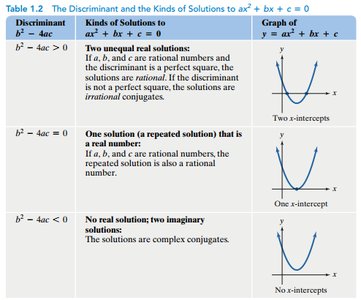
The Discriminant and Types of Solutions
The discriminant determines the nature of the solutions:
Discriminant | Kinds of Solutions | Graph |
|---|---|---|
Two unequal real solutions (rational or irrational) | Two x-intercepts | |
One real solution (repeated root) | One x-intercept | |
Two imaginary solutions (complex conjugates) | No x-intercepts |
Section 1.6: Other Types of Equations
Polynomial Equations
Polynomial equations can often be solved by factoring and applying the zero-product principle.
Example:
Radical Equations
Equations involving roots can be solved by isolating the radical and then raising both sides to the appropriate power. Always check for extraneous solutions.
Example:
Equations with Rational Exponents
Rewrite rational exponents as roots and solve as radical equations.
Example:
Section 1.7: Linear Inequalities and Absolute Value Equations
Solving Absolute Value Equations
Absolute value equations can be rewritten as two separate equations:
If , then or
Solving Linear Inequalities
Linear inequalities are solved similarly to equations, but the direction of the inequality reverses when multiplying or dividing by a negative number. Solutions are often expressed in interval notation.
Example:
Solving Absolute Value Inequalities
If , then
If , then or
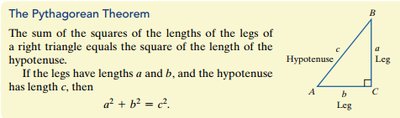
Additional Topic: The Pythagorean Theorem
Right Triangle Relationships
The Pythagorean Theorem relates the lengths of the sides of a right triangle. If the legs have lengths a and b, and the hypotenuse has length c, then: