Back
BackConic Sections, Systems of Equations, and Partial Fractions: Exam 3 Study Guide
Study Guide - Smart Notes
 Tailored notes based on your materials, expanded with key definitions, examples, and context.
Conic Sections
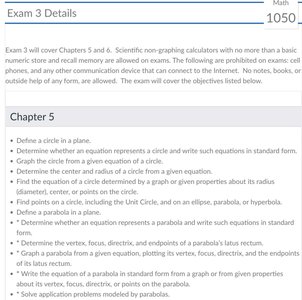
Circles
A circle is the set of all points in a plane that are equidistant from a fixed point called the center. The distance from the center to any point on the circle is called the radius.
Standard Equation: The equation of a circle with center and radius is $
Determining Center and Radius: Given the equation of a circle, rewrite it in standard form to identify the center and radius.
Graphing: Plot the center and use the radius to draw the circle.
Application: Circles are used in geometry, physics, and engineering to model round objects and paths.
Parabolas
A parabola is the set of all points in a plane equidistant from a fixed point (focus) and a fixed line (directrix).
Standard Equation: For a parabola opening right/left: $
Vertex, Focus, Directrix: The vertex is , the focus is or depending on orientation, and the directrix is or .
Graphing: Plot the vertex, focus, and directrix, then sketch the parabola.
Applications: Parabolas model projectile motion and satellite dishes.
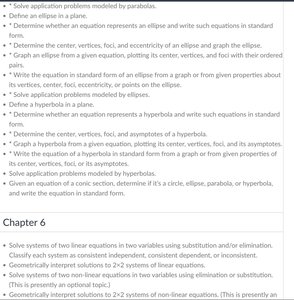
Ellipses
An ellipse is the set of all points in a plane where the sum of the distances from two fixed points (foci) is constant.
Standard Equation: where is the center, is the semi-major axis, and is the semi-minor axis.
Vertices and Foci: Vertices are at or ; foci are at where .
Graphing: Plot the center, vertices, and foci, then sketch the ellipse.
Applications: Ellipses model planetary orbits and optics.
Hyperbolas
A hyperbola is the set of all points in a plane where the difference of the distances from two fixed points (foci) is constant.
Standard Equation: or
Vertices, Foci, Asymptotes: Vertices are at or ; foci at where . Asymptotes are lines through the center with slopes .
Graphing: Plot the center, vertices, foci, and asymptotes, then sketch the hyperbola.
Applications: Hyperbolas model radio navigation and certain optical systems.
Systems of Equations and Matrices
Solving Systems of Linear Equations
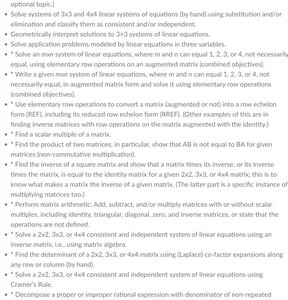
A system of linear equations consists of two or more linear equations involving the same set of variables. Solutions can be found using substitution, elimination, or matrix methods.
Substitution and Elimination: Solve for one variable and substitute into other equations, or add/subtract equations to eliminate variables.
Classification: Systems can be consistent (at least one solution), inconsistent (no solution), or independent (unique solution).
Application Problems: Systems model real-world scenarios such as business, chemistry, and physics.
Matrices and Row Operations
A matrix is a rectangular array of numbers. Matrices are used to represent and solve systems of equations.
Row Echelon Form: Use elementary row operations to transform a matrix to row echelon form (REF) or reduced row echelon form (RREF).
Inverse of a Matrix: The inverse of a matrix is such that , where is the identity matrix.
Multiplication: Matrix multiplication is not commutative; may not equal .
Determinant: The determinant is a scalar value that can be computed for square matrices and is used to determine invertibility.
Solving Linear Systems with Matrices
Augmented Matrix: Write the system as an augmented matrix and use row operations to solve.
Inverse Method: If is invertible, solve by .
Application: Used in engineering, computer science, and economics.
Properties and Operations of Matrices
Matrix Arithmetic: Add, subtract, and multiply matrices; multiply by scalars.
Special Matrices: Identity, diagonal, triangular, zero, and inverse matrices.
Determinant Calculation: Use cofactor expansion or row reduction.
Partial Fractions
Decomposition of Rational Expressions
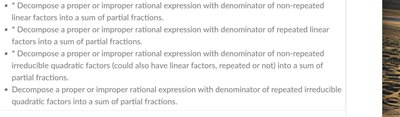
Partial fraction decomposition is the process of expressing a rational function as a sum of simpler fractions. This is useful for integration and solving equations.
Linear Factors: Decompose expressions with non-repeated and repeated linear factors in the denominator.
Quadratic Factors: Decompose expressions with irreducible quadratic factors, repeated or non-repeated.
General Form: where is factored into linear and quadratic terms.
Application: Used in calculus for integration and in engineering for signal processing.
Summary Table: Conic Sections
Conic Section | Standard Equation | Key Features |
|---|---|---|
Circle | Center, radius | |
Parabola | or | Vertex, focus, directrix |
Ellipse | Center, vertices, foci | |
Hyperbola | Center, vertices, foci, asymptotes |