 Back
BackDeMoivre’s Theorem and nth Roots of Complex Numbers
Study Guide - Smart Notes
 Tailored notes based on your materials, expanded with key definitions, examples, and context.
DeMoivre’s Theorem and nth Roots of Complex Numbers
DeMoivre’s Theorem
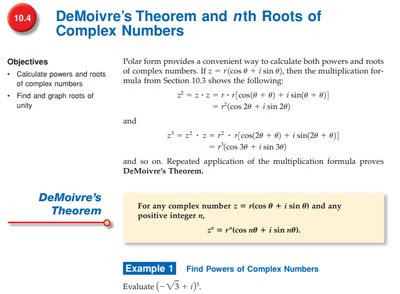
DeMoivre’s Theorem provides a powerful method for calculating powers and roots of complex numbers using their polar form. This theorem is especially useful in simplifying computations involving complex numbers raised to integer powers or extracting roots.
Polar Form of a Complex Number: Any complex number can be written as , where is the modulus and is the argument.
DeMoivre’s Theorem: For any complex number and any positive integer :
$
This formula allows us to raise complex numbers to integer powers efficiently.
Finding Powers of Complex Numbers
To find the power of a complex number:
Express the number in polar form: .
Apply DeMoivre’s Theorem to compute .
Simplify the result back to rectangular form if needed.
Example: Evaluate by first converting to polar form, then applying the theorem.
nth Roots of Complex Numbers
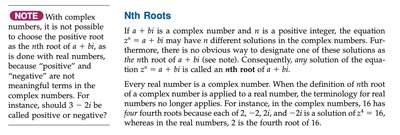
Finding the nth root of a complex number involves determining all possible solutions to . Unlike real numbers, complex numbers have n distinct nth roots for each positive integer .
Key Point: There is no single “positive” root in the complex plane; all roots are equally valid.
Definition: Any solution to is called an nth root of .
Formula for nth Roots
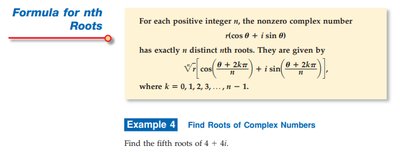
For each positive integer , the nonzero complex number has exactly $n$ distinct nth roots, given by:
$
Each value of gives a different root, spaced evenly around the complex plane.
Example: To find the fifth roots of , express in polar form and apply the formula for .
Roots of Unity
The nth roots of unity are the solutions to . These roots are equally spaced points on the unit circle in the complex plane.
The formula for the nth roots of unity is:
$
These roots are important in many areas of mathematics, including algebra and Fourier analysis.

Summary Table: DeMoivre’s Theorem and nth Roots
Concept | Formula | Description |
|---|---|---|
DeMoivre’s Theorem | Raises a complex number to an integer power | |
nth Roots of Complex Numbers | Finds all nth roots for | |
Roots of Unity | nth roots of 1, spaced evenly on the unit circle |
