 Back
BackDividing Polynomials: Long Division, Synthetic Division, Remainder and Factor Theorems
Study Guide - Smart Notes
 Tailored notes based on your materials, expanded with key definitions, examples, and context.
Dividing Polynomials: Long Division, Synthetic Division, Remainder and Factor Theorems
Long Division of Polynomials
Polynomial long division is a method for dividing a polynomial by another polynomial of equal or lower degree. The process is similar to long division with numbers and is used to simplify expressions or solve equations.
Step 1: Arrange both the dividend and divisor in descending powers of the variable.
Step 2: Divide the leading term of the dividend by the leading term of the divisor to obtain the first term of the quotient.
Step 3: Multiply the entire divisor by this term and subtract the result from the dividend.
Step 4: Bring down the next term from the dividend and repeat the process until the degree of the remainder is less than the degree of the divisor.
The Division Algorithm: For polynomials and (with ), there exist unique polynomials (quotient) and (remainder) such that:
where the degree of is less than the degree of .
Example: Divide by using long division.
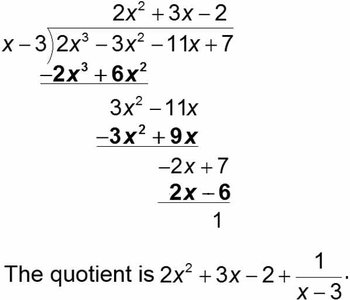
The quotient is .
Synthetic Division
Synthetic division is a shortcut method for dividing a polynomial by a linear divisor of the form . It is more efficient than long division for this specific case.
Step 1: Write the coefficients of the dividend in descending order, using 0 for any missing terms.
Step 2: Write (from ) to the left.
Step 3: Bring down the leading coefficient.
Step 4: Multiply by the value just written, add to the next coefficient, and repeat until done.
Step 5: The last number is the remainder; the others are coefficients of the quotient.
Example: Divide by using synthetic division ():
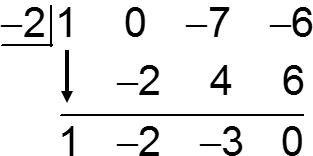
The quotient is .
The Remainder Theorem
The Remainder Theorem states that if a polynomial is divided by , the remainder is .
This theorem allows for quick evaluation of polynomials at specific values.
Example: Evaluate at using synthetic division:
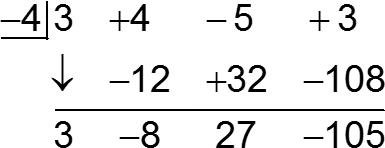
The remainder is , so .
The Factor Theorem
The Factor Theorem is a special case of the Remainder Theorem and provides a test for factors of polynomials:
If , then is a factor of .
If is a factor of , then .
Example: Solve given that is a zero of .
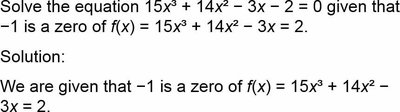
We use synthetic division to divide by :
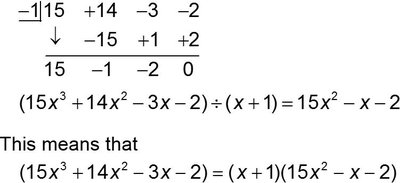
This gives as the quotient. Factoring further:
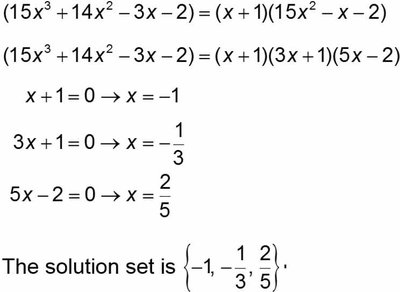
The solution set is .
Summary Table: Key Theorems and Methods
Method/Theorem | Purpose | Key Steps |
|---|---|---|
Long Division | Divide polynomials of any degree | Arrange, divide, multiply, subtract, repeat |
Synthetic Division | Divide by linear divisors () | Use coefficients, multiply and add |
Remainder Theorem | Find remainder of divided by | Evaluate |
Factor Theorem | Test if is a factor of | Check if |
