 Back
BackDrawing Angles in Standard Position and Identifying Quadrants
Study Guide - Smart Notes
 Tailored notes based on your materials, expanded with key definitions, examples, and context.
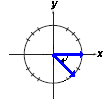
Q: Draw the angle −π/4 in standard position. State the quadrant in which the angle lies. Choose the correct graph below.
Background
Topic: Angles in Standard Position & Quadrants
This question tests your understanding of how to draw angles in standard position on the coordinate plane and how to identify which quadrant the terminal side of the angle lies in.
Key Terms and Concepts:
Standard Position: An angle is in standard position if its vertex is at the origin and its initial side lies along the positive x-axis.
Terminal Side: The ray that rotates from the initial side to form the angle.
Quadrants: The coordinate plane is divided into four quadrants, labeled I, II, III, and IV, starting from the upper right and moving counterclockwise.
Negative Angles: Negative angles are measured clockwise from the positive x-axis.
Step-by-Step Guidance
Recall that an angle in standard position starts at the positive x-axis. For negative angles, rotate clockwise.
Since is negative, rotate the terminal side radians (or 45°) clockwise from the positive x-axis.
Visualize or sketch the angle: The terminal side will be below the x-axis, making a 45° angle with the x-axis.
Identify the quadrant: The terminal side of will be in Quadrant IV (lower right quadrant).
Compare your sketch to the provided graphs and select the one that matches this description.
Try solving on your own before revealing the answer!
Final Answer:
The correct graph is image_4, and the angle lies in Quadrant IV.
This matches the description: the terminal side is rotated 45° clockwise from the positive x-axis, ending in the lower right quadrant.
