 Back
BackFinding the Six Trigonometric Ratios for a Right Triangle
Study Guide - Smart Notes
 Tailored notes based on your materials, expanded with key definitions, examples, and context.
Q1. Find the 6 trigonometric ratios of for the triangle below:
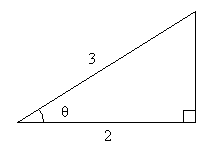
Background
Topic: Right Triangle Trigonometry
This question tests your understanding of how to find the six basic trigonometric ratios (sine, cosine, tangent, cosecant, secant, and cotangent) for a given angle in a right triangle.
Key Terms and Formulas
Opposite side: The side opposite the angle .
Adjacent side: The side next to the angle (but not the hypotenuse).
Hypotenuse: The longest side of the right triangle (opposite the right angle).
The six trigonometric ratios are:
Step-by-Step Guidance
Identify the sides of the triangle relative to . In the diagram, the side labeled 2 is adjacent to $\theta$, the hypotenuse is 3, and the opposite side is currently unknown.
Use the Pythagorean Theorem to find the length of the missing side (opposite to ):
Let be the unknown side, , and .
Substitute the known values and solve for the missing side:
Once you have the length of the opposite side, write the six trigonometric ratios using the definitions above.
Try solving on your own before revealing the answer!
Final Answer:
The missing side is , so the six trigonometric ratios are:
These ratios are found by substituting the side lengths into the definitions for each trigonometric function.
