 Back
BackFunctions and Their Graphs: Foundations and Operations
Study Guide - Smart Notes
 Tailored notes based on your materials, expanded with key definitions, examples, and context.
Functions and Their Graphs
Definition and Identification of Functions
A function is a correspondence between two sets of elements such that to each element in the first set (the domain) there corresponds one and only one element in the second set (the range). In other words, a function assigns exactly one output to each input.


Domain: The set of all possible input values (first components of ordered pairs).
Range: The set of all possible output values (second components of ordered pairs).
To determine if a relation is a function, check that no input value (domain element) is paired with more than one output value (range element).
Examples of Relations and Functions
Tables and diagrams can be used to represent relations. If each input is associated with only one output, the relation is a function.
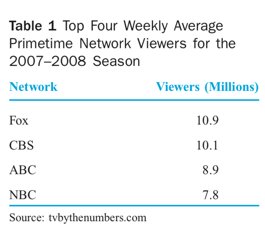
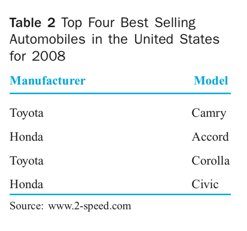
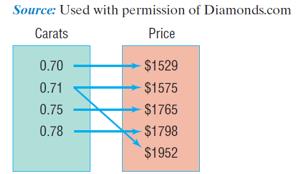
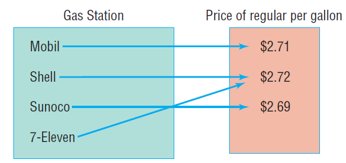
For example, the mapping of carat weights to diamond prices is a function if each carat weight corresponds to exactly one price.
Ordered Pairs and Functions
A function can also be defined as a set of ordered pairs with the property that no two ordered pairs have the same first component and different second components.
Visual Representations
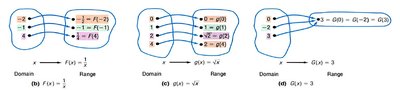
Mappings visually show how each element of the domain is paired with an element of the range. If any domain element points to more than one range element, the relation is not a function.
Defining Functions by Equations
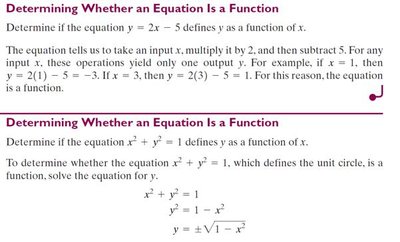
Functions are often defined by equations. To determine if an equation defines y as a function of x, check if each x-value yields only one y-value.
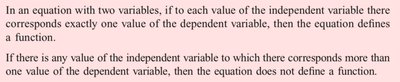
If for every x there is only one corresponding y, the equation defines y as a function of x.
If any x yields more than one y, the equation does not define a function.
Evaluating Functions and the Difference Quotient
To evaluate a function, substitute the input value into the function's formula. The difference quotient is a key concept for understanding rates of change and is defined as:
For a function f(x):
, where
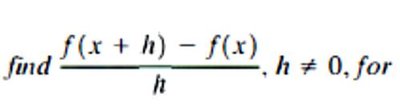
This expression is foundational for calculus and measures the average rate of change of the function over an interval of length h.
Domain of Functions
The domain of a function is the set of all input values for which the function is defined. Determining the domain involves considering restrictions such as:
Denominators cannot be zero (for rational functions).
Even roots (e.g., square roots) require non-negative radicands.
Logarithms require positive arguments.
Type of Function | Rule | Example | Domain |
|---|---|---|---|
Polynomial | All real numbers | ||
Absolute Value | All real numbers | ||
Radical (even index) | Radicand | ||
Radical (odd index) | All real numbers | ||
Rational | Denominator |
Operations with Functions
Functions can be combined using addition, subtraction, multiplication, and division. The resulting functions are defined as follows:
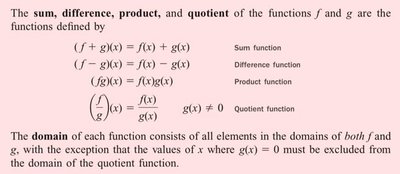
Sum:
Difference:
Product:
Quotient:
The domain of each combined function is the intersection of the domains of the original functions, except for the quotient, where the denominator cannot be zero.
Applications of Functions
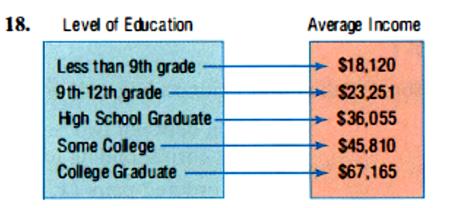
Functions are used to model real-world relationships, such as the cost of electricity based on usage, or the relationship between education level and average income.
For example, the monthly electric charge c as a function of electricity consumed x (in kilowatt-hours) can be modeled as:
If a household uses 712 kilowatt-hours, the charge is:
Dirhams
Summary Table: Key Properties of Functions
Concept | Definition | Example |
|---|---|---|
Function | Each input has one output | |
Domain | All allowed input values | for |
Range | All possible output values | for |
Difference Quotient | Used to find average rate of change | |
Sum/Product | Combine two functions |
Additional info: The difference quotient is foundational for calculus, as it leads to the definition of the derivative. Understanding domains is crucial for correctly applying functions in mathematical modeling and problem-solving.
