 Back
BackGeometry Essentials for Precalculus: Circles, Triangles, and Solids
Study Guide - Smart Notes
 Tailored notes based on your materials, expanded with key definitions, examples, and context.
Fundamental Concepts of Algebra
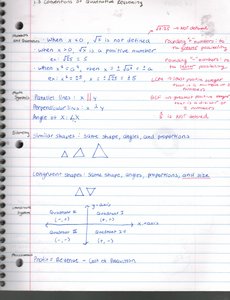
Square Roots and Properties
Understanding square roots is essential for solving equations and working with geometric formulas. The square root of a negative number is not defined in the set of real numbers.
Square Root Definition: For a positive number x, is the positive number whose square is x.
Examples: , ,
Properties:
Not Defined: is not defined for real numbers.
Geometry: Lines and Angles
Parallel and Perpendicular Lines
Lines are fundamental objects in geometry. Parallel lines never intersect, while perpendicular lines intersect at a right angle.
Parallel Lines: Notation:
Perpendicular Lines: Notation:
Angle: denotes the angle at point X.
Similar and Congruent Shapes
Shapes can be classified as similar or congruent based on their properties.
Similar Shapes: Same shape, angles, and proportions.
Congruent Shapes: Same shape, angles, proportions, and size.
Transformations
Transformations move or change shapes in the plane. Common transformations include translation, rotation, and reflection.
Translation: Moves a shape without rotating or flipping it.
Rotation: Turns a shape around a fixed point.
Reflection: Flips a shape over a line (axis).
Circles
Area and Circumference
The area and circumference of a circle are fundamental geometric properties.
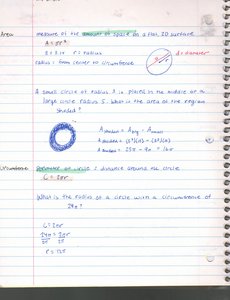
Area: where r is the radius.
Diameter:
Circumference:
Annulus (Ring-Shaped Region)
An annulus is the region between two concentric circles.
Area of Annulus: where R is the outer radius and r is the inner radius.
Sectors and Arcs
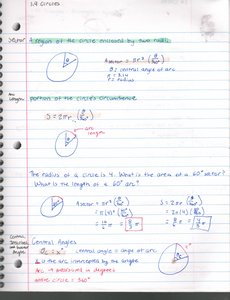
A sector is a region of a circle bounded by two radii and the arc between them. The arc is a portion of the circle's circumference.
Area of Sector: where is the central angle in degrees.
Length of Arc:
Central and Inscribed Angles
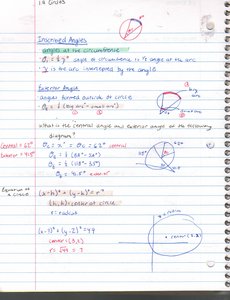
Central angles are formed at the center of the circle, while inscribed angles are formed on the circumference.
Central Angle: The angle at the center; its measure equals the arc it intercepts.
Inscribed Angle: The angle at the circumference; its measure is half the intercepted arc.
Triangles
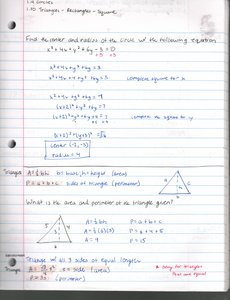
Area and Perimeter of Triangles
The area and perimeter of triangles are calculated using their base and height or side lengths.
Area: where b is the base and h is the height.
Perimeter: where a, b, and c are the side lengths.
Equilateral Triangles
Equilateral triangles have all sides of equal length and all angles equal to 60°.
Area: where s is the side length.
Perimeter:
Rectangles and Squares
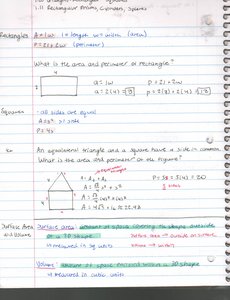
Area and Perimeter of Rectangles
Rectangles have opposite sides equal and four right angles.
Area: where l is length and w is width.
Perimeter:
Area and Perimeter of Squares
Squares have all sides equal and four right angles.
Area:
Perimeter:
Solids: Prisms, Cylinders, and Spheres
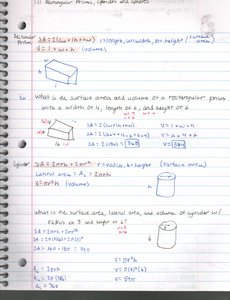
Rectangular Prisms
Rectangular prisms are three-dimensional solids with six rectangular faces.
Surface Area:
Volume:
Cylinders
Cylinders are solids with two parallel circular bases connected by a curved surface.
Surface Area:
Lateral Area:
Volume:
Spheres
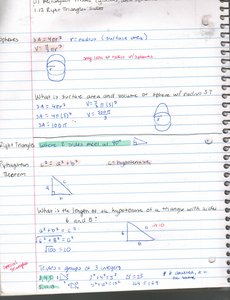
Spheres are perfectly round three-dimensional objects.
Surface Area:
Volume:
Right Triangles and the Pythagorean Theorem
Pythagorean Theorem
The Pythagorean Theorem relates the sides of a right triangle.
Theorem: where c is the hypotenuse.
Application: Used to find the length of a side when the other two are known.
Surface Area and Volume
Definitions
Surface area is the total area covering the surface of a 3D shape, while volume is the space contained within it.
Surface Area: Measured in square units.
Volume: Measured in cubic units.
Summary Table: Area and Volume Formulas
Shape | Area Formula | Perimeter/Surface Area | Volume Formula |
|---|---|---|---|
Circle | — | ||
Rectangle | — | ||
Square | — | ||
Triangle | — | ||
Rectangular Prism | — | ||
Cylinder | — | ||
Sphere | — |
