Back
BackGraph Equations and Equivalent Equations in Precalculus
Study Guide - Smart Notes
 Tailored notes based on your materials, expanded with key definitions, examples, and context.
Graph Equations and Equivalent Equations
Graph Equations Using a Graphing Utility
Graphing equations is a fundamental skill in precalculus, allowing students to visualize mathematical relationships. A graphing utility can be used to plot equations and analyze their properties, such as intercepts, symmetry, and shape. Understanding how to manipulate equations to obtain equivalent forms is essential for effective graphing and problem-solving.
Graphing Utility: A tool (such as a calculator or software) used to plot equations and visualize their graphs.
Equivalent Equations: Equations that have the same solution set, often obtained by algebraic manipulation.
Purpose: Rewriting equations in different forms can make graphing easier and reveal important features.
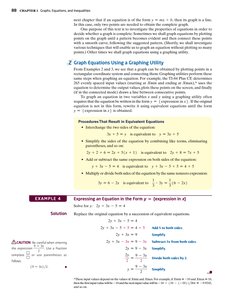
Procedures That Result in Equivalent Equations
To obtain equivalent equations, certain algebraic operations can be performed without changing the solution set. These procedures are useful for simplifying equations and preparing them for graphing.
Substitution: Replace the variable with an equivalent expression.
Add/Subtract: Add or subtract the same value from both sides of the equation.
Multiply/Divide: Multiply or divide both sides by the same nonzero value.
Example: If , subtract 3 from both sides to get , then divide by 2 to get .
Procedure | Result |
|---|---|
Substitute with | New equation in terms of |
Add/Subtract same value | Equation remains equivalent |
Multiply/Divide by nonzero value | Equation remains equivalent |
Expressing an Equation in the Form
Many equations can be rewritten in the form , which is useful for graphing and analysis. This process involves isolating on one side of the equation.
Step 1: Identify the variable to isolate (usually ).
Step 2: Use algebraic operations to solve for .
Step 3: Express the equation as .
Example: Given , solve for :
Add to both sides:
Divide both sides by 2:
Application: Rewriting equations in this form makes it easier to use graphing utilities and analyze the function's behavior.