 Back
BackGraphing Techniques and Transformations of Functions
Study Guide - Smart Notes
 Tailored notes based on your materials, expanded with key definitions, examples, and context.
Functions and Their Graphs
Graphing Techniques: Transformations
This section explores how the graphs of functions can be manipulated using shifts, reflections, and combinations of these transformations. Understanding these techniques is essential for analyzing and sketching the behavior of functions in precalculus.
Vertical and Horizontal Shifts
Shifting a graph means moving it up, down, left, or right without changing its shape. These transformations are fundamental for understanding how function graphs respond to changes in their equations.
Vertical Shift: Adding or subtracting a constant to the output of a function moves the graph up or down.
Horizontal Shift: Adding or subtracting a constant inside the function argument moves the graph left or right.
Key Properties:
If , the graph shifts up units if .
If , the graph shifts down units if .
If , the graph shifts right units if .
If , the graph shifts left units if .



Examples of Shifts
Example 1a: to is a vertical shift up by 3 units.
Example 1b: to is a horizontal shift right by 2 units.
Example 2a: to is a horizontal shift right by 2 units.
Example 2b: to is a horizontal shift left by 2 units.
Reflections
Reflections flip the graph of a function over a specific axis, changing the orientation of the graph.
Reflection about the x-axis: reflects the graph over the x-axis.
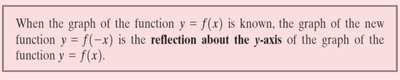
Reflection about the y-axis: reflects the graph over the y-axis.

Summary Table: Transformations
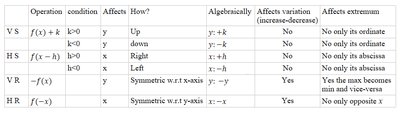
The following table summarizes the main types of transformations, their algebraic forms, and their effects on the graph:
Operation | Condition | Affects | How? | Algebraically | Affects variation (increase/decrease) | Affects extremum |
|---|---|---|---|---|---|---|
VS | , | y | Up | No | No, only its ordinate | |
VS | , | y | Down | No | No, only its ordinate | |
HS | , | x | Right | No | No, only its abscissa | |
HS | , | x | Left | No | No, only its abscissa | |
VR | y | Symmetric w.r.t x-axis | Yes | Yes, the max becomes min and vice-versa | ||
HR | x | Symmetric w.r.t y-axis | Yes | No, only opposite x |
Multiple Transformations
When more than one transformation is applied, the order of operations matters. Apply transformations step by step, starting with those inside the function argument (horizontal shifts and reflections), followed by those outside (vertical shifts and reflections).
Example: To graph , apply the following steps:
Reflect about the y-axis to get .
Shift right by 1 unit: .
Reflect about the x-axis: .
Shift up by 1 unit: .
Domain and Range under Transformations
Transformations affect the domain and range of a function as follows:
Vertical shifts: Add or subtract the shift value to the range.
Horizontal shifts: Add or subtract the shift value to the domain.
Reflections: Reflect the domain or range accordingly.
Effect on Points and Intercepts
Given a point on the graph of :
On , the corresponding point is .
On , the corresponding point is .
On , the corresponding point is .
On , the corresponding point is .
Practice and Application
Use transformations to sketch new graphs from basic parent functions.
Analyze how intercepts, extrema, and intervals of increase/decrease change under transformations.
Example Graphs

Sample Questions
What are the x-intercepts of the graph of ?
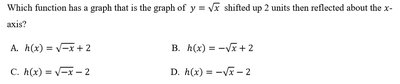
Which function has a graph that is shifted up 2 units then reflected about the x-axis?
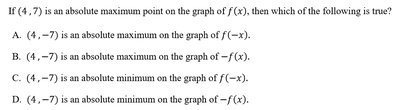
If is an absolute maximum on , what is its status on or ?

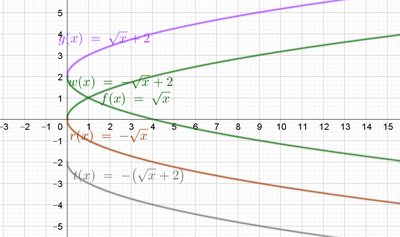
Additional info: For more complex transformations, always apply horizontal changes (shifts and reflections) before vertical ones, unless otherwise specified. This ensures the correct order of operations and accurate graphing.
