 Back
BackGraphs of the Sine and Cosine Functions
Study Guide - Smart Notes
 Tailored notes based on your materials, expanded with key definitions, examples, and context.
Trigonometric Functions
Introduction to Trigonometric Functions
Trigonometric functions are fundamental in precalculus and describe periodic phenomena. The six basic trigonometric functions are sine, cosine, tangent, cosecant, secant, and cotangent. In this section, we focus on the properties and graphs of the sine and cosine functions, which are essential for understanding more advanced topics in mathematics and its applications.
Graphs of the Sine and Cosine Functions
Objectives
Graph the sine function y = \sin x and functions of the form y = A \sin(\omega x)
Graph the cosine function y = \cos x and functions of the form y = A \cos(\omega x)
Determine the amplitude and period of sinusoidal functions
Graph sinusoidal functions using key points
Find an equation for a sinusoidal graph
Properties of the Sine Function
Domain: All real numbers,
Range:
Odd Function: Symmetric with respect to the origin, i.e.,
Periodicity: Period is
x-intercepts:
y-intercept: $0$
Maximum value: $1$
Minimum value:
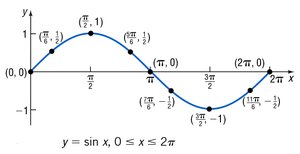
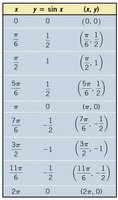
Graphing Sine Functions with Transformations
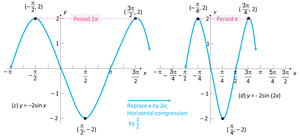
Functions of the form can be graphed using transformations:
Vertical Stretch/Compression: stretches or compresses the graph vertically.
Reflection: If , the graph is reflected about the x-axis.
Period Change: The period is .
Example: Graph . The domain is and the range is .
Example: Graph . The domain is and the range is . The period is .
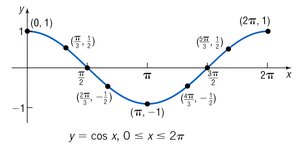
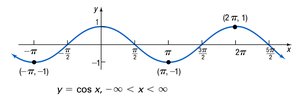
Properties of the Cosine Function
Domain: All real numbers,
Range:
Even Function: Symmetric with respect to the y-axis, i.e.,
Periodicity: Period is
x-intercepts:
y-intercept: $1$
Maximum value: $1x = ..., -2\pi, 0, 2\pi, ...$
Minimum value: at
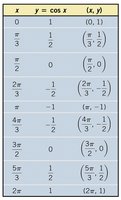
Graphing Cosine Functions with Transformations
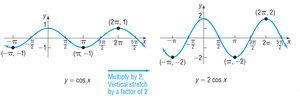
Functions of the form can be graphed using similar transformations as sine functions:
Vertical Stretch/Compression: stretches or compresses the graph vertically.
Reflection: If , the graph is reflected about the x-axis.
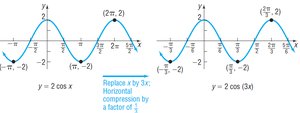
Period Change: The period is .
Example: Graph . The domain is and the range is . The period is .
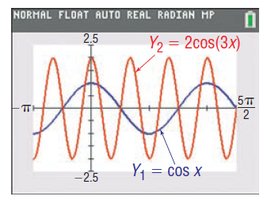
Amplitude and Period of Sinusoidal Functions
For functions of the form or :
Amplitude:
Period:
Theorem: If , the amplitude and period are given by:
Amplitude:
Period:
Example: For , amplitude is $5\frac{2\pi}{3}$.
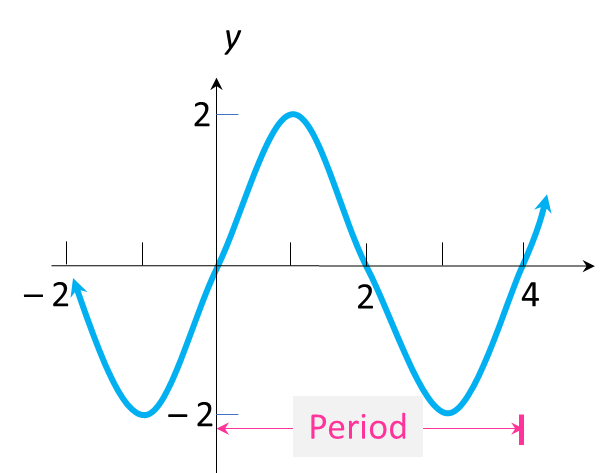
Graphing Sinusoidal Functions Using Key Points
To graph or using key points:
Determine amplitude and period.
Divide one period into four equal subintervals.
Calculate the function value at the five key points (endpoints and midpoints).
Plot these points and sketch the curve.
Example: Graph using key points. Amplitude is $2\pi$.
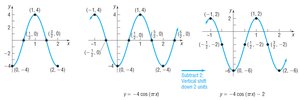
Example: Graph using key points. Amplitude is $4, and the graph is shifted down by $2$ units.
Finding an Equation for a Sinusoidal Graph
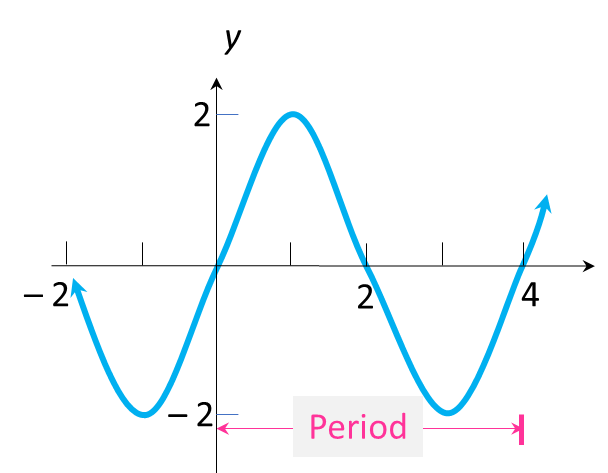
Given a sinusoidal graph, you can determine its equation by identifying the amplitude, period, and any phase or vertical shifts. The general form is:
or
Where is amplitude, determines period, is phase shift, and is vertical shift.
Example: If the maximum value is $2x = 1, then , , so , and the equation is (with possible phase shift depending on the graph's starting point).
Additional info: Sinusoidal functions are widely used to model periodic phenomena such as sound waves, light waves, and seasonal temperature variations. Mastery of their properties and transformations is essential for further study in mathematics, physics, and engineering.
