 Back
BackIntroduction to Trigonometry: Angles, Measurement, and Right-Triangle Relationships
Study Guide - Smart Notes
 Tailored notes based on your materials, expanded with key definitions, examples, and context.
Introduction to Trigonometry
What is Trigonometry and Why Does It Matter?
Trigonometry is the branch of mathematics that studies the relationships between the angles and sides of triangles. It is foundational for understanding periodic phenomena, navigation, engineering, and many aspects of science and technology.
Applications: Trigonometry is used in GPS navigation, music (sound waves), engineering (roller coasters), astronomy, and video game graphics.
Key Concept: Trigonometry connects angles to ratios and functions, allowing us to predict unknown side lengths or angles in triangles.

Review of Right Triangle Geometry
Key Vocabulary and The Pythagorean Theorem
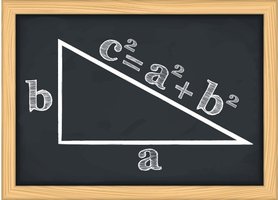
Understanding right triangles is essential for trigonometry. The right angle is always 90°, and the hypotenuse is the side opposite the right angle. The other two sides are called the opposite and adjacent sides, relative to a given angle.
Pythagorean Theorem: For a right triangle with legs a and b, and hypotenuse c:
Example: If one leg is 5 and the hypotenuse is 13, the other leg is found as follows:
Measuring Angles: Degrees and Radians
Degrees
Degrees measure the amount of rotation between two rays meeting at a vertex. A full circle is .
Angle Type | Degree Measurement | Description |
|---|---|---|
Acute | 0° < θ < 90° | Sharp, narrow opening |
Right | 90° | Perfect L-shape |
Obtuse | 90° < θ < 180° | Wide opening |
Straight | 180° | Flat line |
Reflex | 180° < θ < 360° | Opens past a straight line |
Full Turn | 360° | Complete loop |
Historical Note: The 360-degree system originated with Babylonian astronomers and was later adopted by the Greeks.
Radians
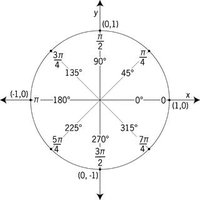
Radians are a natural, unitless way to measure angles based on the radius and arc length of a circle.
Definition: One radian is the angle created when the arc length equals the radius.
Key Conversion: radians =
Degrees | Radians |
|---|---|
$0$ | |
Converting Between Degrees and Radians
Conversion Formulas and Examples
Degrees to Radians:
Example:
Radians to Degrees:
Example:
Drawing Angles in Standard Position
Standard Position and Quadrants
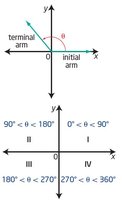
An angle is in standard position if its initial side lies along the positive x-axis and it is measured by rotating counterclockwise for positive angles. The coordinate plane is divided into four quadrants:
Quadrant I:
Quadrant II:
Quadrant III:
Quadrant IV:
Right Triangle Trigonometric Functions
SOH-CAH-TOA and Basic Ratios
Trigonometric functions relate the angles of a right triangle to the ratios of its sides:
Example: For a triangle with opposite = 3, adjacent = 4, hypotenuse = 5:
Finding Remaining Trigonometric Functions
Using One Known Ratio
If one trigonometric ratio is known, the others can be found using the Pythagorean Theorem and reciprocal identities.
Given , draw the triangle: opposite = 3, hypotenuse = 5, adjacent = 4.
Then:
Exact Values of Trigonometric Functions for Special Angles
Special Angles and Their Values
Certain angles have exact trigonometric values that are important to memorize:
Note: Calculators are not used for these; exact values are required.
Practice Problems (Exit Ticket)
Convert to radians.
Convert to degrees.
Draw in standard position.
Given , find .
Find the exact value: .
