 Back
BackInverse Circular (Trigonometric) Functions: Definitions, Properties, and Applications
Study Guide - Smart Notes
 Tailored notes based on your materials, expanded with key definitions, examples, and context.
Inverse Functions and Their Properties
Definition and Graphical Interpretation
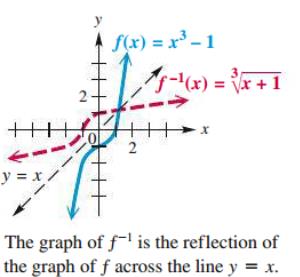
Inverse functions are fundamental in mathematics, allowing us to reverse the effect of a function. For a function f to have an inverse, it must be one-to-one, meaning each output corresponds to exactly one input. The graph of an inverse function f-1 is the reflection of the graph of f across the line y = x.
One-to-one function: Each x-value maps to a unique y-value, and vice versa.
Inverse function: If f is one-to-one, then f-1 exists such that f(f-1(x)) = x and f-1(f(x)) = x.
Domain and range: The domain of f becomes the range of f-1 and vice versa.
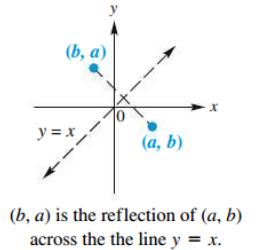
Graphical reflection: The point (a, b) on f corresponds to (b, a) on f-1.
Steps to find an inverse function:
Replace f(x) with y and interchange x and y.
Solve for y.
Replace y with f-1(x).
Restricting Domains to Obtain Inverses
Horizontal Line Test and Domain Restriction
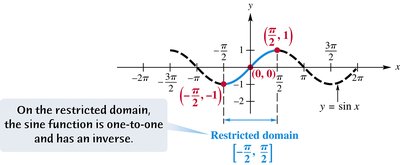
Not all functions are one-to-one over their entire domains. The horizontal line test determines if a function has an inverse: if any horizontal line crosses the graph more than once, the function is not one-to-one. By restricting the domain, we can often obtain a one-to-one function and thus define an inverse.
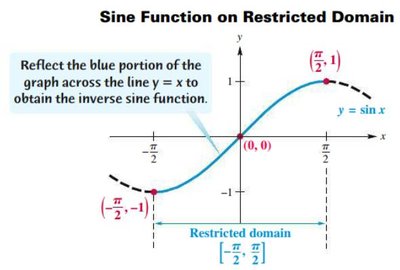
Example: The sine function y = \sin x is not one-to-one on (-\infty, \infty), but restricting the domain to \left[ -\frac{\pi}{2}, \frac{\pi}{2} \right] makes it one-to-one.
Inverse Sine Function (arcsin)
Definition, Domain, and Range
The inverse sine function is denoted as y = \sin^{-1} x or y = \arcsin x. It returns the angle y in the interval \left[ -\frac{\pi}{2}, \frac{\pi}{2} \right] whose sine is x.
Domain: [-1, 1]
Range: \left[ -\frac{\pi}{2}, \frac{\pi}{2} \right]
Odd function: \sin^{-1}(-x) = -\sin^{-1}(x)
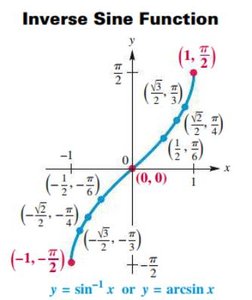
Examples:
\( y = \arcsin \frac{1}{2} = \frac{\pi}{6} \)
\( y = \sin^{-1}(-1) = -\frac{\pi}{2} \)
\( y = \sin^{-1}(-2) \) is undefined (since -2 is outside the domain).
Inverse Cosine Function (arccos)
Definition, Domain, and Range
The inverse cosine function is denoted as y = \cos^{-1} x or y = \arccos x. It returns the angle y in the interval [0, \pi] whose cosine is x.
Domain: [-1, 1]
Range: [0, \pi]
Not symmetric with respect to the origin or y-axis.
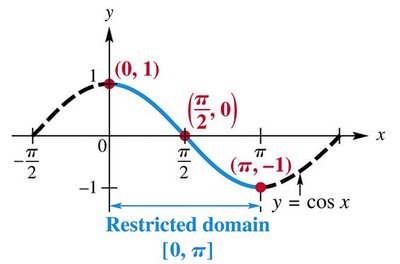
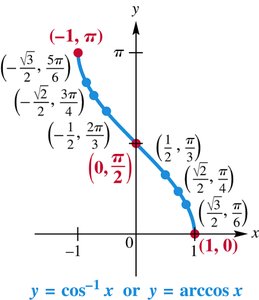
Examples:
\( y = \arccos 1 = 0 \)
\( y = \cos^{-1} \left(-\frac{\sqrt{2}}{2}\right) = \frac{3\pi}{4} \)
Inverse Tangent Function (arctan)
Definition, Domain, and Range
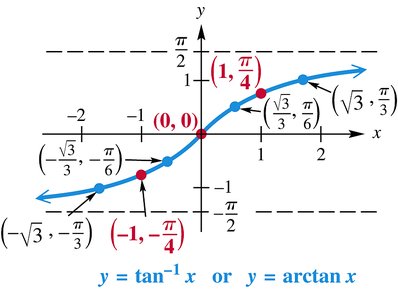
The inverse tangent function is denoted as y = \tan^{-1} x or y = \arctan x. It returns the angle y in the interval \left( -\frac{\pi}{2}, \frac{\pi}{2} \right) whose tangent is x.
Domain: (-\infty, \infty)
Range: \left( -\frac{\pi}{2}, \frac{\pi}{2} \right)
Odd function: \tan^{-1}(-x) = -\tan^{-1}(x)
Horizontal asymptotes: y = \frac{\pi}{2}, y = -\frac{\pi}{2}
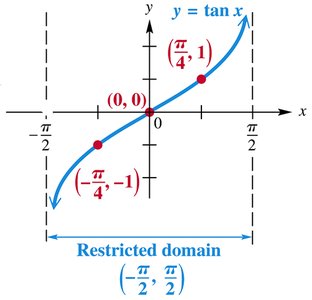
Examples:
\( y = \arctan 1 = \frac{\pi}{4} \)
\( y = \tan^{-1}(-1) = -\frac{\pi}{4} \)
Inverse Cotangent, Secant, and Cosecant Functions
Definitions, Domains, and Ranges
Inverse Cotangent: y = \cot^{-1} x or y = \text{arccot} x
Domain: (-\infty, \infty)
Range: (0, \pi)
Horizontal asymptotes: y = 0, y = \pi
Inverse Cosecant: y = \csc^{-1} x or y = \text{arccsc} x
Domain: (-\infty, -1] \cup [1, \infty)
Range: \left[ -\frac{\pi}{2}, 0 \right) \cup \left( 0, \frac{\pi}{2} \right]
Odd function: \csc^{-1}(-x) = -\csc^{-1}(x)
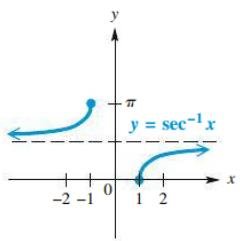
Inverse Secant: y = \sec^{-1} x or y = \text{arcsec} x
Domain: (-\infty, -1] \cup [1, \infty)
Range: [0, \frac{\pi}{2}) \cup (\frac{\pi}{2}, \pi]
Horizontal asymptote: y = \frac{\pi}{2}
Summary Table: Inverse Trigonometric Functions
Function | Domain | Range | Quadrants |
|---|---|---|---|
y = sin-1 x | [–1, 1] | [–π/2, π/2] | I and IV |
y = cos-1 x | [–1, 1] | [0, π] | I and II |
y = tan-1 x | (–∞, ∞) | (–π/2, π/2) | I and IV |
y = cot-1 x | (–∞, ∞) | (0, π) | I and II |
y = sec-1 x | (–∞, –1] ∪ [1, ∞) | [0, π/2) ∪ (π/2, π] | I and II |
y = csc-1 x | (–∞, –1] ∪ [1, ∞) | [–π/2, 0) ∪ (0, π/2] | I and IV |
Evaluating Inverse Trigonometric Functions
Calculator Use and Exact Values
Calculator keys typically provide sin-1, cos-1, and tan-1.
Other inverses can be computed as:
cot-1 x = π/2 – tan-1 x
sec-1 x = cos-1 (1/x)
csc-1 x = sin-1 (1/x)
Always ensure x is in the correct domain for the function.
Inverse Trigonometric Values as Angles
Inverse trigonometric functions return angles in radians, but sometimes degree measures are required. For example:
\( \theta = \arctan 1 = \frac{\pi}{4} = 45^\circ \)
\( \theta = \sin^{-1}(-\frac{1}{2}) = -\frac{\pi}{6} = -30^\circ \)
\( \theta = \cos^{-1} \frac{1}{2} = \frac{\pi}{3} = 60^\circ \)
Compositions and Applications
Finding Exact Values Using Definitions
Inverse trigonometric functions can be used in composition with other trigonometric functions to find exact values. For example:
\( \sin(\tan^{-1}(\frac{3}{2})) \)
\( \tan(\cos^{-1}(-\frac{5}{13})) \)
\( \cos(\arctan 3 + \arcsin \frac{1}{3}) \)
\( \tan(2 \arcsin \frac{2}{5}) \)
These can be solved by drawing right triangles and using the definitions of the trigonometric functions.
