 Back
BackInverse Functions and One-to-One Functions: Precalculus Study Notes
Study Guide - Smart Notes
 Tailored notes based on your materials, expanded with key definitions, examples, and context.
Inverse, Exponential, and Logarithmic Functions
Inverse Functions: Introduction
Inverse functions are a fundamental concept in precalculus, allowing us to 'reverse' the effect of a function. If a function f takes an input x and produces an output y, its inverse function, denoted f-1, takes y as input and returns x.
Inverse operations undo each other (e.g., addition/subtraction, multiplication/division).
For functions f and g, if g(f(x)) = x and f(g(x)) = x for all x in the domain, then g is the inverse of f.
Not all functions have inverses; only one-to-one functions do.
One-to-One Functions
A function is one-to-one if each output value is produced by exactly one input value. This property is essential for a function to have an inverse.
Definition: A function f is one-to-one if, for all a and b in the domain, a ≠ b implies f(a) ≠ f(b).
Vertical Line Test: Determines if a graph represents a function (each vertical line crosses at most once).
Horizontal Line Test: Determines if a function is one-to-one (each horizontal line crosses at most once).
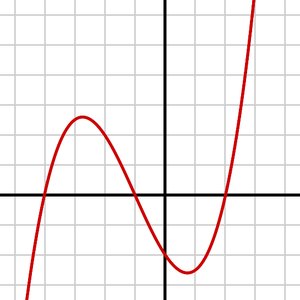
Example: The graph above fails the horizontal line test, so it is not one-to-one.
Example: The function f(x) = -4x + 12 is one-to-one because it passes the horizontal line test.
Determining Inverse Functions
To verify if two functions are inverses, compose them in both orders. If both compositions yield the identity function, they are inverses.
Example: Let f(x) = x^3 - 1 and g(x) = \sqrt[3]{x + 1}. Check if f(g(x)) = x and g(f(x)) = x.
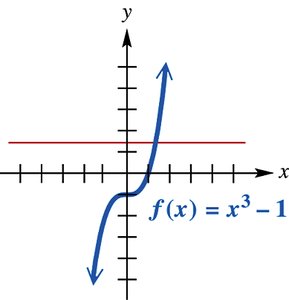
The graph above passes the horizontal line test, confirming f is one-to-one and thus has an inverse.
Notation and Properties of Inverse Functions
The inverse of f is denoted f-1 (read as "f-inverse").
The domain of f is the range of f-1, and vice versa.
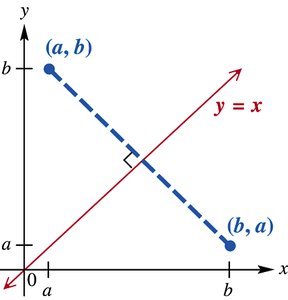
If the point (a, b) is on the graph of f, then (b, a) is on the graph of f-1.
The graphs of f and f-1 are reflections across the line y = x.
Finding the Inverse of a Function
To find the inverse of a one-to-one function defined by y = f(x):
Replace f(x) with y.
Interchange x and y.
Solve for y.
Replace y with f-1(x).
Example: For f(x) = 2x + 5:
Write y = 2x + 5
Interchange: x = 2y + 5
Solve: y = (x - 5)/2
So, f-1(x) = (x - 5)/2
Evaluating Inverse Functions Using Graphs
To find f-1(a) using the graph of f, locate the point where f(x) = a. The corresponding x value is f-1(a).
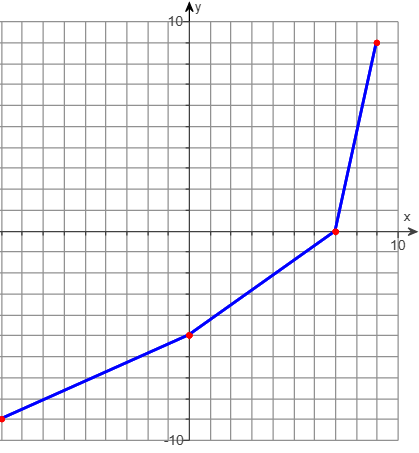
Example: Use the graph above to find f-1(-5).
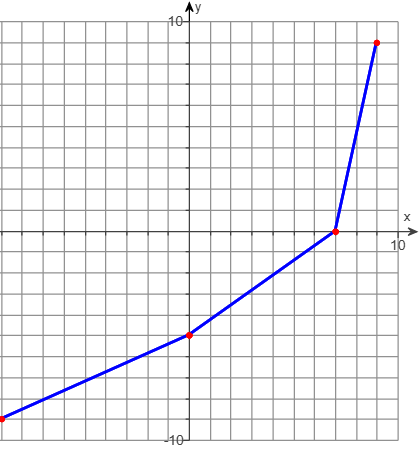
Example: Use the graph above to find f-1(0).
Graphing Inverse Functions
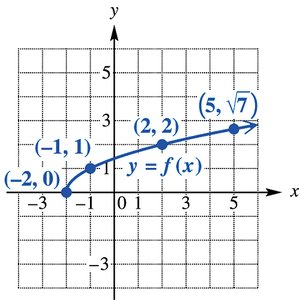
To graph the inverse of a function, reflect the graph of the original function across the line y = x. Each point (a, b) on f becomes (b, a) on f-1.
Finding Inverses with Restricted Domains and Rational Functions
Some functions are not one-to-one on their entire domain but can be made invertible by restricting the domain.
Example: For f(x) = x^2 + 2, restrict the domain to x ≥ 0 to make it one-to-one.
For rational functions, follow the same steps to find the inverse, being careful with domain restrictions.
Example: For f(x) = \frac{2x}{x-1}, solve for x in terms of y to find the inverse.
Summary Table: Properties of Inverse Functions
Property | f(x) | f-1(x) |
|---|---|---|
Domain | Domain of f | Range of f |
Range | Range of f | Domain of f |
Graph | (a, b) | (b, a) |
Reflection | Graphs are reflections across y = x | |
Key Facts
A function must be one-to-one to have an inverse.
The domain and range swap roles between a function and its inverse.
The graph of a function and its inverse are symmetric with respect to the line y = x.
