 Back
BackInverse Trigonometric Functions: Definitions, Properties, and Applications
Study Guide - Smart Notes
 Tailored notes based on your materials, expanded with key definitions, examples, and context.
Inverse Trigonometric Functions
Introduction
Inverse trigonometric functions are essential tools in precalculus for solving equations involving trigonometric expressions. Because the six basic trigonometric functions are periodic and not one-to-one over their entire domains, their inverses are defined by restricting their domains to intervals where they are one-to-one. This section covers the definitions, properties, graphs, and applications of the inverse sine, cosine, and tangent functions.
Inverse Sine Function (Arcsine)
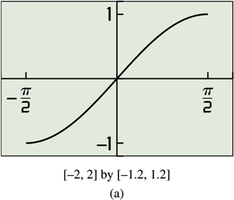
The inverse sine function, denoted as or , returns the unique angle in the interval such that . The domain of is , and its range is $\left[ -\frac{\pi}{2}, \frac{\pi}{2} \right]$.
Definition: means and .
Domain:
Range:
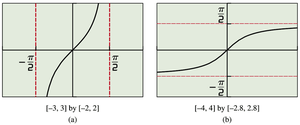
Graph: The graph of is an increasing curve from to .
Example: Evaluating Inverse Sine Without a Calculator
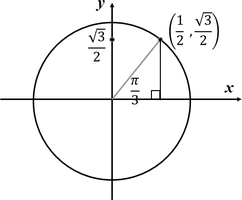
Problem: Find .
Solution: The angle in whose sine is is .
Example: Evaluating Inverse Sine With a Calculator
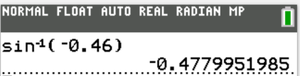
Problem: Find (in radians).
Solution: Using a calculator, radians.
Inverse Cosine Function (Arccosine)
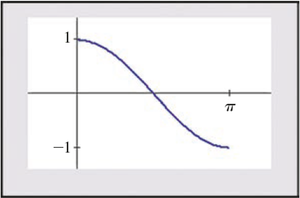
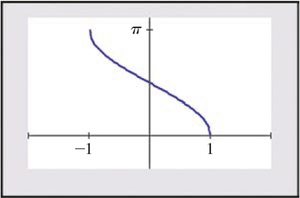
The inverse cosine function, denoted as or , returns the unique angle in the interval such that . The domain of is , and its range is $[0, \pi]$.
Definition: means and .
Domain:
Range:
Graph: The graph of is a decreasing curve from to .
Inverse Tangent Function (Arctangent)
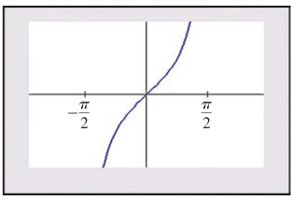
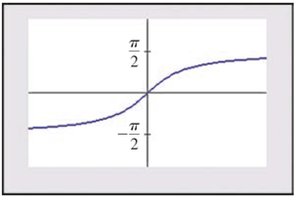
The inverse tangent function, denoted as or , returns the unique angle in the interval such that . The domain of is , and its range is $\left( -\frac{\pi}{2}, \frac{\pi}{2} \right)$.
Definition: means and .
Domain:
Range:
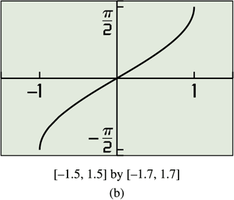
Graph: The graph of is an increasing curve with horizontal asymptotes at .
End Behavior of Inverse Tangent Function
As , .
As , .
Composing Trigonometric and Inverse Trigonometric Functions
Compositions of trigonometric and inverse trigonometric functions can simplify expressions and solve equations. The following identities are always true for all in the domain:
for
for
for
However, , , and are only true for in the restricted domains of the respective inverse functions.
Example: Composing Trig Functions with Arccosine
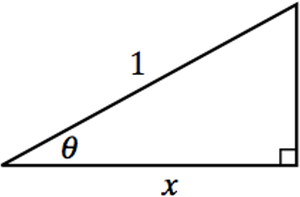
Problem: Express as an algebraic expression.
Solution: Let , so . In a right triangle with adjacent side and hypotenuse $1\sqrt{1 - x^2}\sin(\arccos(x)) = \sqrt{1 - x^2}$.
Applications of Inverse Trigonometric Functions
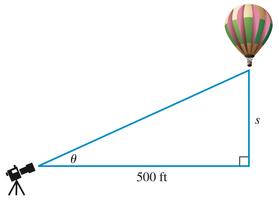
Inverse trigonometric functions are used in real-world applications such as calculating angles of elevation, navigation, and physics problems. For example, the viewing angle of a photographer observing a rising balloon can be modeled using the inverse tangent function.
Example: Calculating a Viewing Angle
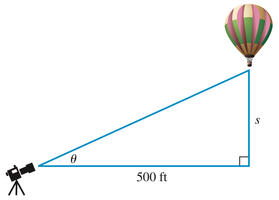
Problem: A photographer is 500 ft from a balloon rising vertically. Let be the height of the balloon. Find the viewing angle as a function of $s$.
Solution:
Observation: The change in is greater for small values of than for large values, because increases rapidly near and slowly as approaches infinity.
Summary Table: Properties of Inverse Trigonometric Functions
Function | Domain | Range | Notation |
|---|---|---|---|
Inverse Sine | or | ||
Inverse Cosine | or | ||
Inverse Tangent | or |
Additional info: The notes above expand on the textbook content by providing explicit domain and range intervals, algebraic derivations for compositions, and practical applications for inverse trigonometric functions.
