 Back
BackInverse Trigonometric Functions: Sine, Cosine, and Tangent
Study Guide - Smart Notes
 Tailored notes based on your materials, expanded with key definitions, examples, and context.
Inverse Trigonometric Functions
Introduction
Inverse trigonometric functions are essential in precalculus for solving equations involving trigonometric expressions and for understanding the relationship between angles and their trigonometric values. This section covers the definitions, properties, and applications of the inverse sine, cosine, and tangent functions.
Properties of One-To-One Functions and Their Inverses
Definition and Key Properties
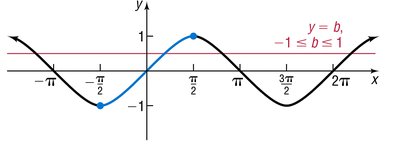
One-to-one function: A function is one-to-one if each output corresponds to exactly one input.
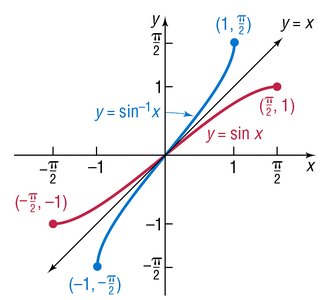
Inverse function: The inverse of a function f, denoted f-1, reverses the roles of inputs and outputs.
Key properties:
for every in the domain of .
for every in the domain of .
The domain of is the range of , and vice versa.
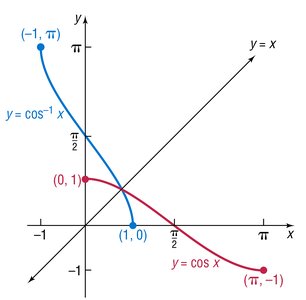
The graphs of and are symmetric with respect to the line .
Inverse Sine Function
Definition and Properties
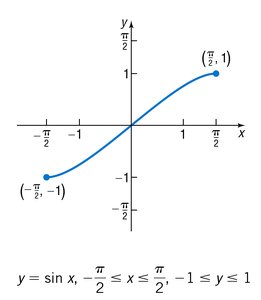
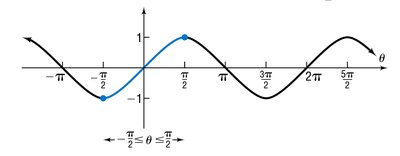
The inverse sine function, denoted as or , gives the angle whose sine is x.
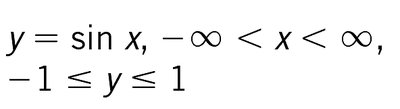
Domain:
Range:
Relationship: if and only if


Finding Values of the Inverse Sine Function
To find , determine the angle in such that .
Example:
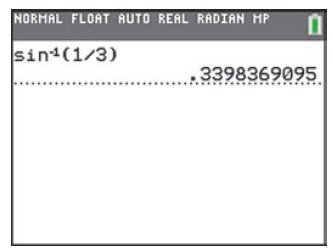
Example: radians (calculator required)
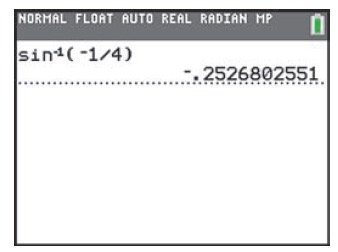
Example: radians (calculator required)

Inverse Cosine Function
Definition and Properties
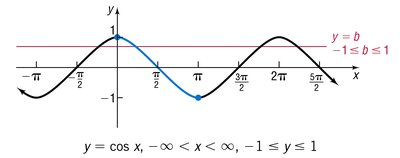
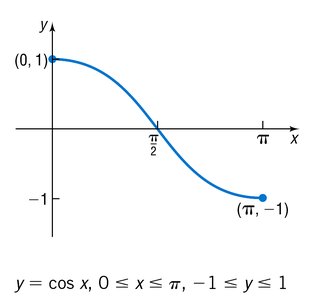
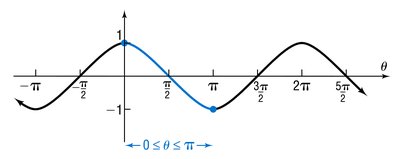
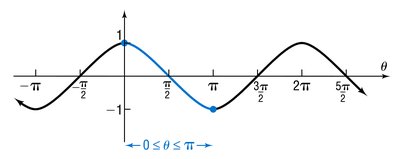
The inverse cosine function, denoted as or , gives the angle whose cosine is x.
Domain:
Range:
Relationship: if and only if

Finding Values of the Inverse Cosine Function
To find , determine the angle in such that .
Example:
Example:
Inverse Tangent Function
Definition and Properties
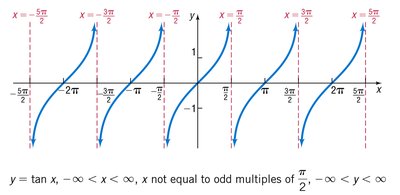
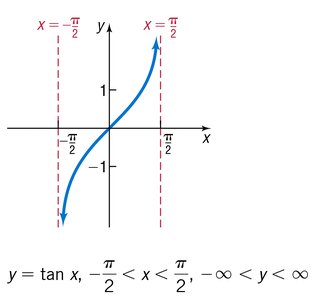
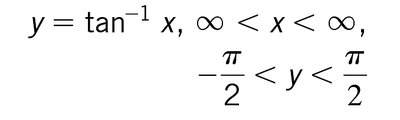
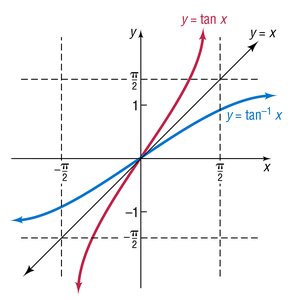
The inverse tangent function, denoted as or , gives the angle whose tangent is x.
Domain:
Range:
Relationship: if and only if

Finding Values of the Inverse Tangent Function
To find , determine the angle in such that .
Example:
Properties of Composite Functions
Composite Function Properties
Sine: where
where
Cosine: where
where
Tangent: where
where



Solving Equations Involving Inverse Trigonometric Functions
General Approach
Isolate the inverse trigonometric function.
Apply the definition and properties to solve for the variable.
Example: Solve
Tables of Values
Sine and Cosine Values for Common Angles
These tables are useful for quickly finding exact values of trigonometric functions and their inverses.
\theta | \sin \theta |
|---|---|
\frac{\pi}{2} | -1 |
\frac{3\pi}{4} | -\frac{\sqrt{2}}{2} |
\frac{\pi}{6} | -\frac{1}{2} |
0 | 0 |
\frac{\pi}{4} | \frac{\sqrt{2}}{2} |
\frac{\pi}{3} | \frac{1}{2} |
\frac{\pi}{2} | 1 |
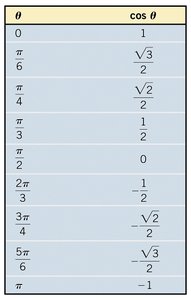
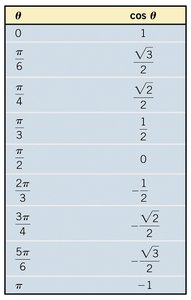
\theta | \cos \theta |
|---|---|
0 | 1 |
\frac{\pi}{6} | \frac{\sqrt{3}}{2} |
\frac{\pi}{4} | \frac{\sqrt{2}}{2} |
\frac{\pi}{3} | \frac{1}{2} |
\frac{\pi}{2} | 0 |
\frac{2\pi}{3} | -\frac{1}{2} |
\frac{3\pi}{4} | -\frac{\sqrt{2}}{2} |
\frac{5\pi}{6} | -\frac{\sqrt{3}}{2} |
\pi | -1 |
Summary
Inverse trigonometric functions are fundamental tools in precalculus, allowing students to solve equations and understand the relationship between angles and their trigonometric values. Mastery of their properties, domains, ranges, and applications is essential for further study in mathematics.
