 Back
BackLibrary of Functions and Piecewise-Defined Functions: Study Notes
Study Guide - Smart Notes
 Tailored notes based on your materials, expanded with key definitions, examples, and context.
Library of Functions
Overview
The library of functions consists of basic functions that serve as building blocks for more complex mathematical models. Understanding their properties and graphs is essential for precalculus students.
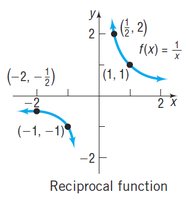
Reciprocal Function
The reciprocal function is defined as . It is important for its unique graph and properties.
Domain: All real numbers except
Range: All real numbers except
x-intercept: None
y-intercept: None
Symmetry: Symmetrical with respect to the origin (odd function)
Increasing/Decreasing: Decreasing on and
Local/Absolute Extrema: None
Example: ,
Square Function
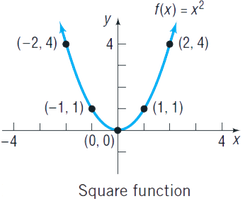
The square function is defined as . It is a fundamental quadratic function.
Domain: All real numbers
Range:
x-intercept:
y-intercept:
Symmetry: Symmetrical about the y-axis (even function)
Increasing: On
Decreasing: On
Local/Absolute Minimum: At
Local/Absolute Maximum: None
Example: ,
Cube Function
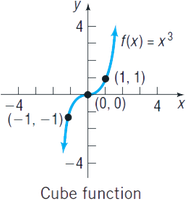
The cube function is defined as . It is another basic polynomial function.
Domain: All real numbers
Range: All real numbers
x-intercept:
y-intercept:
Symmetry: Symmetrical with respect to the origin (odd function)
Increasing: Everywhere
Decreasing: Nowhere
Local/Absolute Extrema: None
Example: ,
Constant Function
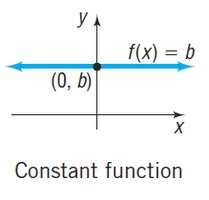
The constant function is defined as , where is a real number. Its graph is a horizontal line.
Domain: All real numbers
Range:
x-intercept: None (unless )
y-intercept:
Symmetry: Even function
Increasing/Decreasing: Neither
Local/Absolute Extrema: All points are both maximum and minimum
Example:
Identity Function
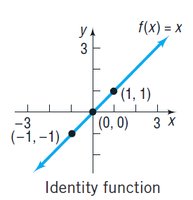
The identity function is defined as . Its graph is a straight line through the origin.
Domain: All real numbers
Range: All real numbers
x-intercept:
y-intercept:
Symmetry: Symmetrical with respect to the origin (odd function)
Increasing: Everywhere
Decreasing: Nowhere
Local/Absolute Extrema: None
Example:
Greatest Integer Function
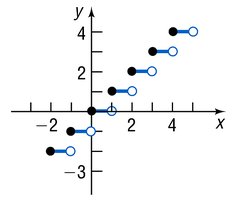
The greatest integer function (also known as the floor function) is defined as , which returns the greatest integer less than or equal to .
Domain: All real numbers
Range: All integers
Graph: Step-like appearance
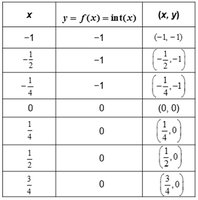
Example: ,
x | y = f(x) = int(x) | (x, y) |
|---|---|---|
-1 | -1 | (-1, -1) |
-1/2 | -1 | (-1/2, -1) |
-1/4 | -1 | (-1/4, -1) |
0 | 0 | (0, 0) |
1/4 | 0 | (1/4, 0) |
1/2 | 0 | (1/2, 0) |
3/4 | 0 | (3/4, 0) |
Piecewise-Defined Functions
Definition and Properties
A piecewise-defined function uses different formulas for different parts of its domain. These functions are useful for modeling situations where a rule changes based on input value.
Notation:
Graph: May have jumps, holes, or different shapes in different intervals
Example: Cellular Phone Plan
Consider a function for monthly cost based on minutes used:
For ,
For ,
For ,
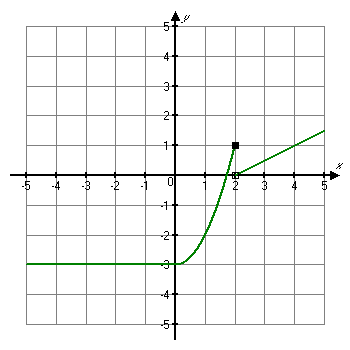
Example: Piecewise Quadratic Function
Consider defined as:
for
for
x \leq 0 | x | y |
|---|---|---|
-2 | -3 | |
-1 | -3 | |
0 | -3 |
0 < x \leq 2 | x | y |
|---|---|---|
0 | -3 | |
1 | -2 | |
2 | 1 |
Graphing Piecewise Functions
To graph a piecewise function, plot each segment according to its formula and domain. Pay attention to open and closed endpoints.
Summary Table: Library Functions
Function | Formula | Domain | Range | Symmetry |
|---|---|---|---|---|
Reciprocal | Odd | |||
Square | All real numbers | Even | ||
Cube | All real numbers | All real numbers | Odd | |
Constant | All real numbers | Even | ||
Identity | All real numbers | All real numbers | Odd | |
Greatest Integer | All real numbers | Integers | Neither |
Applications
Piecewise Functions in Real Life
Piecewise functions are used to model real-world situations such as pricing plans, tax brackets, and physical phenomena where rules change at certain thresholds.
Example: A phone plan with a flat rate up to a certain number of minutes, then a per-minute charge after that, is modeled by a piecewise function.
Key Takeaways
Mastery of library functions is foundational for precalculus.
Piecewise-defined functions require careful attention to domain and formula for each segment.
Graphing these functions involves plotting each segment and marking endpoints correctly.
