 Back
BackMAC 1114C College Trigonometry Syllabus and Course Overview
Study Guide - Smart Notes
 Tailored notes based on your materials, expanded with key definitions, examples, and context.
Course Overview
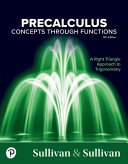
This study guide summarizes the key elements of the MAC 1114C College Trigonometry course at the University of Central Florida. The course is designed to prepare students for upper-level mathematics by covering foundational and advanced topics in trigonometry, including angle measurement, trigonometric functions, identities, equations, applications, and vectors. The course follows the textbook Precalculus: Concepts Through Functions, A Right Triangle Approach to Trigonometry by Sullivan & Sullivan.
Course Structure and Assessment
Lecture and Lab Attendance: In-person lectures and mandatory lab (MALL) sessions with quizzes and exams.
Homework: Assigned via MyLab Math, with multiple attempts and some late submission flexibility.
Exams: Three in-term exams and a comprehensive final, all proctored and closed-book.
Grading: Weighted by homework (12%), quizzes (12%), attendance (10%), exams (44%), and final exam (22%). Lowest scores are dropped in most categories.
Key Topics and Learning Objectives
Angles, Arc Length, and Circular Motion
Angle Measurement: Understanding degrees, radians, and conversions between them.
Arc Length: Calculating the length of a circle's arc using (where is in radians).
Sector Area: Finding the area of a sector using .
Linear Speed: Determining speed in circular motion with .
Right Triangle Trigonometry
Trigonometric Functions: Definitions for sine, cosine, tangent, and their reciprocals for acute angles.
Fundamental Identities: Pythagorean, quotient, and cofunction identities.
Complementary Angles: Using and similar relationships.
Trigonometric Functions of Any Angle
Unit Circle: Defining trigonometric functions for all angles using the unit circle.
Reference Angles: Finding exact values using reference angles and quadrant signs.
Coterminal Angles: Angles differing by multiples of or radians.
Graphs of Trigonometric Functions
Sine and Cosine: Graphing and , identifying amplitude and period.
Other Functions: Graphing tangent, cotangent, secant, and cosecant functions, including transformations.
Phase Shift: Understanding horizontal shifts in sinusoidal graphs.
Inverse Trigonometric Functions
Definitions: Inverse sine, cosine, tangent, and their domains/ranges.
Solving Equations: Using inverse functions to solve trigonometric equations.
Trigonometric Identities and Equations
Establishing Identities: Proving and applying sum, difference, double-angle, and half-angle formulas.
Solving Equations: Techniques for equations involving one or more trigonometric functions.
Applications of Trigonometry
Right Triangles: Solving triangles and applied problems using trigonometric ratios.
Law of Sines and Cosines: Solving non-right triangles (SAA, ASA, SSA, SAS, SSS cases).
Simple Harmonic Motion: Modeling periodic motion with trigonometric functions.
Polar Coordinates and Vectors
Polar Coordinates: Plotting points, converting between polar and rectangular forms.
Polar Equations: Graphing and analyzing equations in polar form.
Vectors: Graphing, adding, subtracting, and finding magnitudes and directions of vectors.
Course Policies and Resources
Calculator Policy: Only the TI-30XA is permitted on exams.
Academic Integrity: Strict adherence to UCF’s honesty policies; violations result in severe penalties.
Accessibility: Accommodations available through Student Accessibility Services (SAS).
Tutoring: Free in-person tutoring at the UCF Math Success Center.
Exam Schedule and Grading Table
Exam | Date | Sections Covered |
|---|---|---|
Exam 1 | 7/2/26 | 5.1 to 5.3 |
Exam 2 | 7/9/26 | 5.6 to 5.8 |
Exam 3 | 7/23/26 | 6.1 to 6.5 |
Final Exam | 7/30/26 | Comprehensive (5.1–8.4) |
Assignment | Weight | Drops |
|---|---|---|
Homework | 12% | Lowest 2 |
Lab/MALL Quizzes | 12% | Lowest 2 |
Lecture Attendance | 10% | Lowest 2 |
Exams 1–3 | 44% | Lowest 1 |
Final Exam | 22% | None |
Grade | Average (%) |
|---|---|
A | 90–100 |
B | 80–89 |
C | 70–79 |
NC (No Credit) | 30–69 |
F | 29 or below |
Textbook and Materials
Textbook: Precalculus: Concepts Through Functions, A Right Triangle Approach to Trigonometry (Sullivan & Sullivan, 5th Edition)
Calculator: TI-30XA (provided during exams)
Notebook: For organized notes and practice
Additional Information
Consistent participation and practice are emphasized for success.
Extra credit is not offered; course structure provides flexibility for absences and emergencies.
Students are encouraged to use AI tools only as a study aid, not for graded assignments.
