 Back
BackMathematical Models: Building and Analyzing Functions
Study Guide - Smart Notes
 Tailored notes based on your materials, expanded with key definitions, examples, and context.
Section 1.6 Mathematical Models: Building Functions
Introduction to Building and Analyzing Functions
Mathematical modeling is a crucial skill in precalculus, allowing us to translate real-world scenarios into mathematical language using functions. This process involves identifying independent and dependent variables, constructing a function to describe their relationship, and analyzing the resulting model for specific values and domains.
Building Functions from Verbal Descriptions
Translating Real-World Problems into Functions
Independent Variable: The variable that represents the input or cause (often denoted as x).
Dependent Variable: The variable that represents the output or effect (often denoted as y or another letter).
Function Rule: The equation or formula that relates the independent and dependent variables.
To build a function, assign symbols to the variables and use the information given to write an equation that models the situation.
Examples of Building and Analyzing Functions
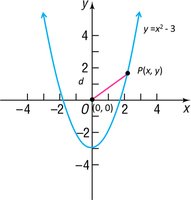
Example 1: Distance from the Origin to a Point on a Graph
Consider a point P = (x, y) on the graph of a function. We are interested in expressing the distance d from P to the origin O = (0, 0) as a function of x.
Distance Formula: The distance from P = (x, y) to the origin is given by:
If y is given as a function of x (e.g., y = x^2 - 3), substitute to express d in terms of x:
Evaluating the Function:
If x = 0:
If x = 2:
Example 2: Area of a Rectangle under a Parabola
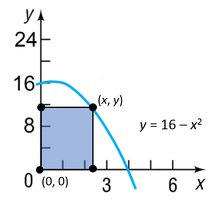
Suppose a rectangle has one corner at the origin, one on the positive x-axis, one on the positive y-axis, and one in quadrant I on the graph of y = 16 - x^2. We want to express the area A of the rectangle as a function of x and determine its domain.
Area Formula: The area of the rectangle is A = x \cdot y.
Since the upper-right corner lies on the parabola, y = 16 - x^2:
Domain of A(x):
Since the rectangle must be in quadrant I, both x > 0 and y > 0.
From y = 16 - x^2 > 0, we get x^2 < 16, so -4 < x < 4.
Combining with x > 0, the domain is 0 < x < 4.
Summary Table: Key Steps in Building Functions
Step | Description | Example |
|---|---|---|
1. Identify Variables | Assign symbols to independent and dependent variables | x = input, y = output |
2. Write the Function Rule | Express the dependent variable in terms of the independent variable | y = x^2 - 3 |
3. Substitute as Needed | Insert the function rule into other formulas | d(x) = \sqrt{x^2 + (x^2 - 3)^2} |
4. Determine Domain | Find all valid input values for the model | 0 < x < 4 |
