 Back
BackOblique Triangles, Law of Sines & Cosines, Vectors, Polar & Parametric Equations: Precalculus Study Guide
Study Guide - Smart Notes
 Tailored notes based on your materials, expanded with key definitions, examples, and context.
Solving Oblique Triangles
Triangle Properties and Classification
Oblique triangles are triangles that do not contain a right angle. To solve such triangles, at least three of the six parts (three sides and three angles) must be known, with at least one part being a side. Key properties include:
Sum of angles: The sum of the measures of the three angles is always 180°.
Side length relationships: The sum of the lengths of any two sides must be greater than the third side.
Opposite relationships: The longest side is opposite the largest angle; the shortest side is opposite the smallest angle.
Strategies for Solving Triangles
The method used to solve a triangle depends on the combination of known sides and angles:
# of Sides Known | Type | # of Triangles | Strategy |
|---|---|---|---|
0 | AAA | No Unique Triangle | Cannot solve the triangle |
1 | ASA or AAS | 1 Triangle | Find 3rd angle (sum is 180°), then use Law of Sines |
2 | SAS | 1 Triangle | Law of Cosines for missing side, Law of Sines for smaller angle |
2 | SSA | 1 or 2 Triangles | Law of Sines for 2nd angle, check for ambiguous case |
3 | SSS | 1 Triangle | Law of Cosines for largest angle, Law of Sines for smaller angle |
Law of Sines
Definition and Formula
The Law of Sines relates the sides and angles of an oblique triangle. It states that the ratio of the sine of an angle to the length of the side opposite that angle is constant for all three pairings:
Law of Sines:
Or equivalently:
When to Use the Law of Sines
Given one side and two angles (ASA or AAS).
Given two sides and a non-included angle (SSA, ambiguous case).
Ambiguous Case (SSA)
When two sides and a non-included angle are given, the number of possible triangles depends on the relationship between the sides and the height:
No triangle if
One right triangle if
One triangle if
Two triangles if

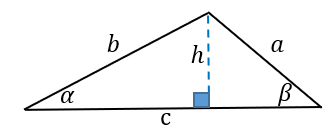
Additional info: The height is calculated as .
Area of Triangles
Area Formulas for Oblique Triangles
The area of a triangle can be calculated using the base and height, or using the Law of Sines:
General formula:
Using Law of Sines:
Application Problems: Bearings and Directions
Bearings
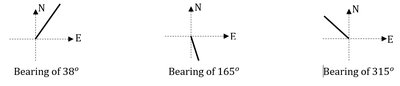
Bearings describe direction relative to due North, measured clockwise. For example, a bearing of 90° is due East.
Degrees and Direction from North or South
Directions can also be given as degrees from North or South, such as N38°E or S15°E.

Parallel Lines and Traversals
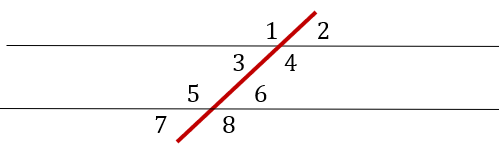
When solving application problems, knowledge of angles formed by a transversal intersecting parallel lines is useful. Key angle relationships include corresponding, alternate interior, alternate exterior, and vertical angles.
Law of Cosines
Definition and Formula
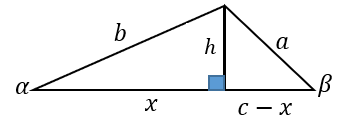
The Law of Cosines is used when three sides (SSS) or two sides and the included angle (SAS) are known. It generalizes the Pythagorean Theorem for oblique triangles:
Solving SSS and SAS Triangles
For SSS: Find the largest angle using Law of Cosines, then use Law of Sines for smaller angles.
For SAS: Find the unknown side using Law of Cosines, then use Law of Sines for remaining angles.
Heron's Area Formula
For triangles with all three sides known:
where
Length of a Chord in a Circle
The length of a chord in a circle with radius and central angle :
Vectors
Definition and Properties
Vectors are directed line segments with both magnitude and direction. Examples include velocity, force, and displacement. The magnitude is denoted .
Scalar Multiplication
Multiplying a vector by a scalar changes its magnitude and possibly its direction.
Resultant Vector
The sum of two vectors is called the resultant vector, found by the parallelogram method.
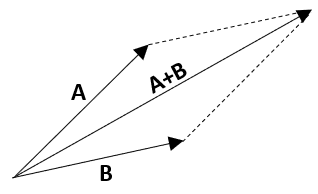
Components and Position Vector
Vectors can be broken into horizontal and vertical components. The position vector in component form is .
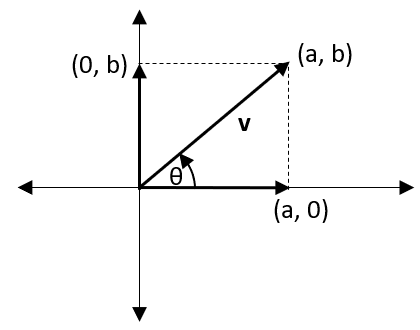
Magnitude and Direction Angle
Magnitude:
Direction angle (counterclockwise from x-axis):
Vector Operations
Scalar Product:
Vector Sum:
Vector Difference:
Dot Product:
Angle Between Two Vectors
The angle between vectors and :
If , vectors are perpendicular.
If , vectors are parallel.
Unit Vectors
Unit vectors and are used to express any vector as .
Polar Equations
Polar Coordinates
Polar coordinates describe a point by its distance from the pole (origin) and angle from the polar axis (positive x-axis).
Plot angle first, then distance .
can be positive or negative.
Multiple representations for the same point are possible.
Conversion Between Rectangular and Polar Coordinates
From rectangular to polar: ,
From polar to rectangular: ,
Parametric Equations
Definition and Graphing
Parametric equations express and as functions of a parameter . The graph is produced by plotting for values of within a specified interval.
Eliminating the Parameter
To convert parametric equations to a rectangular equation, solve for in one equation and substitute into the other.
Projectile Motion Application
For a projectile thrown at angle with initial velocity and height :
Horizontal distance:
Vertical height:
Additional info: The coefficient -16 is for feet/sec2; use -4.9 for meters/sec2.
