 Back
BackParametric and Vector-Valued Functions, Modeling Motion, and Implicit Functions in Precalculus
Study Guide - Smart Notes
 Tailored notes based on your materials, expanded with key definitions, examples, and context.
Parametric and Vector-Valued Functions
Parametric Curves and Equations
Parametric equations are a fundamental tool in precalculus for describing curves by expressing both x and y as functions of a third variable, typically t (the parameter). This approach allows for more flexible modeling of motion and geometric shapes.
Parametric Curve: The set of ordered pairs (x, y) where x = f(t) and y = g(t) for t in interval I.
Parameter: The variable t, which determines the position on the curve.
Parameter Interval: The set of t values over which the functions are defined.
Example: Graphing a Parametric Function
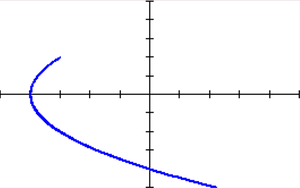
Given parametric equations, graph the curve by plotting (x(t), y(t)) for t in the interval.
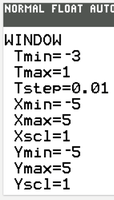
Calculator window settings are important for visualizing the curve.
Vector-Valued Functions
Vector-valued functions generalize parametric equations by representing position as a vector.
Definition: A vector-valued function is written as where x(t) and y(t) are functions of t.
Magnitude: The distance from the origin at time t is
Eliminating the Parameter
Converting Parametric Equations to Cartesian Form
Eliminating the parameter t allows us to rewrite parametric equations as a single equation in x and y, often revealing familiar geometric shapes.
Method: Solve one equation for t, substitute into the other.
Result: The resulting equation describes the curve in Cartesian coordinates.
Example: Parabola from Parametric Equations
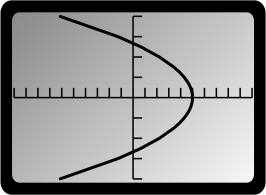
After elimination, the graph is a parabola opening to the left with vertex at (5, 0).
Example: Line from Parametric Equations
Elimination yields a linear equation with slope 2 and y-intercept.
Modeling Planar Motion with Parametric Functions
Simulating Horizontal Motion
Parametric equations are used to model the motion of objects along a path, such as a person walking along a line.
Position Function: x(t) gives the horizontal position at time t.
Direction Change: By analyzing x(t), we can estimate when the object changes direction.
Example: Julia's Walk
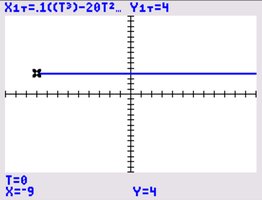
At t = 0, Julia is at x = -9.
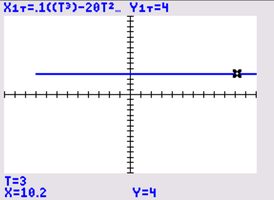
At t = 3, Julia is at x = 10.2.
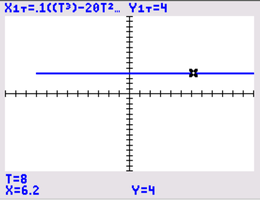
At t = 8, Julia is at x = 6.2.
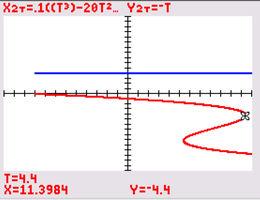
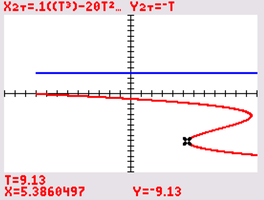
Julia changes direction at t ≈ 4.4 sec and again at t ≈ 9.13 sec.
Modeling Projectile Motion: Hitting a Baseball
Parametric equations are used to model the path of a projectile, such as a baseball.
Initial Conditions: Height, velocity, angle, and distance to fence.
Equations: where is initial velocity, is launch angle, is initial height.
Analysis: Determine if the ball clears the fence by evaluating y at the x-distance of the fence.
Example: Baseball Path and Fence
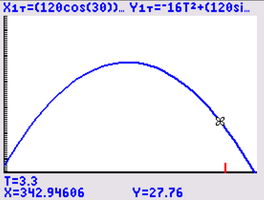
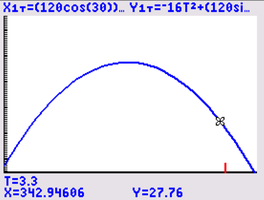
At t = 3.3 sec, x ≈ 343 ft, y ≈ 27.76 ft.
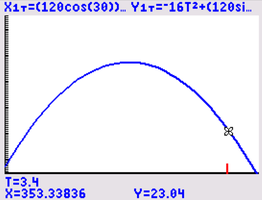
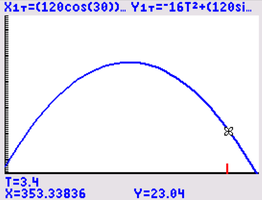
At t = 3.4 sec, x ≈ 353 ft, y ≈ 23.04 ft.
The ball does not clear the 30 ft fence at 350 ft; it will hit the wall.
Implicit and Explicit Functions
Implicitly Defined Functions
An equation in two variables may define a function implicitly, even if it is not solved for y in terms of x.
Implicit Form: Standard form of a line, .
Explicit Form: Slope-intercept form, , or point-slope form, .
Advantage: Explicit form directly defines the dependent variable and is suitable for graphing calculators.
Example: Using Implicitly Defined Functions
Given a relation, solve for y to obtain the explicit function.
Rates of Change for Parametric Curves
Average Rate of Change
For curves defined parametrically, the average rate of change can be computed for x and y independently, and for the curve as a whole.
Formula:
Interpretation: The slope between two points on the curve corresponds to the average rate of change.
Example: Parametric Rate of Change
On interval [0, 2], compute the change in y and x to find the average rate.
On interval [2, 0], y decreases by an average of 1 unit per unit change in x.
Summary Table: Parametric vs. Explicit vs. Implicit Functions
Form | Definition | Example |
|---|---|---|
Parametric | x and y defined as functions of t | x = f(t), y = g(t) |
Explicit | y defined directly in terms of x | y = mx + b |
Implicit | Relation between x and y, not solved for y | Ax + By = C |
Additional info: Academic context was added to clarify definitions, formulas, and applications, and to ensure completeness for exam preparation.
