 Back
BackPascal's Triangle and Lattice Paths: Binomial Coefficients and Combinatorics
Study Guide - Smart Notes
 Tailored notes based on your materials, expanded with key definitions, examples, and context.
Combinatorics and Pascal's Triangle
Binomial Coefficients and Pascal's Triangle
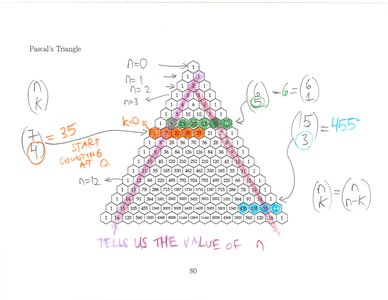
Pascal's Triangle is a triangular array of numbers that represents the coefficients in the binomial expansion and is fundamental in combinatorics. Each entry in the triangle corresponds to a binomial coefficient, which counts the number of ways to choose k objects from n objects, denoted as .
Binomial Coefficient: The number of ways to choose k objects from n objects is given by the formula:
Structure of Pascal's Triangle: Each row corresponds to a value of n, starting with n = 0 at the top. The k-th entry in the n-th row is .
Symmetry: Pascal's Triangle is symmetric; .
Recursive Property: Each entry is the sum of the two entries directly above it:
Applications: Binomial coefficients are used in probability, algebra (binomial theorem), and combinatorics (counting problems).
Example: (number of ways to choose 4 objects from 7). , , .
Lattice Paths and the Integer Lattice
Counting Lattice Paths
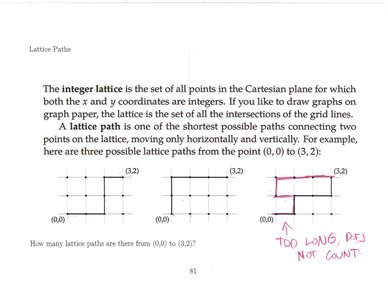
The integer lattice is the set of all points in the Cartesian plane where both coordinates are integers. A lattice path is a shortest path connecting two points on the lattice, moving only horizontally and vertically (no diagonal or backtracking moves).
Definition: A lattice path from (0,0) to (m,n) consists of m steps right and n steps up, in some order.
Counting Paths: The number of shortest lattice paths from (0,0) to (m,n) is given by the binomial coefficient: This counts the number of ways to arrange m right moves and n up moves.
Example: From (0,0) to (3,2), the number of shortest lattice paths is .
Restrictions: Only the shortest paths (with exactly m right and n up moves) are counted; longer or backtracking paths are not included.
Summary Table: Binomial Coefficient Properties
Property | Formula/Description |
|---|---|
Definition | |
Symmetry | |
Recursive Rule | |
Sum of Row | |
Lattice Paths | Number of shortest paths from (0,0) to (m,n): |
