 Back
BackPolynomial and Rational Functions: Graphs, Properties, and Zeros
Study Guide - Smart Notes
 Tailored notes based on your materials, expanded with key definitions, examples, and context.
Polynomial Functions
Definition and Degree
A polynomial function is a function of the form , where the coefficients are real numbers and is a nonnegative integer. The degree of a polynomial is the largest exponent of with a nonzero coefficient. The domain of a polynomial function is all real numbers.
Example: is a polynomial of degree 3.
Key Properties: Every polynomial is both smooth (no sharp corners) and continuous (no breaks).
Zeros and Multiplicity
A real zero of a polynomial function is a real number such that . The multiplicity of a zero is the number of times appears as a factor in the polynomial.
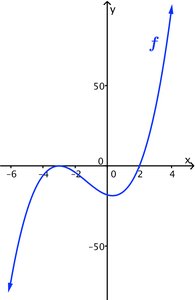
If is a zero of even multiplicity, the graph touches the x-axis at .
If is a zero of odd multiplicity, the graph crosses the x-axis at .
Equivalent statements: is an x-intercept of , is a factor of $f$, $r$ is a solution to .
Turning Points
The graph of a polynomial function of degree can have at most turning points (local maxima or minima).
If a graph has turning points, the degree is at least .
End Behavior
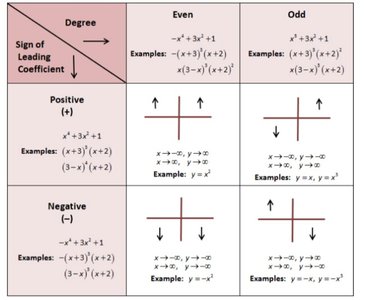
The end behavior of a polynomial function is determined by its leading term. For large values of (positive or negative), the graph resembles the graph of its leading term.
Even degree, positive leading coefficient: Both ends rise.
Even degree, negative leading coefficient: Both ends fall.
Odd degree, positive leading coefficient: Left end falls, right end rises.
Odd degree, negative leading coefficient: Left end rises, right end falls.
Graph Analysis Steps
To analyze the graph of a polynomial function:
Determine end behavior.
Find x- and y-intercepts.
Determine zeros and their multiplicity.
Find the maximum number of turning points.
Describe behavior near each x-intercept.
Draw the complete graph.
Rational Functions
Definition and Domain
A rational function is a function of the form , where and are polynomial functions and $q(x)$ is not the zero polynomial. The domain is all real numbers except those for which .
Lowest terms: is in lowest terms if and have no common factors.
Vertical, Horizontal, and Oblique Asymptotes
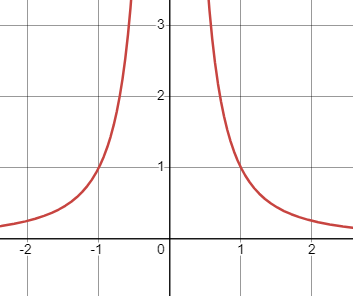
Vertical asymptotes: Occur at real zeros of the denominator (in lowest terms).
Horizontal asymptotes: If , then is a horizontal asymptote.
Oblique (slant) asymptotes: If approaches a linear expression as , then is an oblique asymptote.
Multiplicity and Vertical Asymptotes: If the multiplicity is odd, the graph approaches positive infinity on one side and negative infinity on the other. If even, the graph approaches the same infinity on both sides.
Graph Analysis Example
To analyze a rational function:
Find the domain (exclude zeros of denominator).
Find x- and y-intercepts.
Locate vertical and horizontal asymptotes.
Check if the graph intercepts the horizontal asymptote.
Sketch the graph using this information.
Asymptote Rules Table
If degree of numerator < degree of denominator: horizontal asymptote at .
If degree of numerator = degree of denominator: horizontal asymptote at .
If degree of numerator > degree of denominator: oblique asymptote (use long division).
Polynomial and Rational Inequalities
Solving Polynomial Inequalities
To solve a polynomial inequality, graph the function and determine where it is above or below the x-axis.
Example: Solve by graphing .
Solving Rational Inequalities
To solve a rational inequality, find critical points (zeros of numerator and denominator), test intervals, and determine where the inequality holds.
Example: Solve .
Synthetic Division and Theorems
Synthetic Division
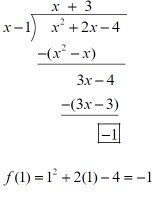
Synthetic division is a shortcut for dividing a polynomial by . It is especially useful for finding remainders and factors.
Write the coefficients of the polynomial.
Use the zero to perform the division.
The last number is the remainder.
Remainder and Factor Theorems
Remainder Theorem: If is divided by , the remainder is .
Factor Theorem: is a factor of if and only if .
Rational Zeros Theorem
If is a polynomial with integer coefficients, any rational zero must have as a factor of the constant term and as a factor of the leading coefficient.
Intermediate Value Theorem
If and are of opposite sign, then has at least one real zero between and .
Complex Zeros and Fundamental Theorem of Algebra
Complex Zeros
A complex zero is a solution to in the complex number system. If a polynomial has real coefficients and is a zero, then is also a zero (conjugate pairs).
Fundamental Theorem of Algebra
Every complex polynomial function of degree has at least one complex zero and can be factored into linear factors.
Every polynomial of degree has exactly $n$ complex zeros (counting multiplicity).
Summary Table: End Behavior of Polynomial Functions
Degree | Sign of Leading Coefficient | End Behavior | Example |
|---|---|---|---|
Even | Positive | Both ends up | |
Even | Negative | Both ends down | |
Odd | Positive | Left down, right up | |
Odd | Negative | Left up, right down |
