 Back
BackPrecalculus Concepts: Domain, Symmetry, Transformations, and Applications
Study Guide - Smart Notes
 Tailored notes based on your materials, expanded with key definitions, examples, and context.
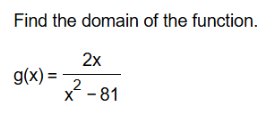
Q1. Find the domain of the function .
Background
Topic: Domain of Rational Functions
This question tests your understanding of how to find the domain of a rational function by identifying values that make the denominator zero.
Key Terms and Formulas:
Domain: The set of all real numbers for which the function is defined.
Rational Function: A function of the form , where .
Step-by-Step Guidance
Set the denominator equal to zero to find values that are not in the domain: .
Solve for to find the excluded values.
Express the domain as all real numbers except the values found in step 2.
Try solving on your own before revealing the answer!
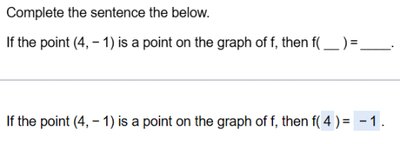
Q2. If the point (4, -1) is a point on the graph of , then ____.
Background
Topic: Function Notation and Ordered Pairs
This question checks your understanding of how points on the graph of a function relate to function notation.
Key Terms:
Function Notation: means the point is on the graph of .
Step-by-Step Guidance
Recall that the first coordinate of the point is the input ( value), and the second is the output ( value).
Match the coordinates to the function notation .
Try solving on your own before revealing the answer!
Q3. Determine whether the graph is that of a function by using the vertical-line test. If it is, use the graph to find (a) its domain and range, (b) the intercepts, if any, (c) any symmetry with respect to the x-axis, y-axis, or the origin.
Background
Topic: Graphs of Functions and Their Properties
This question tests your ability to analyze a graph for function properties, including domain, range, intercepts, and symmetry.
Key Terms:
Vertical-Line Test: A graph is a function if no vertical line intersects it more than once.
Domain: All possible -values.
Range: All possible -values.
Intercepts: Points where the graph crosses the axes.
Symmetry: Even (y-axis), odd (origin), or neither.
Step-by-Step Guidance
Apply the vertical-line test to the graph to determine if it is a function.
Identify the domain and range by observing the and values covered by the graph.
Find the - and -intercepts by locating where the graph crosses the axes.
Check for symmetry by reflecting the graph over the -axis, -axis, and origin.
Try solving on your own before revealing the answer!
Q4. Determine algebraically whether the function is even, odd, or neither.
Background
Topic: Even and Odd Functions
This question tests your ability to use algebraic methods to classify a function as even, odd, or neither.
Key Terms and Formulas:
Even Function: for all in the domain.
Odd Function: for all in the domain.
Step-by-Step Guidance
Find by substituting into the function: .
Simplify using the property .
Compare to and to determine if the function is even, odd, or neither.
Try solving on your own before revealing the answer!
Q5. Let .
(a) Find the average rate of change from 4 to 6.
(b) Find an equation of the secant line containing and .
Background
Topic: Average Rate of Change and Secant Lines
This question tests your understanding of how to compute the average rate of change of a function and write the equation of a secant line.
Key Terms and Formulas:
Average Rate of Change:
Secant Line: A line passing through two points on the graph of a function.
Point-Slope Form:
Step-by-Step Guidance
Calculate and using the given function.
Find the average rate of change using the formula above.
Use the two points and to write the equation of the secant line in point-slope form.
Try solving on your own before revealing the answer!
Q6. Complete the sentence below: An ______ function is one for which for every in the domain of . An ______ function is one for which for every $x$ in the domain of $f$.
Background
Topic: Even and Odd Functions (Definitions)
This question tests your knowledge of the definitions of even and odd functions.
Key Terms:
Even Function:
Odd Function:
Step-by-Step Guidance
Recall the definitions of even and odd functions.
Fill in the blanks with the correct terms based on the definitions.
Try solving on your own before revealing the answer!
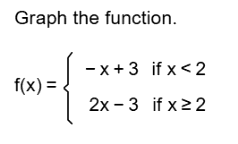
Q7. Graph the function
Background
Topic: Piecewise Functions
This question tests your ability to graph a piecewise-defined function by considering each piece on its respective interval.
Key Terms:
Piecewise Function: A function defined by different expressions on different intervals of the domain.
Step-by-Step Guidance
Graph for (left of ).
Graph for (right of ).
Check the value at to ensure the graph transitions correctly between the two pieces.
Try solving on your own before revealing the answer!
Q8. Find the function that is finally graphed after the following transformations are applied to the graph of in the order listed: (1) Vertical stretch by a factor of 2, (2) Shift down 1 unit, (3) Shift left 3 units.
Background
Topic: Transformations of Functions
This question tests your understanding of how to apply multiple transformations to a basic function.
Key Terms and Formulas:
Vertical Stretch: stretches the graph by a factor of .
Vertical Shift: shifts the graph up or down by units.
Horizontal Shift: shifts the graph left by units.
Step-by-Step Guidance
Apply the vertical stretch to to get .
Shift the graph down 1 unit: .
Shift the graph left 3 units: .
Try solving on your own before revealing the answer!
Q9. An island is 4 miles from the nearest point P on a straight shoreline. A town is 11 miles down the shore from P. (a) If a person can row a boat at an average speed of 2 miles per hour and the same person can walk 3 miles per hour, express the time it takes to go from the island to town as a function of the distance from P to where the person lands the boat.
Background
Topic: Applications of Functions (Optimization/Modeling)
This question tests your ability to model a real-world scenario with a function, using the Pythagorean theorem and rates.
Key Terms and Formulas:
Pythagorean Theorem: for right triangles.
Time = Distance / Rate
Step-by-Step Guidance
Express the distance rowed as (using the Pythagorean theorem).
Express the distance walked as .
Write the total time as .
Try solving on your own before revealing the answer!
Q10. How long will it take to travel from the island to town if the person lands the boat 3 miles from P? ____ hours.
Background
Topic: Function Evaluation (Application)
This question tests your ability to evaluate a function at a specific value in a real-world context.
Key Terms and Formulas:
Use the function from the previous question.
Step-by-Step Guidance
Substitute into the function .
Calculate each term separately: and .
Add the results to find .
Try solving on your own before revealing the answer!
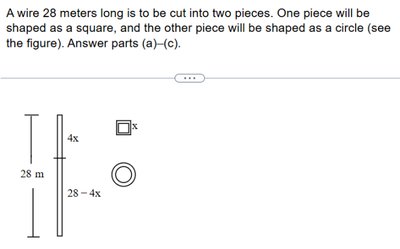
Q11. A wire 28 meters long is to be cut into two pieces. One piece will be shaped as a square, and the other as a circle. (a) Express the total area as a function of , where $x$ is the length of one side of the square.
Background
Topic: Applications of Quadratic and Circle Formulas
This question tests your ability to model a geometric scenario with a function, using perimeter and area formulas.
Key Terms and Formulas:
Perimeter of Square:
Area of Square:
Circumference of Circle:
Area of Circle:
Step-by-Step Guidance
Let be the side of the square, so the length used for the square is .
The remaining wire is , which forms the circumference of the circle: .
Solve for in terms of and write the area of the circle in terms of $x$.
Add the area of the square and the area of the circle to get .
Try solving on your own before revealing the answer!
Q12. What is the domain of ?
Background
Topic: Domain of Application Functions
This question tests your ability to determine the set of possible values for based on the physical constraints of the problem.
Key Terms:
Domain: All possible values of that make sense in the context of the problem (e.g., , ).
Step-by-Step Guidance
Since is the side of a square, .
The total length used for the square is , so (otherwise, there would be no wire left for the circle).
Solve for to find the upper bound.
Express the domain in interval notation.
Try solving on your own before revealing the answer!
