Back
BackPrecalculus Practice: Graph Transformations and Function Operations
Study Guide - Smart Notes
 Tailored notes based on your materials, expanded with key definitions, examples, and context.
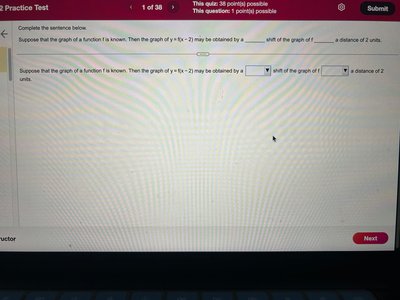
Q1. Suppose that the graph of a function f is known. Then the graph of y = f(x - 2) may be obtained by a ___ shift of the graph of y = f(x), a distance of 2 units.
Background
Topic: Transformations of Functions
This question tests your understanding of horizontal shifts of function graphs. Specifically, it asks how the graph of a function changes when the input variable x is replaced by (x - h).
Key Terms and Formulas:
Horizontal Shift: shifts the graph of horizontally.
If , the shift is to the right; if , the shift is to the left.
Step-by-Step Guidance
Identify the transformation inside the function: means x is replaced by (x - 2).
Recall that shifts the graph of horizontally by units.
Determine the direction: If the sign is negative, the shift is to the right; if positive, to the left.
State the distance of the shift, which is the absolute value of .
Try solving on your own before revealing the answer!
Q2. Suppose that the graph of a function f is known. Then the graph of y = -f(x) may be obtained by a reflection about the ___ axis of the graph of the function y = f(x).
Background
Topic: Reflections of Functions
This question tests your understanding of how multiplying a function by -1 affects its graph, specifically which axis the reflection occurs over.
Key Terms and Formulas:
Reflection about the x-axis:
Reflection about the y-axis:
Step-by-Step Guidance
Identify the transformation: means every output value of is multiplied by -1.
Recall that multiplying the function by -1 reflects the graph over the x-axis.
Compare with , which reflects over the y-axis.
Try solving on your own before revealing the answer!

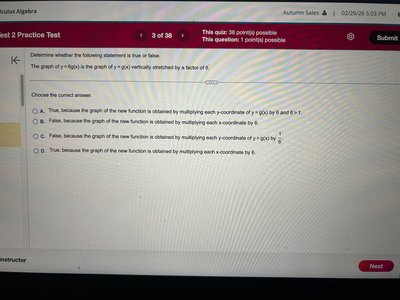
Q3. Determine whether the following statement is true or false: The graph of y = f(6x) is the graph of y = f(x) vertically stretched by a factor of 6.
Background
Topic: Function Transformations – Horizontal and Vertical Stretches
This question tests your understanding of how multiplying the input variable x by a constant affects the graph of a function, and whether this results in a vertical or horizontal stretch/compression.
Key Terms and Formulas:
Vertical Stretch: stretches the graph vertically by a factor of .
Horizontal Compression: compresses the graph horizontally by a factor of .
Step-by-Step Guidance
Identify the transformation: means the input x is multiplied by 6.
Recall that multiplying x inside the function affects the graph horizontally, not vertically.
Determine if this is a stretch or compression, and in which direction.
Compare with , which would be a vertical stretch.
Try solving on your own before revealing the answer!
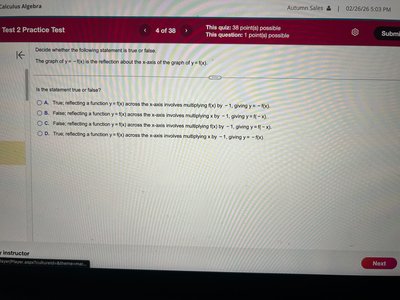
Q4. The graph of y = -f(x) is the reflection about the x-axis of the graph of y = f(x). Is the statement true or false?
Background
Topic: Reflections of Functions
This question tests your understanding of how multiplying a function by -1 affects its graph, and asks you to identify the correct reasoning for the reflection.
Key Terms and Formulas:
Reflection about the x-axis:
Reflection about the y-axis:
Step-by-Step Guidance
Recall that reflects the graph over the x-axis.
Check the reasoning: multiplying the output (y-values) by -1 flips the graph over the x-axis.
Compare with reflecting over the y-axis, which would involve .
Review the answer choices for the correct explanation.
Try solving on your own before revealing the answer!
Q5. Which of the following functions has a graph that is the graph of y = \sqrt{x} shifted up 1 unit?
Background
Topic: Vertical Shifts of Functions
This question tests your ability to recognize how adding or subtracting a constant outside the function affects the graph vertically.
Key Terms and Formulas:
Vertical Shift: shifts the graph up by units if , down if .
Step-by-Step Guidance
Identify the base function: .
Recall that adding a constant outside the function shifts the graph vertically.
Look for the function in the answer choices that matches .
Check that the shift is up (not down or sideways).
Try solving on your own before revealing the answer!
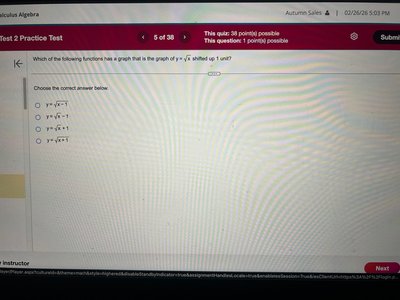
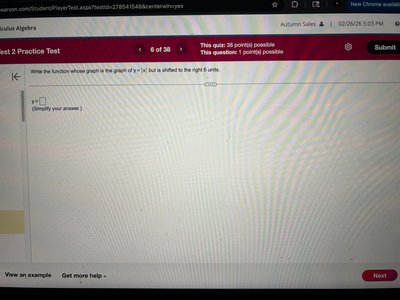
Q6. Write the function whose graph is the graph of y = |x| but is shifted to the right 6 units.
Background
Topic: Horizontal Shifts of Absolute Value Functions
This question tests your ability to apply horizontal shifts to the absolute value function.
Key Terms and Formulas:
Horizontal Shift: shifts the graph right by units if .
For , a shift right by units is .
Step-by-Step Guidance
Start with the base function: .
To shift right by 6 units, replace with inside the absolute value.
Write the new function in terms of .
Try solving on your own before revealing the answer!
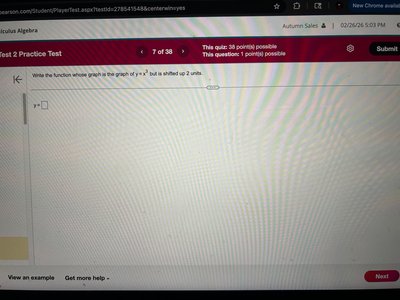
Q7. Write the function whose graph is the graph of y = x^2 but is shifted up 2 units.
Background
Topic: Vertical Shifts of Quadratic Functions
This question tests your ability to apply vertical shifts to the basic quadratic function.
Key Terms and Formulas:
Vertical Shift: shifts the graph up by units if .
For , a shift up by units is .
Step-by-Step Guidance
Start with the base function: .
Add 2 to the entire function to shift it up by 2 units.
Write the new function in terms of .
Try solving on your own before revealing the answer!
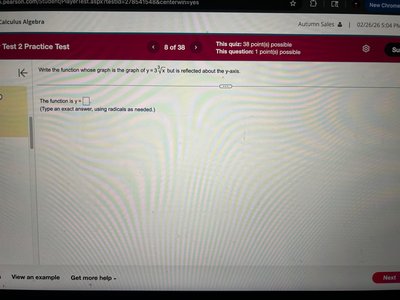
Q8. Write the function whose graph is the graph of y = \sqrt[3]{x} but is reflected about the y-axis.
Background
Topic: Reflections of Functions
This question tests your ability to reflect a function about the y-axis, which involves replacing with inside the function.
Key Terms and Formulas:
Reflection about the y-axis:
For , the reflection is .
Step-by-Step Guidance
Start with the base function: .
To reflect about the y-axis, replace with inside the radical.
Write the new function in terms of .
Try solving on your own before revealing the answer!
Q9. Write the function whose graph is the graph of y = \sqrt{x}, but is vertically stretched by a factor of 8.
Background
Topic: Vertical Stretches of Functions
This question tests your ability to apply a vertical stretch to a function, which involves multiplying the entire function by a constant.
Key Terms and Formulas:
Vertical Stretch: stretches the graph vertically by a factor of .
For , a vertical stretch by 8 is .
Step-by-Step Guidance
Start with the base function: .
Multiply the entire function by 8 to stretch it vertically.
Write the new function in terms of .
Try solving on your own before revealing the answer!
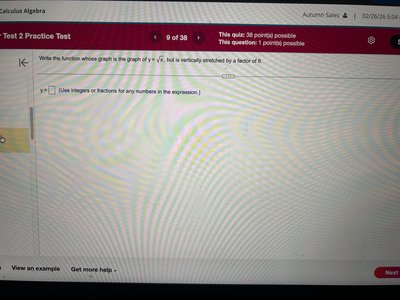
Q10. Find the function that is finally graphed after the following transformations are applied to the graph of y = \sqrt{x}, in the order listed: (1) Shift up 7 units, (2) Reflect about the y-axis.
Background
Topic: Multiple Transformations of Functions
This question tests your ability to apply a sequence of transformations (vertical shift and reflection) to a function, and to write the resulting function.
Key Terms and Formulas:
Vertical Shift:
Reflection about the y-axis:
Order matters: Apply transformations in the given sequence.
Step-by-Step Guidance
Start with .
First, shift up 7 units: .
Next, reflect about the y-axis: replace with to get .
Try solving on your own before revealing the answer!
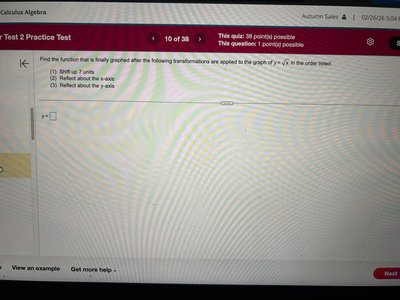
Q11. Find the function that is finally graphed after the following transformations are applied to the graph of y = \sqrt{x}, in the order listed: (1) Reflect about the x-axis, (2) Shift down 4 units, (3) Shift right 6 units.
Background
Topic: Multiple Transformations of Functions
This question tests your ability to apply a sequence of transformations (reflection, vertical shift, horizontal shift) to a function, and to write the resulting function.
Key Terms and Formulas:
Reflection about the x-axis:
Vertical Shift:
Horizontal Shift:
Order matters: Apply transformations in the given sequence.
Step-by-Step Guidance
Start with .
First, reflect about the x-axis: .
Next, shift down 4 units: .
Finally, shift right 6 units: replace with to get .
Try solving on your own before revealing the answer!
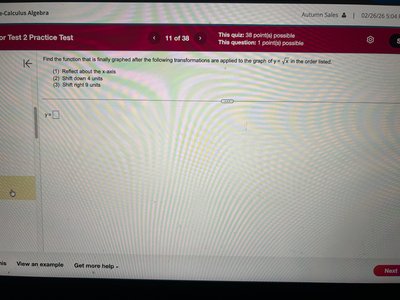
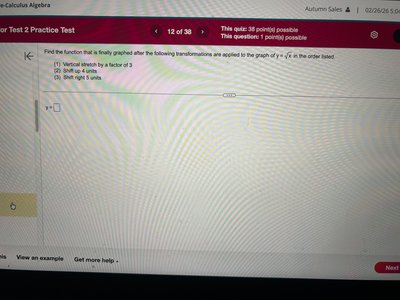
Q12. Find the function that is finally graphed after the following transformations are applied to the graph of y = \sqrt{x}, in the order listed: (1) Vertical stretch by a factor of 3, (2) Shift up 4 units, (3) Shift right 5 units.
Background
Topic: Multiple Transformations of Functions
This question tests your ability to apply a sequence of transformations (vertical stretch, vertical shift, horizontal shift) to a function, and to write the resulting function.
Key Terms and Formulas:
Vertical Stretch:
Vertical Shift:
Horizontal Shift:
Order matters: Apply transformations in the given sequence.
Step-by-Step Guidance
Start with .
First, apply the vertical stretch: .
Next, shift up 4 units: .
Finally, shift right 5 units: replace with to get .
Try solving on your own before revealing the answer!
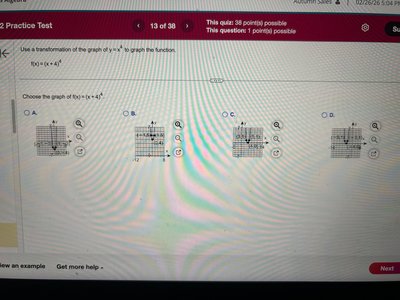
Q13. Use a transformation of the graph of y = x^4 to graph the function f(x) = (x + 4)^4.
Background
Topic: Horizontal Shifts of Polynomial Functions
This question tests your ability to recognize how adding a constant inside the function argument shifts the graph horizontally.
Key Terms and Formulas:
Horizontal Shift: shifts the graph left by units if .
Step-by-Step Guidance
Start with the base function: .
Adding 4 inside the parentheses shifts the graph left by 4 units.
Look for the graph that matches this transformation among the choices.
Try solving on your own before revealing the answer!
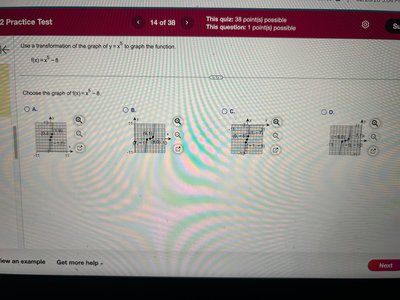
Q14. Use a transformation of the graph of y = x^2 to graph the function f(x) = x^2 - 8.
Background
Topic: Vertical Shifts of Quadratic Functions
This question tests your ability to recognize how subtracting a constant outside the function shifts the graph vertically.
Key Terms and Formulas:
Vertical Shift: shifts the graph down by units if .
Step-by-Step Guidance
Start with the base function: .
Subtracting 8 shifts the graph down by 8 units.
Look for the graph that matches this transformation among the choices.
Try solving on your own before revealing the answer!
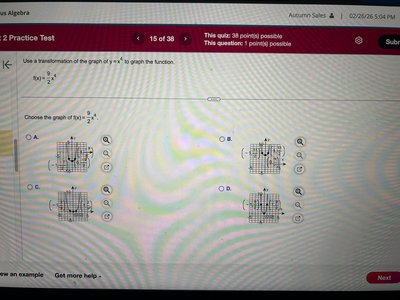
Q15. Use a transformation of the graph of y = \frac{1}{x} to graph the function f(x) = \frac{2}{x}.
Background
Topic: Vertical Stretches of Rational Functions
This question tests your ability to recognize how multiplying a function by a constant outside affects the graph vertically.
Key Terms and Formulas:
Vertical Stretch: stretches the graph vertically by a factor of .
Step-by-Step Guidance
Start with the base function: .
Multiplying by 2 stretches the graph vertically by a factor of 2.
Look for the graph that matches this transformation among the choices.
Try solving on your own before revealing the answer!
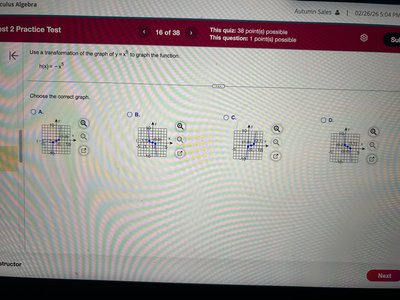
Q16. Use a transformation of the graph of y = x^3 to graph the function h(x) = -x^3.
Background
Topic: Reflections of Polynomial Functions
This question tests your ability to recognize how multiplying a function by -1 reflects the graph over the x-axis.
Key Terms and Formulas:
Reflection about the x-axis:
Step-by-Step Guidance
Start with the base function: .
Multiplying by -1 reflects the graph over the x-axis.
Look for the graph that matches this transformation among the choices.
Try solving on your own before revealing the answer!
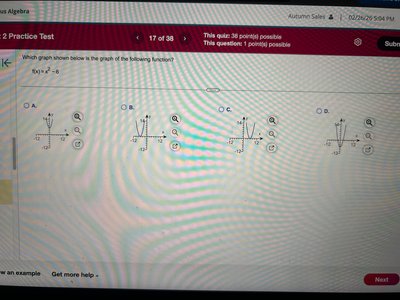
Q17. Which graph shown below is the graph of the following function? f(x) = |x| - 6
Background
Topic: Vertical Shifts of Absolute Value Functions
This question tests your ability to recognize how subtracting a constant outside the function shifts the graph vertically.
Key Terms and Formulas:
Vertical Shift: shifts the graph down by units if .
Step-by-Step Guidance
Start with the base function: .
Subtracting 6 shifts the graph down by 6 units.
Look for the graph that matches this transformation among the choices.
Try solving on your own before revealing the answer!
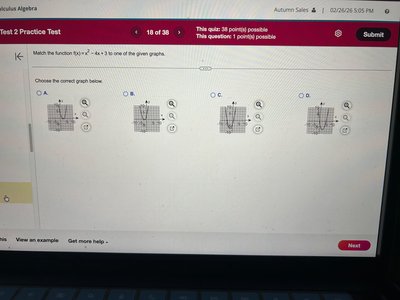
Q18. Match the function f(x) = x^2 - 4x + 3 to one of the given graphs.
Background
Topic: Graphing Quadratic Functions
This question tests your ability to recognize the graph of a quadratic function in standard form by identifying its vertex, axis of symmetry, and intercepts.
Key Terms and Formulas:
Standard Form:
Vertex:
Y-intercept:
X-intercepts: Solve
Step-by-Step Guidance
Identify the vertex using .
Find the y-intercept by evaluating .
Find the x-intercepts by solving .
Match these features to the correct graph among the choices.
Try solving on your own before revealing the answer!
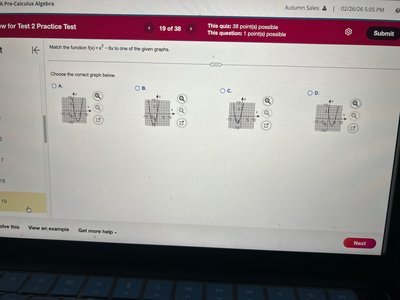
Q19. Match the function f(x) = x^2 - 6x to one of the given graphs.
Background
Topic: Graphing Quadratic Functions
This question tests your ability to recognize the graph of a quadratic function in standard form by identifying its vertex, axis of symmetry, and intercepts.
Key Terms and Formulas:
Standard Form:
Vertex:
Y-intercept:
X-intercepts: Solve
Step-by-Step Guidance
Identify the vertex using .
Find the y-intercept by evaluating .
Find the x-intercepts by solving .
Match these features to the correct graph among the choices.
Try solving on your own before revealing the answer!