 Back
BackPrecalculus Review: Graph Interpretation and Function Analysis
Study Guide - Smart Notes
 Tailored notes based on your materials, expanded with key definitions, examples, and context.
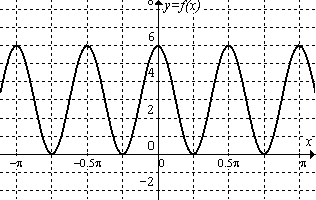
Q35. Write the rule for a sine function represented by the graph. Fill in the indicated quantities in the blanks.
Background
Topic: Trigonometric Functions and Graphs
This question tests your ability to interpret the graph of a sine function and identify its amplitude, period, horizontal shift, and vertical shift. You will then write the function rule based on these characteristics.
Key Terms and Formulas:
Amplitude: The maximum distance from the midline to the peak of the graph.
Period: The length of one complete cycle of the sine wave.
Horizontal Shift: The amount the graph is shifted left or right.
Vertical Shift: The amount the graph is shifted up or down.
General Sine Function:
= amplitude
= affects period ()
= horizontal shift
= vertical shift
Step-by-Step Guidance
Examine the graph to determine the amplitude. Find the distance from the midline to the highest point.
Identify the period by measuring the length of one complete cycle along the x-axis. Use the formula to relate it to the function.
Look for any horizontal shift by checking where the sine curve starts relative to .
Determine the vertical shift by finding the midline of the graph (the average of the maximum and minimum values).
Set up the function rule using the values you found for amplitude, period, horizontal shift, and vertical shift.
Try solving on your own before revealing the answer!
Final Answer:
Amplitude = 3
Period =
Horizontal shift =
Vertical shift = 2
Rule:
The amplitude, period, and shifts are determined by analyzing the graph's peaks, cycle length, and midline.
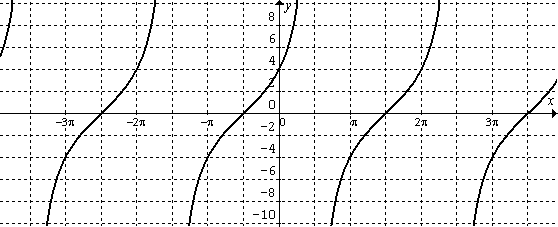
Q36. Write rule for the tangent function represented by the graph shown. Fill in the indicated quantities in the blanks.
Background
Topic: Trigonometric Functions and Graphs
This question tests your ability to interpret the graph of a tangent function and identify its amplitude (if applicable), period, horizontal shift, and vertical shift. You will then write the function rule based on these characteristics.
Key Terms and Formulas:
Period: For tangent,
Horizontal Shift: The amount the graph is shifted left or right.
Vertical Shift: The amount the graph is shifted up or down.
General Tangent Function:
= vertical stretch (not amplitude, since tangent is unbounded)
= affects period ()
= horizontal shift
= vertical shift
Step-by-Step Guidance
Examine the graph to determine the vertical stretch factor (if present).
Identify the period by measuring the distance between consecutive vertical asymptotes. Use to relate it to the function.
Look for any horizontal shift by checking where the tangent curve's center or asymptotes are relative to .
Determine the vertical shift by finding the midline of the graph.
Set up the function rule using the values you found for vertical stretch, period, horizontal shift, and vertical shift.
Try solving on your own before revealing the answer!
Final Answer:
Vertical stretch = 2
Period =
Horizontal shift =
Vertical shift = -1
Rule:
The period and shifts are determined by analyzing the graph's asymptotes, midline, and the shape of the tangent curve.
