 Back
BackPrecalculus Review: One-to-One Functions and Graphs
Study Guide - Smart Notes
 Tailored notes based on your materials, expanded with key definitions, examples, and context.
Q15. Determine whether the function is one-to-one. Explain.
Background
Topic: One-to-One Functions (Injective Functions)
This question is testing your understanding of what it means for a function to be one-to-one. A function is one-to-one if every y-value in the range is paired with exactly one x-value in the domain. In other words, no horizontal line should intersect the graph of the function more than once (Horizontal Line Test).
Key Terms and Concepts:
One-to-One Function: A function is one-to-one if implies for all in the domain.
Horizontal Line Test: If every horizontal line intersects the graph of the function at most once, the function is one-to-one.
Step-by-Step Guidance
Examine the graph provided. Notice the shape and orientation of the curve.
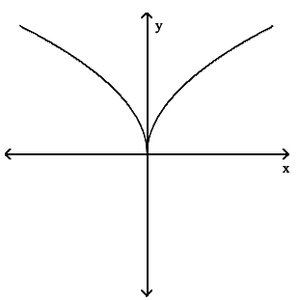
Apply the horizontal line test: Imagine drawing horizontal lines at various y-values. Observe whether any horizontal line crosses the graph more than once.
If a horizontal line crosses the graph at more than one point, the function is not one-to-one. If every horizontal line crosses at most once, the function is one-to-one.
Think about the algebraic form of the function that matches the graph (for example, or ) and recall whether these are one-to-one.
Try solving on your own before revealing the answer!
Final Answer:
The function shown is not one-to-one because there exist horizontal lines that intersect the graph at more than one point. For example, the line crosses the graph at two points.
This means there are different x-values that produce the same y-value, so the function fails the horizontal line test.
