 Back
BackPrecalculus Study Guide: Angles, Arc Length, and Trigonometric Modeling
Study Guide - Smart Notes
 Tailored notes based on your materials, expanded with key definitions, examples, and context.
Q1. Convert 37.2° to degrees, minutes, and seconds (DMS).
Background
Topic: Angle Measurement Conversion
This question tests your ability to convert decimal degrees into the DMS (degrees, minutes, seconds) format, which is commonly used in navigation and geometry.
Key Terms and Formulas
1 degree () = 60 minutes ()
1 minute () = 60 seconds ()
Step-by-Step Guidance
Take the decimal part of the degree and multiply by 60 to get the minutes.
Take the decimal part of the minutes and multiply by 60 to get the seconds.
Combine the whole number degrees, minutes, and seconds for the DMS format.
Try solving on your own before revealing the answer!
Q2. Convert 42°6’36” to decimal degrees.
Background
Topic: Angle Measurement Conversion
This question tests your ability to convert an angle given in DMS format to decimal degrees, which is often used in calculations.
Key Terms and Formulas
Decimal degrees = degrees + (minutes/60) + (seconds/3600)
Step-by-Step Guidance
Divide the minutes by 60 to convert to degrees.
Divide the seconds by 3600 to convert to degrees.
Add all parts together to get the decimal degree value.
Try solving on your own before revealing the answer!
Q3. Find the arc length of a circle with a radius of 3 cm intercepted by an angle of radians.
Background
Topic: Arc Length in Circles
This question tests your understanding of how to calculate the arc length of a circle given the radius and the central angle in radians.
Key Terms and Formulas
Arc length formula:
Where is arc length, is radius, is angle in radians.
Step-by-Step Guidance
Identify the radius cm and angle radians.
Plug these values into the arc length formula: .
Multiply the radius by the angle in radians to set up the calculation.
Try solving on your own before revealing the answer!
Q4a. Find a trigonometric equation for the height of the water as a function of time (hours since midnight).
Background
Topic: Trigonometric Modeling of Periodic Phenomena
This question tests your ability to model real-world periodic events (like tides) using trigonometric functions.
Key Terms and Formulas
General cosine function:
Amplitude (), period (), phase shift (), vertical shift ()
Step-by-Step Guidance
Determine the amplitude: .
Find the midline: .
Calculate the period: .
Set up the cosine function using amplitude, period, phase shift, and midline.
Try solving on your own before revealing the answer!
Q4b. When does the next high tide occur according to your model?
Background
Topic: Application of Trigonometric Models
This question tests your ability to interpret a trigonometric model to predict future events.
Key Terms and Formulas
High tide corresponds to the maximum value of the cosine function.
Use the model equation to solve for when is at its maximum.
Step-by-Step Guidance
Set the cosine function equal to its maximum value.
Solve for to find the time of the next high tide.
Try solving on your own before revealing the answer!
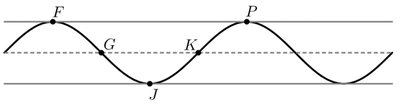
Q5A. Determine possible coordinates for the five points: F, G, J, K, and P.
Background
Topic: Graphing Periodic Functions
This question tests your ability to interpret and assign coordinates to points on a graph of a periodic function, such as a sine wave.
Key Terms and Formulas
Periodic function: models the distance as a function of time.
Maximum, minimum, and midline values correspond to specific points on the graph.
Step-by-Step Guidance
Identify the maximum, minimum, and midline values from the graph.
Assign coordinates to each labeled point based on their position relative to the cycle.
Use the period and amplitude to estimate the -values for each point.
Try solving on your own before revealing the answer!
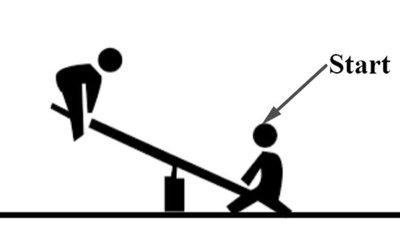
Q5B. Write the function in the form . Find values of , , , and .
Background
Topic: Sinusoidal Function Parameters
This question tests your ability to write a sine function to model a periodic situation and determine its parameters.
Key Terms and Formulas
Amplitude ():
Vertical shift ():
Period:
Phase shift (): determined by the starting point of the cycle
Step-by-Step Guidance
Calculate amplitude and vertical shift using the maximum and minimum values.
Determine the period from the time it takes for one full cycle.
Find the phase shift based on the starting position.
Write the function in the required form using these values.
Try solving on your own before revealing the answer!
Q5C. On the interval , which of the following is true about ?
Background
Topic: Behavior of Periodic Functions
This question tests your understanding of the increasing/decreasing behavior of a sine function over a given interval.
Key Terms and Formulas
Positive/negative values: above/below the midline
Increasing/decreasing: determined by the slope of the function
Step-by-Step Guidance
Examine the graph to determine whether is above or below the midline in the interval.
Check the direction of the curve (up or down) to decide if it is increasing or decreasing.
Try solving on your own before revealing the answer!
Q5D. Describe how the rate of change of is changing over the interval .
Background
Topic: Concavity and Rate of Change
This question tests your understanding of how the rate of change (derivative) of a periodic function behaves over an interval, including concepts of concavity.
Key Terms and Formulas
Concave up/down: relates to whether the rate of change is increasing or decreasing
Second derivative: indicates concavity
Step-by-Step Guidance
Determine the concavity of the function in the interval by examining the graph.
Relate concavity to the behavior of the rate of change (is it increasing or decreasing?).
Try solving on your own before revealing the answer!
Final Answers
1. 42°12’ 2. 37.11° 3. 4. a) or b) 23.75 or 11:45 pm 5. A) F (1.5, 60) G (2.25, 42) J (3, 24) K (3.75, 42) P (4.5, 60) B) C) b D) Since is concave down in the interval, the rate of change of is decreasing.
