 Back
BackPrecalculus Study Guide: Exponential, Logarithmic, Piecewise, Conic Sections, Matrices, Sequences, Induction, and Binomial Theorem
Study Guide - Smart Notes
 Tailored notes based on your materials, expanded with key definitions, examples, and context.
Exponential and Logarithmic Functions
Properties of Logarithms
Logarithms are mathematical functions that are the inverse of exponentiation. Understanding their properties is essential for solving equations and simplifying expressions.
Product Rule:
Quotient Rule:
Power Rule:
Change of Base Formula:
Example: Simplify using the product rule.
Since , .
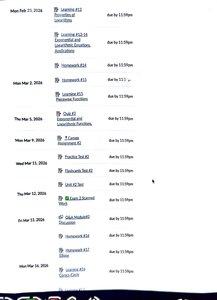
Exponential and Logarithmic Equations
Solving exponential and logarithmic equations often involves applying logarithmic properties or exponent rules to isolate the variable.
Exponential Equation: →
Logarithmic Equation: →
Example: Solve . Since , .
Applications of Exponential and Logarithmic Functions
These functions are used in modeling growth and decay, such as population growth, radioactive decay, and compound interest.
Exponential Growth:
Exponential Decay:
Example: The population of bacteria doubles every hour. If there are 100 bacteria initially, after 3 hours: bacteria.
Piecewise Functions
Definition and Examples
Piecewise functions are defined by different expressions depending on the input value. They are useful for modeling situations where a rule changes based on conditions.
Definition:
Example: For , . For , .

Conic Sections
Circle, Ellipse, Parabola, Hyperbola
Conic sections are curves obtained by intersecting a plane with a cone. The main types are circles, ellipses, parabolas, and hyperbolas.
Circle:
Ellipse:
Parabola:
Hyperbola:
Example: The equation represents a circle with radius 3.

Matrices and Determinants
Basic Operations and Applications
Matrices are rectangular arrays of numbers used to solve systems of equations and perform linear transformations. Determinants are scalar values that can be computed from square matrices and are used to determine invertibility.
Addition: Add corresponding elements.
Multiplication: Multiply rows by columns.
Determinant of 2x2: ,
Example: , .

Sequences, Series, Mathematical Induction, and Binomial Theorem
Sequences and Series
A sequence is an ordered list of numbers, and a series is the sum of a sequence. Common types include arithmetic and geometric sequences.
Arithmetic Sequence:
Geometric Sequence:
Sum of Arithmetic Series:
Sum of Geometric Series: ,
Mathematical Induction
Mathematical induction is a proof technique used to establish the truth of an infinite sequence of statements.
Base Case: Prove the statement for .
Inductive Step: Assume true for , prove for .
Binomial Theorem
The binomial theorem provides a formula for expanding powers of binomials.
Formula:
Example: Expand using the binomial theorem: .

Summary Table: Main Precalculus Topics Covered
Topic | Key Concepts | Example Formula |
|---|---|---|
Exponential & Logarithmic Functions | Properties, Equations, Applications | |
Piecewise Functions | Definition, Evaluation | |
Conic Sections | Circle, Ellipse, Parabola, Hyperbola | |
Matrices & Determinants | Operations, Determinant | |
Sequences & Series | Arithmetic, Geometric, Sums | |
Mathematical Induction | Proof Technique | Base & Inductive Step |
Binomial Theorem | Expansion of Binomials |
