 Back
BackPrecalculus Study Notes: Functions, Domains, and Intervals
Study Guide - Smart Notes
 Tailored notes based on your materials, expanded with key definitions, examples, and context.
Functions and Their Graphs
Function Notation and Evaluation
A function is a rule that assigns each input value (from the domain) to exactly one output value (in the range). Function notation is written as f(x), where x is the input variable.
Function notation: If f(x) = 3/(x+1), then to evaluate the function at a specific value, substitute that value for x.
Example: To find f(2) for f(x) = 3/(x+1):
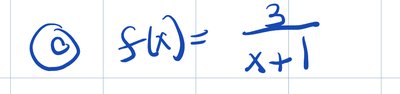
Domain and Range
The domain of a function is the set of all possible input values (x-values) for which the function is defined. The range is the set of all possible output values (y-values).
Domain: For rational functions like f(x) = 3/(x+1), exclude values that make the denominator zero. Domain:
Range: For f(x) = 3/(x+1), the output can be any real number except zero (since the numerator is always 3, and the denominator can be any real number except -1). Range: Additional info: The function never equals zero because the numerator is nonzero.
Intervals and Set Notation
Types of Intervals
Intervals are used to describe sets of real numbers, especially domains and ranges. The main types are open, closed, half-open, and infinite intervals.
Type of Interval | Interval Notation | Description | Set-Builder Notation |
|---|---|---|---|
Open interval | (a, b) | All real numbers between a and b, not including a or b | { x | a < x < b } |
Closed interval | [a, b] | All real numbers between a and b, including both endpoints | { x | a ≤ x ≤ b } |
Half-open interval | [a, b) | Includes a, excludes b | { x | a ≤ x < b } |
Half-closed interval | (a, b] | Excludes a, includes b | { x | a < x ≤ b } |
Infinite interval | (a, ∞) | All real numbers greater than a | { x | x > a } |
Infinite interval | [a, ∞) | All real numbers greater than or equal to a | { x | x ≥ a } |
Infinite interval | (-∞, b) | All real numbers less than b | { x | x < b } |
Infinite interval | (-∞, b] | All real numbers less than or equal to b | { x | x ≤ b } |
Infinite interval | (-∞, ∞) | All real numbers | { x | x is a real number } |
Union and Intersection of Intervals
The union of two intervals combines all values in either interval. The intersection includes only values common to both intervals.
Union:
Intersection:
Example: is the domain of f(x) = 3/(x+1).
Vertical Line Test
Determining if a Graph Represents a Function
The vertical line test is a method to determine if a graph represents a function. If every vertical line intersects the graph at most once, the graph is a function.
Key Point: If a vertical line crosses the graph more than once, the relation is not a function.
Example: The graph of y = x^2 passes the vertical line test, but a circle does not.
Difference Quotient
Definition and Calculation
The difference quotient is used to measure the average rate of change of a function over an interval. It is foundational for calculus.
Formula:
Example: For f(x) = x^2:
Slopes of Lines
Finding the Slope
The slope of a line measures its steepness and is calculated as the ratio of the change in y to the change in x between two points.
Formula:
Example: For points (1, 5) and (6, 2):
Classification:
Positive slope: line rises left to right
Negative slope: line falls left to right
Zero slope: horizontal line
Undefined slope: vertical line
Summary Table: Slope Types
Slope Type | Description |
|---|---|
Positive | Line rises from left to right |
Negative | Line falls from left to right |
Zero | Horizontal line |
Undefined | Vertical line |
